
Blog
Green shoots in global learning: lessons from the Philippines, Cambodia and Zambia’s PISA results
Noam Angrist, Manzer Imam and Michelle Kaffenberger
Angrist, N., Imam, M. & Kaffenberger, M. (2026). Green shoots in global learning: lessons from the Philippines, Cambodia and Zambia’s PISA results. What Works Hub for Global Education. https://doi.org/10.35489/BSG-WhatWorksHubforGlobalEducation-BL_2026/032
For many countries, the latest Programme for International Student Assessment (PISA) results offer a sobering picture of global learning, as outcomes stagnated or declined. Yet within this broader picture, there are notable signs of progress.
The Philippines, Cambodia and Zambia stand out.
Figure 1: PISA performance trends in the Philippines, Cambodia and Zambia compared with the OECD average, 2017/18–2025
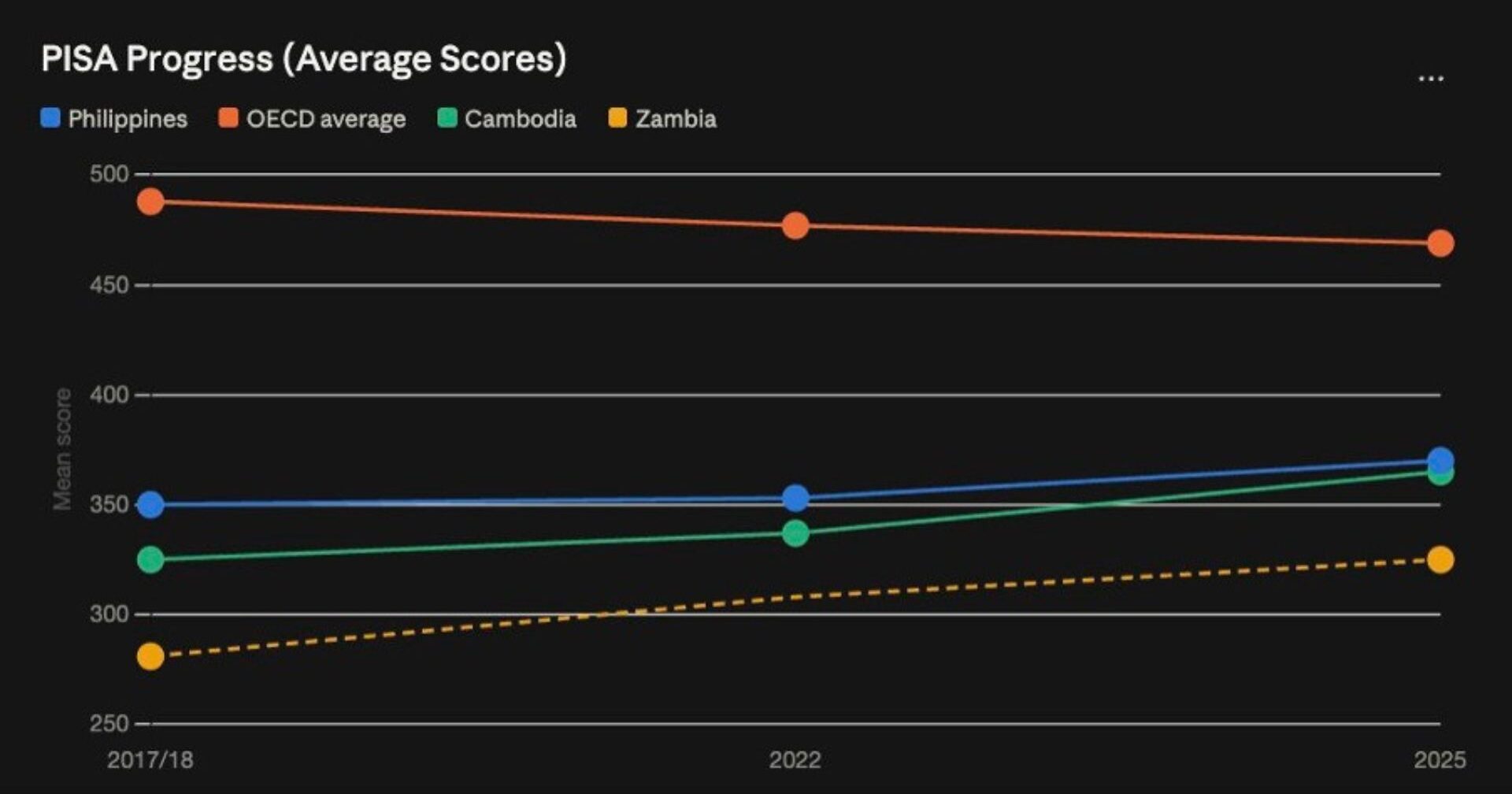
Note: Scores represent averages across science, mathematics and reading. Zambia’s 2017 results are from PISA for Development (PISA-D); comparisons with 2025 should be interpreted with caution because of changes in the size and composition of the PISA-eligible population. Source: OECD PISA 2018, PISA 2022 and PISA 2025.
All three countries achieved notable improvements in their PISA scores. While all three countries remain some distance from the Organisation for Economic Co-operation and Development (OECD) average, their direction of travel stands out for achieving substantial progress over a relatively short period of time.
Table 1: Learning gains in the Philippines, Cambodia and Zambia between 2017/18 and 2025, expressed in PISA points and approximate equivalent years of learning
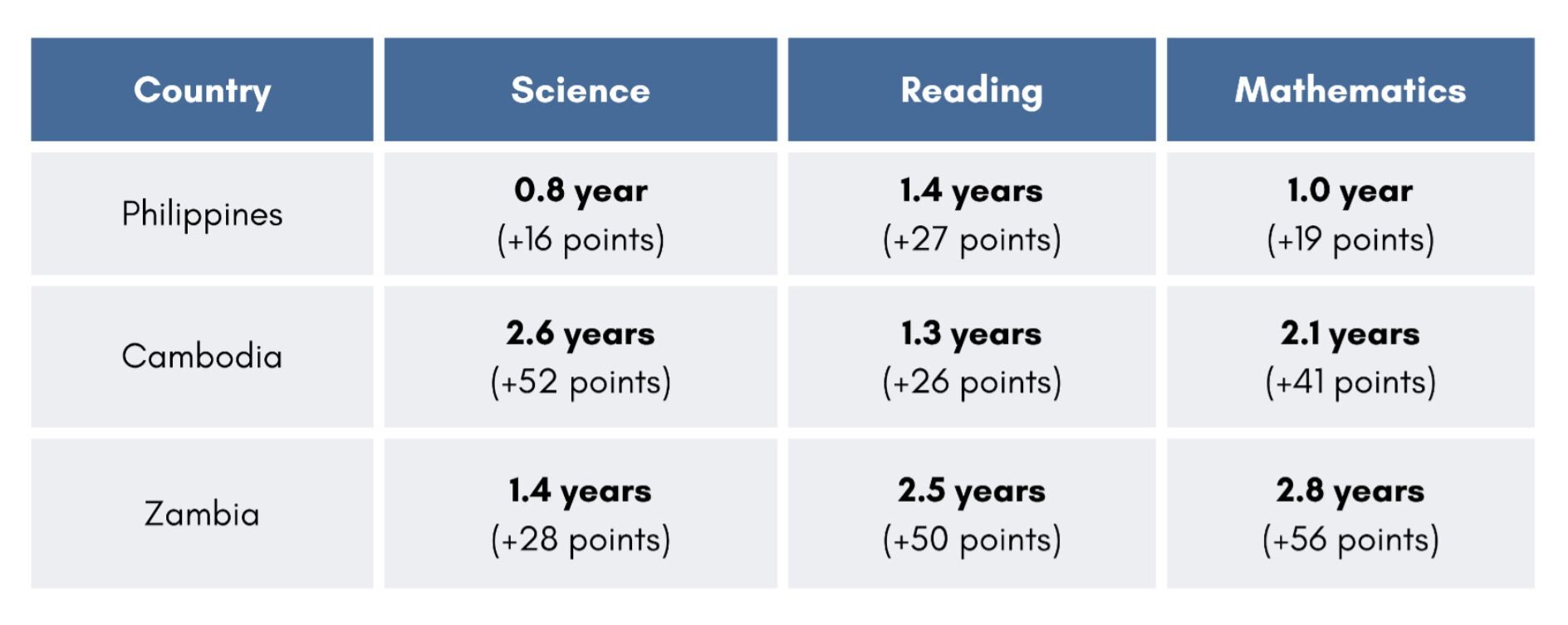
Note: Learning-year equivalents are calculated using the approximate benchmark of 20 PISA points per year, rounded to one decimal place. The Philippines’ baseline is PISA 2018, while Cambodia and Zambia’s baselines are PISA for Development (PISA-D) 2017. Comparisons, particularly for Zambia, should be interpreted cautiously because of changes in the size and composition of the assessed population.
In recent years, all three countries have introduced or scaled reforms that draw on evidence about what can improve learning, from remedial programmes targeting children who have fallen behind, to structured approaches to teaching foundational skills and stronger support for teachers. While we cannot conclude from PISA results exactly which efforts caused the test score improvements, these green shoots are worth examining.
Philippines: focusing on the foundations and targeting instruction at scale
The Philippines’ recent PISA results represent an encouraging trend. Average performance increased between 2022 and 2025 across all three subjects of mathematics, reading and science. Compared with 2018, the proportion of students below minimum proficiency fell by 11 percentage points in reading and 10 percentage points in science, although it did not change significantly in mathematics.
This progress comes amid broad efforts to refocus the education system on foundational learning.
A key recent reform supporting learning improvements is the Academic Recovery and Accessible Learning (ARAL) programme. ARAL was established to provide additional support to learners who are struggling academically, including through frequent diagnostic assessments focused on foundational skills, targeted instruction, tutoring and level appropriate learning resources.
A recent evaluation of the ARAL package estimates that it resulted in a 9 percentage-point reduction in the share of struggling readers, equivalent to around 1.37 million additional learners moving out of the struggling-reader category. The evaluation also estimates a 4.8 percentage point increase in grade-level reading proficiency, equivalent to around 730,000 additional learners reaching grade-level proficiency beyond the progress expected over a typical school year. (Angrist et al., 2026)
ARAL has components in common with evidence-based targeted instruction programmes. Its focus on providing additional support to learners who are behind illustrates how responding to learning gaps rather than simply progressing through the grade-level curriculum can be incorporated into national policy and translate to learning gains in practice, at scale.
These types of evidence-backed reforms are also reflected in major development-partner investments. In April 2026, the World Bank and the Department of Education approved a US$600 million programme to support better learning for more than 21 million Filipino students, including a focus on foundational literacy, numeracy and mathematics and support for around 770,000 teachers.
Cambodia: scaling structured pedagogy and targeted instruction together
In Cambodia, PISA 2025 results increased in mathematics, reading and science compared with both 2022 and 2017. These results complement the picture emerging from the Southeast Asia Primary Learning Metrics (SEA-PLM) 2024 results, which tracks foundational learning at the end of primary school and found strong learning improvements for Cambodia between 2019 and 2024.
A high-profile reform underway is Cambodia’s Early Grade Learning (EGL) programme, which uses structured pedagogy to strengthen foundational literacy and mathematics.
The programme provides structured, curriculum-aligned teacher guides, student workbooks and supplementary materials, alongside practical training that gives teachers opportunities to practice and demonstrate new lesson approaches. Ongoing mentoring, including at school and cluster levels, provides continued support as teachers put these approaches into practice. This aligns closely with several of the core components of structured pedagogy.
Importantly, Cambodia is also generating evidence to improve the programme as it scales. In 2026, Australian Council for Educational Research (ACER) worked with the Ministry of Education on a pilot covering 120 Grade 2 classrooms across eight provinces, examining classroom practice and teaching materials to identify how the EGL package could be strengthened. The work is intended to support the scale-up of structured pedagogy and to improve alignment between curriculum, materials and classroom practice.
There is a second, complementary strand of evidence-based reform underway. Supported by the ASEAN-UK Supporting the Advancement of Girls’ Education (SAGE) programme, Cambodia has been piloting teaching at the right level (TaRL) for Grade 4 and 5 students at risk of falling behind and dropping out. The pilot, implemented in 32 public schools with 821 students, combines level-based grouping, targeted instruction, adapted materials, training, mentoring and digital data use. Early results from the pilot show the share of students reading at paragraph level or above rising from 39% to 85%, while the share reaching subtraction level or above in numeracy rose from 42% to 99%.
These initiatives illustrate the potential of two complementary approaches working in tandem. Both efforts have been led by government and supported by development partnerships, including the ASEAN-UK SAGE programme and the World Bank.
Zambia: taking teaching at the right level to scale
In Zambia, comparing the 2025 PISA results to Zambia’s 2017 PISA-D (PISA for Development) shows higher performance across mathematics, reading and science, even with a larger eligible population being assessed.
Zambia has been implementing an evidence-backed foundational learning approach consistently over the past decade at scale: Catch Up, the country’s adaptation of teaching at the right level (TaRL).
Catch Up was piloted in Zambia in 2016 and now reaches more than one million learners each year through government schools. In this model, teachers assess children’s foundational literacy and numeracy skills, group learners by their current learning levels and provide instruction targeted to those levels. The programme uses a structured sequence of activities, teacher training and mentoring, and regular assessment to track progress and move students between groups as they develop new skills. J-PAL’s work on Catch Up is also evaluating the effects of taking the approach to scale. These types of sustained evidence-backed efforts have likely helped the country make long-term progress on learning.
Embedding evidence-based programmes into government systems
The experiences of the Philippines, Cambodia and Zambia are not identical, nor can attribution be drawn directly to PISA, but all three countries show ‘green shoots’, with unusual levels of PISA progress; alongside this progress, all three countries have prioritised evidence and focused on foundational skills and sustained implementation.
The Philippines is combining a sharper focus on foundational competencies in mainstream instruction with concerted efforts to frequently assess learning and target instruction. Cambodia is putting structured pedagogy into practice while also experimenting with targeted instruction. And Zambia provides a sustained example of taking an evidence-backed teaching at the right level (TaRL) approach and implementing it through the government system.
Amid a global picture in which improvements in learning are too rare, these green shoots are worth celebrating and studying. Moreover, while PISA results show some progress, once-off success at scale is not enough – ongoing tweaking and testing at scale is needed too.
References
American Council for Educational Research. (2026, July 20). Evidence to strengthen early literacy at scale in Cambodia. ACER. https://pivotal.acer.org/gb/news/article/evidence-to-strengthen-early-literacy-at-scale-in-cambodia
Angrist, N., & Kaffenberger, M. (2026). Adopting and adapting ‘what works’: Core components as a guide. What Works Hub for Global Education. https://doi.org/10.35489/BSG-WhatWorksHubforGlobalEducation-BL_2026/022
Angrist, N., Bayangos, M., Buchel, K., Perlman, J., & Umali-Trinos, E. (2026). Evaluation shows education reforms in the Philippines lifted millions of learners’ foundational reading skills through the ARAL Law. Youth Impact. https://www.youth-impact.org/insights/aral-oped
Anaman, A., Sabarwal, S., Masood, S., Angrist, N., & Spivack, M. (2026). Improving implementation while scaling: Differentiated learning in Ghana. What Works Hub for Global Education. https://doi.org/10.35489/BSG-WhatWorksHubforGlobalEducation-RI_2026/003
Hwa, Y.-Y., Kayton, H. L., & Kaffenberger, M. (2024). Implementing structured pedagogy programmes at scale. What Works Hub for Global Education. https://doi.org/10.35489/BSG-WhatWorksHubforGlobalEducation-RI_2024/002
Imam, M., Hwa, Y.-Y., & Kaffenberger, M. (2026). From evidence to action: SEA-PLM provides new data for informing policy. What Works Hub for Global Education. https://doi.org/10.35489/BSG-WhatWorksHubforGlobalEducation-BL_2026/025
Kaffenberger, M., Angrist, N., Hwa, Y.-Y., Kayton, H. L., Jukes, M., & Stern, J. (2026). Core components of teaching at the right level: Unpacking the black box of proven programmes into a set of ‘core components’ by systematically combining multiple sources of rigorous evidence with implementer insights. What Works Hub for Global Education. https://doi.org/10.35489/BSG-WhatWorksHubforGlobalEducation-WP_2026/001
OECD. (2026). PISA 2025 results (Volume I): Future-ready students. OECD Publishing. https://doi.org/10.1787/73451bc5-en
OECD. (2026). PISA 2025 results: Cambodia. PISA 2025 Results — Cambodia country note
OECD. (2026). PISA 2025 results: Philippines. PISA 2025 Results — Philippines country note
OECD. (2026). PISA 2025 results: Zambia. PISA 2025 Results — Zambia country note
Pratham International. (2026). Strengthening retention through Teaching at the Right Level (TaRL) in Cambodia. ASEAN-UK Supporting the Advancement of Girls’ Education Programme. https://elibrary.seameo.org/viewdetail/content/3831.com
SEAMEO Secretariat, & UNICEF. (2025). SEA-PLM 2024 main regional report: Children’s learning in six Southeast Asian countries. SEAMEO Secretariat & UNICEF. https://www.seaplm.org/images/PUBLICATION/2025/SEAPLM_2024_Main_Regional_Report.pdf
World Bank. (2025, August 31). New World Bank support to improve education and learning for young children in Cambodia. https://www.worldbank.org/en/news/press-release/2025/08/31/new-world-bank-support-to-improve-education-and-learning-for-young-children-in-cambodia?utm_.com
World Bank. (2026, April 3). World Bank backs better learning for 21 million Filipino students. https://www.worldbank.org/en/news/press-release/2026/04/03/world-bank-backs-better-learning-for-21-million-filipino-students?utm.com


Discover more
What we do
Our work will directly affect up to 3 million children, and reach up to 17 million more through its influence.
Who we are
A group of strategic partners, consortium partners, researchers, policymakers, practitioners and professionals working together.
Get involved
Share our goal of literacy, numeracy and other key skills for all children? Follow us, work with us or join us at an event.