
Blog
From evidence to action: SEA-PLM provides new data for informing policy
Manzer Imam, Yue-Yi Hwa and Michelle Kaffenberger
Imam, M., Hwa, Y.Y. & Kaffenberger, M. (2026). From evidence to action: SEA-PLM provides new data for informing policy. What Works Hub for Global Education. https://doi.org/10.35489/BSG-WhatWorksHubforGlobalEducation-BL_2026/025
The Southeast Asia Primary Learning Metrics (SEA-PLM), conducted across six Southeast Asian countries, measures learning outcomes at the end of primary school and provides valuable insights into children’s proficiency in reading and mathematics. Beyond providing a snapshot of learning outcomes, it helps governments understand whether children are acquiring the foundational skills they need to succeed in later education and life. At the What Works Hub for Global Education, we are committed to strengthening evidence-informed decision-making, and initiatives such as SEA-PLM play an important role by providing the high-quality data and insights that governments need to identify learning gaps, monitor progress and inform education reforms.
The release of the SEA-PLM 2024 results offer an important opportunity to reflect both progress and persistent challenges in learning across the region. The 2024 assessment marks the second cycle of SEA-PLM, building on the inaugural assessment conducted in 2019 — the first regional large-scale learning assessment of its kind in Southeast Asia. By providing comparable data over time, SEA-PLM offers valuable insights into how learning outcomes are evolving and where further efforts are needed to support children’s learning.
The 2024 results reveal some countries demonstrating progress on learning achievements, with others holding relatively steady (Figures 1 and 2). The findings also show considerable variation between countries, and opportunities for learning within the region.
Perhaps most importantly, the results remind us that improving learning outcomes requires more than expanding access to schooling. As countries work to recover from the long-term effects of COVID-19 and address persistent learning gaps, attention must increasingly focus on what happens inside classrooms and how education systems support effective teaching and learning.
Why measurement matters
One of the strengths of the Southeast Asia Primary Learning Metrics (SEA-PLM) is that it provides governments with high-quality, comparable data on learning outcomes. In recent years, the global education community has increasingly recognised the importance of measuring learning, not just school attendance or enrolment, as a key indicator of education system performance.
Assessments such as the SEA-PLM help identify where learning gaps exist, which groups of learners are being left behind, and whether reforms are translating into improved outcomes. They also contribute to a growing ecosystem of learning assessments aligned with international frameworks, helping countries track progress towards global education goals. Ideally, measurement efforts should include both these types of periodic assessments, and also be complemented by a focus on regular measurement of learning outcomes and implementation, to ensure regular progress.
As governments face difficult decisions about where to invest limited resources, reliable data becomes essential for setting priorities and evaluating whether policies are working.
Signs of progress—and lessons for the region: Spotlight on Cambodia
Cambodia recorded notable improvements between the 2019 and 2024 assessments in both reading and mathematics. While many factors influence learning outcomes and caution is needed when attributing changes to any single reform, Cambodia’s experience is nevertheless noteworthy. The proportion of Grade 5 students achieving high proficiency (as per SDG 4.1.1b) in literacy increased from 27% to 39%, while the share achieving high proficiency in numeracy rose from 39% to 62%.
Over recent years, Cambodia has invested in reforms aimed at strengthening early grade teaching and learning, including structured approaches to literacy instruction and enhanced support for teachers, through initiatives such as the Early Grade Learning programme implemented in partnership with development partners. These efforts have focused on improving foundational literacy, strengthening classroom instruction, and providing teachers with practical tools and support to improve learning outcomes. (See FCDO’s Strengthening retention through TaRL, World Bank’s Basic Education Improvement Project and GPE’s partnership with Cambodia)
Figure 1: 2024 and 2019 percentage of Grade 5 students performing at or above SDG 4.1.1b ‘end of primary’ in reading
Percentage above SDG 4.1.1b, Reading, all grade 5 students
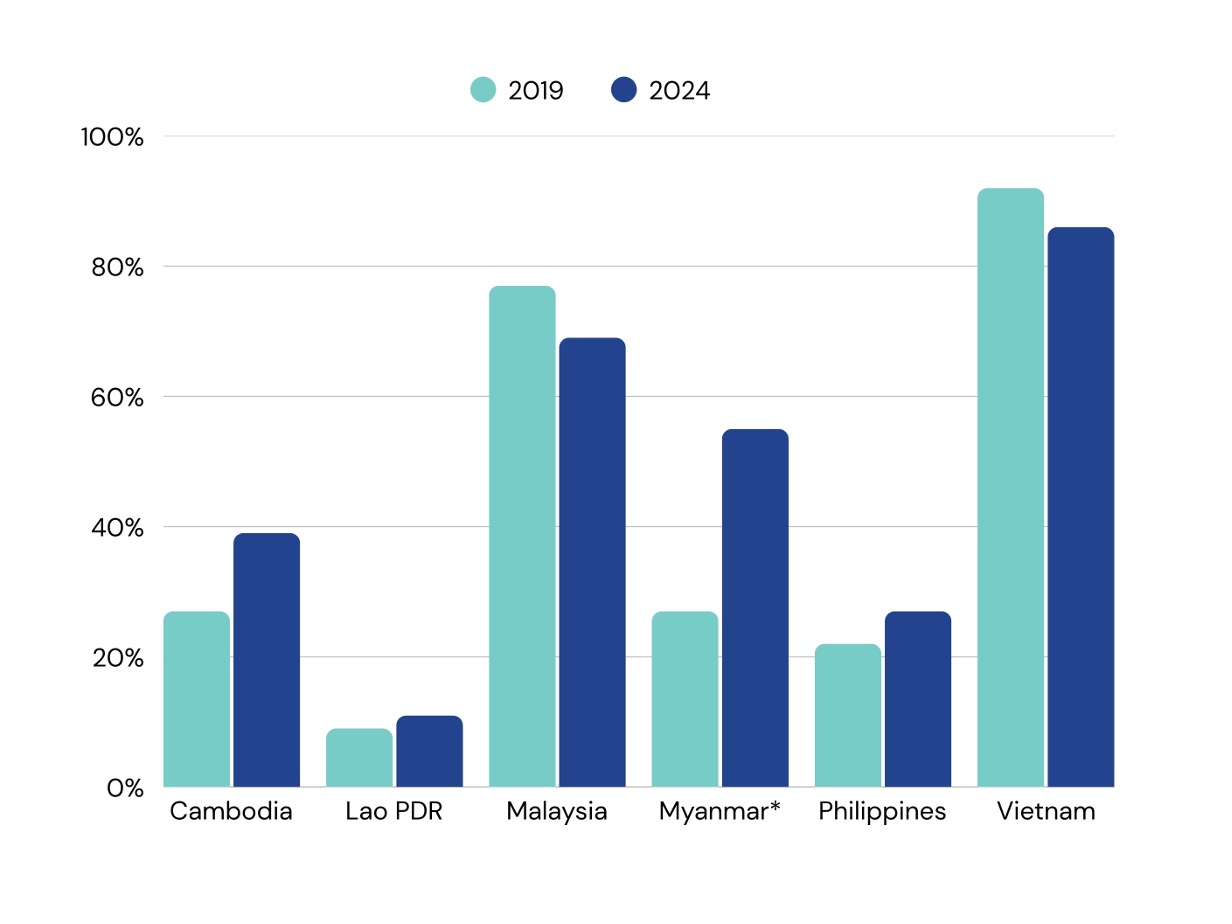 Note: *According to SEA-PLM, caution is required when interpreting and comparing estimates for Myanmar due to changes observed in the composition of the Grade 5 population between the SEA-PLM 2019 and 2024 surveys. All figures are presented using rounded values.
Source: Figure 3.10 in SEA-PLM (2024)
Figure 2: 2024 and 2019 percentage of Grade 5 students performing at or above SDG 4.1.1b ‘end of primary’ in mathematics
Percentage above SDG 4.1.1b, Mathematics, all grade 5 students
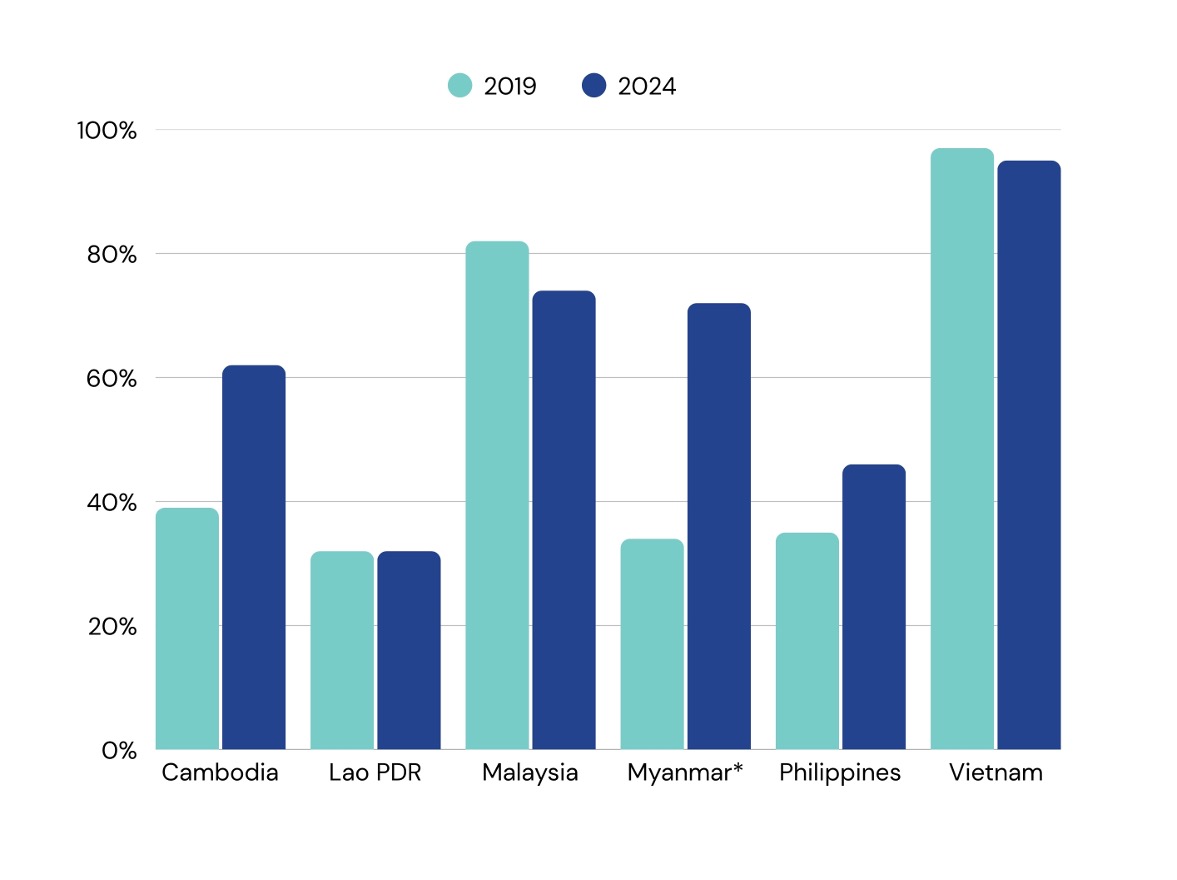
*Caution is required when interpreting and comparing estimates for Myanmar due to significant changes observed in the composition of the Grade 5 population between the SEA-PLM 2019 and 2024 surveys. All figures are presented using rounded values.
Source: Figure 3.11 in SEA-PLM (2024)
For countries across Southeast Asia, the latest SEA-PLM results show that improving learning outcomes is possible, but it requires a sustained focus on implementation, evidence, and system-wide support for teachers and learners.
From evidence to action
While measurement is critical, data alone does not improve learning. Fortunately, there is now a growing body of global evidence on interventions that can improve foundational literacy and numeracy at scale. The Global Education Evidence Advisory Panel, in their report, Cost-Effective Approaches to Improve Global Learning, has identified several highly cost-effective approaches, often referred to as ‘Smart Buys’, including structured pedagogy and targeted instruction approaches such as Teaching at the Right Level.
These approaches share a common focus on ensuring that instruction is aligned with learners’ needs, providing teachers with practical support, and strengthening implementation within education systems. The What Works Hub for Global Education’s ongoing work on the core components of targeted instruction and structured pedagogy seeks to further strengthen understanding of how these approaches can be adapted and implemented effectively across different contexts. The SEA-PLM findings and varied country-level results reveal the importance and relevance of these evidence-based approaches for improving foundational learning in the region.
The What Works Hub for Global Education has been actively engaging with policymakers, practitioners, the UK’s Foreign, Commonwealth & Development Office (FCDO), and regional partners across Southeast Asia to support the use of evidence in education reform. Recent engagements have included contributions to the ASEAN ministerial dialogue at the Education World Forum on accelerating foundational learning, organised with FCDO and partners under the UK-funded ASEAN-UK SAGE programme, and presentations at the Development Economics and Education Conference in Melbourne, the Scaling Up Foundation Learning in Southeast Asia regional forum, and the SEA-PLM 2024 results launch in December 2025.
Across these engagements, a common theme has emerged: governments are seeking practical guidance on how to adapt proven approaches to their contexts and achieve implementation quality with government ownership. These conversations reinforce both the demand for evidence-informed reform and the value of continued regional collaboration and peer learning. They also demonstrate how partnerships between governments, FCDO, the Hub and other regional and development partners can connect global evidence with country-led reform priorities.
Looking ahead
The latest Southeast Asia Primary Learning Metrics (SEA-PLM) results are both a call to action and a source of optimism. They highlight the scale of the learning challenge that remains, while also demonstrating the value of learning assessment data and the potential of evidence-informed reform.
As governments across Southeast Asia continue to strengthen foundational learning, assessments such as SEA-PLM will play a vital role in helping countries understand current learning levels, where progress is being made, and where further action is needed. The recently launched ASEAN Work Plan on Education 2026-2030 provides an important regional framework for this next phase, including a strong focus on evidence based approaches such as structured pedagogy and targeted instruction. Cambodia is stepping up as a co-lead on this regional agenda, while the Philippines is championing an ASEAN Leaders’ Declaration on Foundational Learning. Together, these efforts create an opportunity to embed proven approaches more firmly in regional priorities and move beyond diagnosing learning challenges towards implementing solutions that can improve outcomes for all children.
The UK’s ASEAN-UK Supporting the Advancement of Girls’ Education (SAGE) programme will focus on improving foundational learning in countries with the highest need, including by promoting two evidence-based Smart Buys: structured pedagogy and targeted instruction. This builds on SAGE-supported pilots in Cambodia, Lao PDR and Timor-Leste and its support for regional learning measurement through SEA-PLM. Alongside support from Australian Department of Foreign Affairs and Trade (DFAT), What Works Hub for Global Education, the World Bank, UNICEF and other partners, this creates an opportunity to align regional momentum around approaches backed by rigorous evidence.
The What Works Hub for Global Education looks forward to continuing its partnerships with governments, regional organisations, researchers, and development partners across Southeast Asia as countries work to translate learning data into effective action for children.
References
Akyeampong, K., Andrabi, T., Banerjee, A., Banerji, R., Dynarski, S., Glennerster, R., Grantham-McGregor, S., Muralidharan, K., Piper, B., Ruto, S., Saavedra, J., Schmelkes, S. & Yoshikawa, H. (2023). Cost-effective approaches to improve global learning: What does recent evidence tell us are ‘smart buys’ for improving learning in low- and middle-income countries? Global Education Evidence Advisory Panel. Washington, D.C.: World Bank Group. https://geeap.org/wp-content/uploads/2025/10/Cost-Effective-approaches-to-improve-Global-Learning-2023-English.pdf
Anaman, A., Sabarwal, S., Masood, S., Angrist, N. & Spivack, M. (2026). Improving implementation while scaling: Differentiated learning in Ghana. What Works Hub for Global Education. https://doi.org/10.35489/BSG-WhatWorksHubforGlobalEducation-RI_2026/003
Angrist, N., Djaker, S., Ho, S., Kaffenberger, M., Romero, G. & Sturla, K. (2026). Measuring implementation in education. What Works Hub for Global Education. https://doi.org/10.35489/BSG-WhatWorksHubforGlobalEducation-RI_2026/005
Angrist, N. & Kaffenberger, M. (2026). Adopting and adapting ‘what works’: Core components as a guide. What Works Hub for Global Education. https://doi.org/10.35489/BSG-WhatWorksHubforGlobalEducation-BL_2026/022
British Council. (2026). Sharing insights into TaRL between Cambodia and Lao PDR. ASEAN-UK SAGE Programme. https://www.britishcouncil.id/en/programmes/education/asean-uk-sage/news/TaRL-visit
Development Economics and Education. (n.d.). Development Economics and Education (DEED) Conference [Conference website]. https://www.deved.org/
Global Partnership for Education. (2025). Cambodia: GPE support has enabled stronger planning for more equitable education. Blog. 15 January. https://www.globalpartnership.org/blog/cambodia-gpe-support-has-enabled-stronger-planning-more-equitable-education
Kaffenberger, M., Angrist, N., Hwa, Y.Y., Kayton, H.L., Jukes, M. & Stern, J. (2026). Core components of teaching at the right level: Unpacking the black box of proven programmes into a set of ‘core components’ by systematically combining multiple sources of rigorous evidence with implementer insights. What Works Hub for Global Education. https://doi.org/10.35489/BSG-WhatWorksHubforGlobalEducation-WP_2026/001
SEA-PLM. (2025). Regional forum on foundational learning gathers global experts to advance foundational learning. SEAMEO Secretariat & UNICEF. 26 June. https://www.seaplm.org/index.php/component/k2/item/124-regional-forum-on-foundational-learning-gathers-global-experts-to-advance-foundational-learning
SEA-PLM. (2025). SEA-PLM 2024 main regional results. SEAMEO Secretariat & UNICEF. https://www.seaplm.org/index.php/sea-plm-2024/regional-results-2024
SEAMEO Secretariat & UNICEF. (2025). SEA-PLM 2024 Main Regional Report: Children’s learning in six Southeast Asian countries. SEAMEO Secretariat & UNICEF. https://www.seaplm.org/images/PUBLICATION/2025/SEA-PLM_2024_Main_Regional_Report.pdf
World Bank. (2025). New World Bank support to improve education and learning for young children in Cambodia. Press release. 31 August. https://www.worldbank.org/en/news/press-release/2025/08/31/new-world-bank-support-to-improve-education-and-learning-for-young-children-in-cambodia
ASEAN Secretariat. (2026). ASEAN Work Plan on Education 2026-2030. Jakarta: ASEAN Secretariat. https://asean.org/wp-content/uploads/2026/07/ASEAN-Work-Plan-on-Education-2026-2030.pdf

Discover more
What we do
Our work will directly affect up to 3 million children, and reach up to 17 million more through its influence.
Who we are
A group of strategic partners, consortium partners, researchers, policymakers, practitioners and professionals working together.
Get involved
Share our goal of literacy, numeracy and other key skills for all children? Follow us, work with us or join us at an event.