
Blog
Progress is possible in government systems at scale: new PASEC early grade reading results
Clio Dintilhac, Manzer Imam and Michelle Kaffenberger
Dintilhac, C., Imam, M. & Kaffenberger, M. (2026). Progress is possible in government systems at scale: new PASEC early grade reading results. What Works Hub for Global Education. https://doi.org/10.35489/BSG-WhatWorksHubforGlobalEducation-BL_2026/035
The latest PASEC (Programme for the Analysis of Education Systems, or Programme d’Analyse des Systèmes Éducatifs in French) results show impressive gains in early-grade reading across several sub-Saharan African countries. In countries including Chad, Republic of the Congo, Côte d’Ivoire, Gabon and Guinea, substantially more children are reaching Grade 2 reading proficiency than in 2019.
In this blog we deep dive into two of the countries showing gains: Côte d’Ivoire and Senegal. In recent years, both countries have been implementing evidence-backed programmes such as structured pedagogy. While the gains cannot be attributed to these programmes, these countries’ efforts to improve learning outcomes offer valuable insights. We also point to ways researchers and policymakers can use PASEC data for further analysis to inform policy and practice.
While the gains to early grade reading in so many countries are promising, more work is needed; math scores in the latest PASEC results did not improve, nor did upper primary reading outcomes. These results show more attention is needed to improving learning across subjects and grades.
The PASEC initiated by CONFEMEN (Conference of Ministers of Education of French-speaking States and Governments, or Conférence des ministres de l’Éducation des États et Gouvernements de la francophonie in French) assessed pupils in 16 countries in 2025, including more than 110,000 primary-school pupils. The results provide comparable trend data for 2014, 2019 and 2025. The assessment offers a rare opportunity to examine changes in learning in primary school (PASEC, 2026).
Large gains in children’s early grade reading
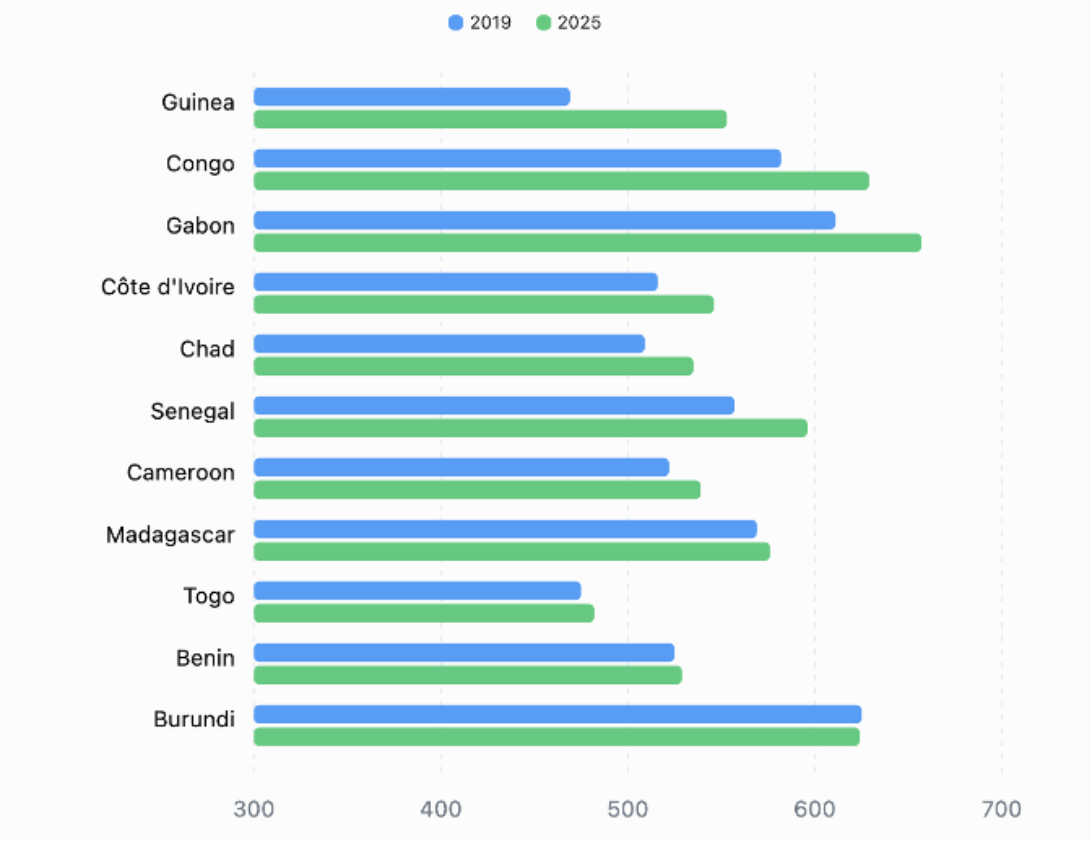
A highlight of the latest PASEC results is the substantial progress in Grade 2 reading outcomes. Between 2019 and 2025, five of the eleven countries with comparable data recorded statistically significant improvements in average reading scores and none decreased (Figure 1). The improvements in averages were accompanied by substantial increases in the share of children reaching PASEC Level 4 reading proficiency, including Guinea (8% to 31%), Congo (36% to 51%), Gabon (41% to 55%), Chad (13% to 26%) and Côte d’Ivoire (11% to 18%) (PASEC, 2026) (Figure 2). PASEC Level 4 is the reading proficiency level calibrated to the international minimum proficiency level for SDG indicator 4.1.1, which captures children who can read and understand short texts.
Figure 1. Improvements in average Grade 2 reading scores, 2019–2025
Source: PASEC (2026)
Figure 2. Grade 2 reading Level 4 shares, 2019 and 2025, for countries with comparable historical distributions
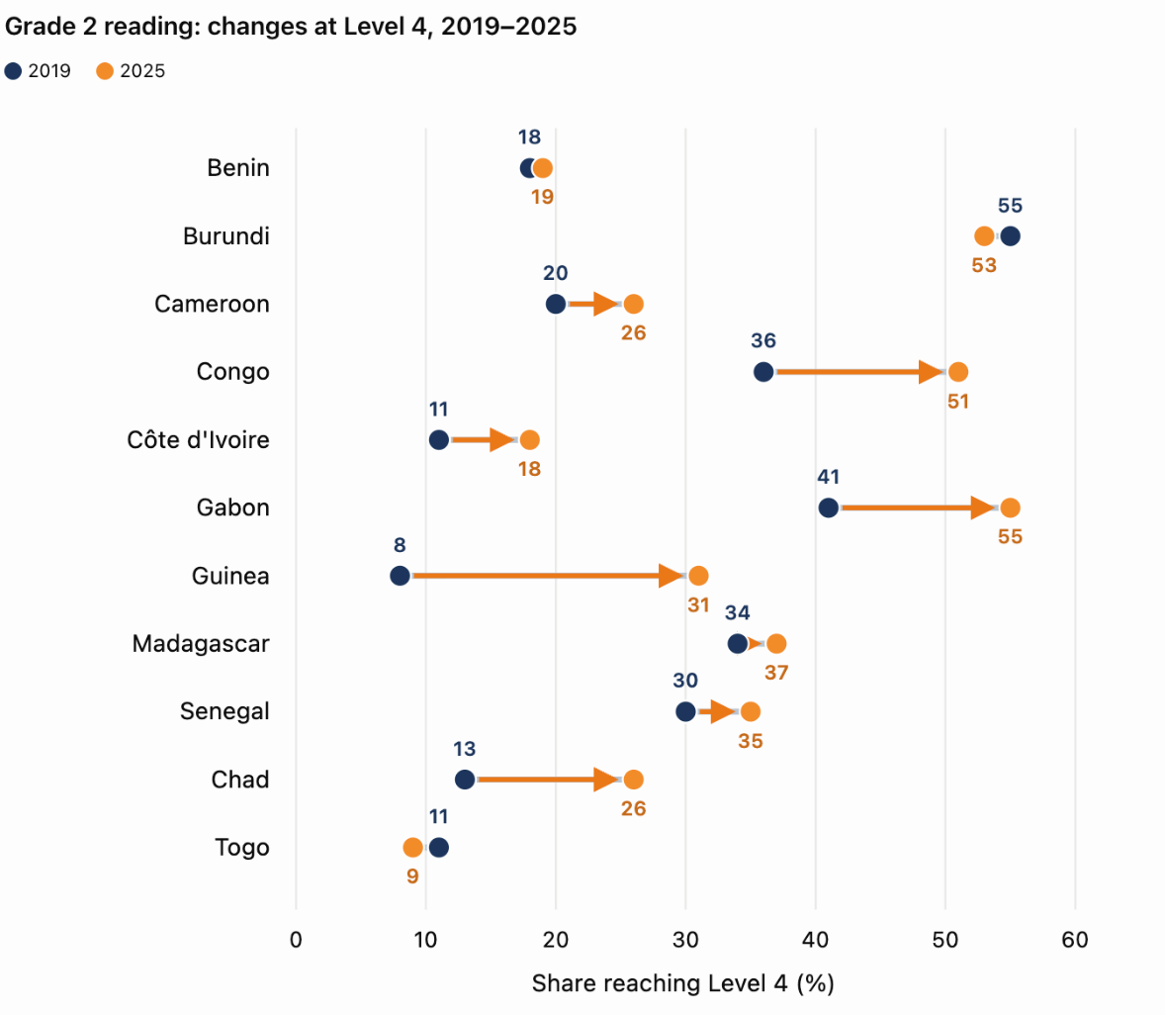
Arrows show the direction of change, not statistical significance. Source: PASEC (2026)
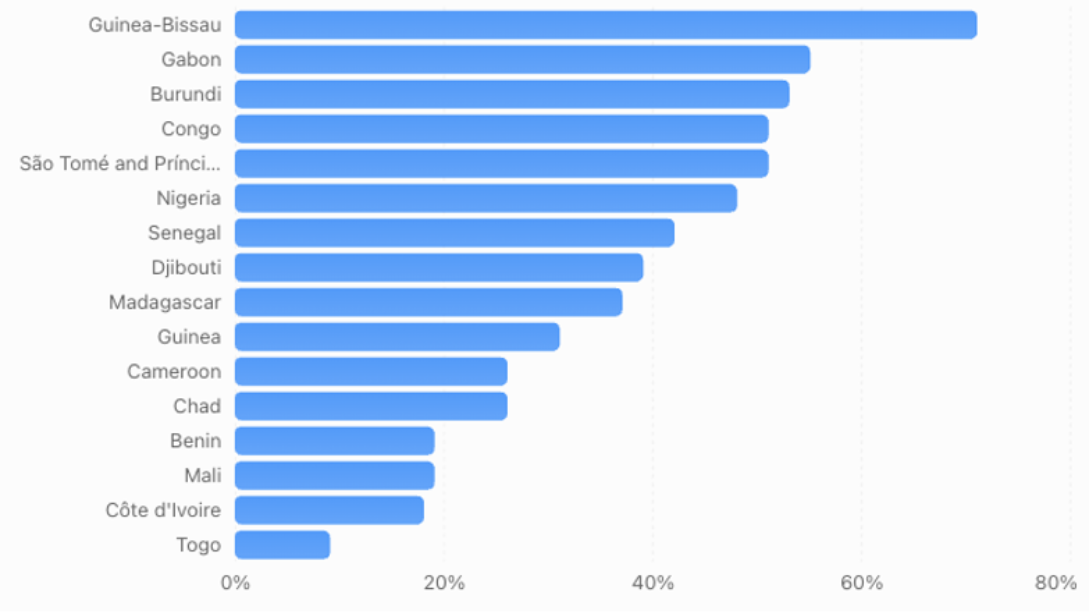
In 2025, the share of Grade 2 pupils reaching Level 4 as reported by PASEC varied across the 16 participating countries, from 9% in Togo to 71% in Guinea-Bissau, with an overall cross-country average of 37% (PASEC, 2026) (Figure 3).
Figure 3. Share of Grade 2 pupils reaching PASEC Level 4 in reading, 2025 [1]
Source: PASEC (2026)
The two measures provide complementary insights. While average scores capture overall learning performance, Level 4 proficiency shows how many children have developed the reading skills expected at this stage in international benchmarks. Côte d’Ivoire illustrates this distinction: despite significant improvements in average reading scores, fewer than one in five Grade 2 pupils reached Level 4 in 2025. This highlights both the progress achieved, and the considerable scope for further improvement to get all children reading at the international benchmark.
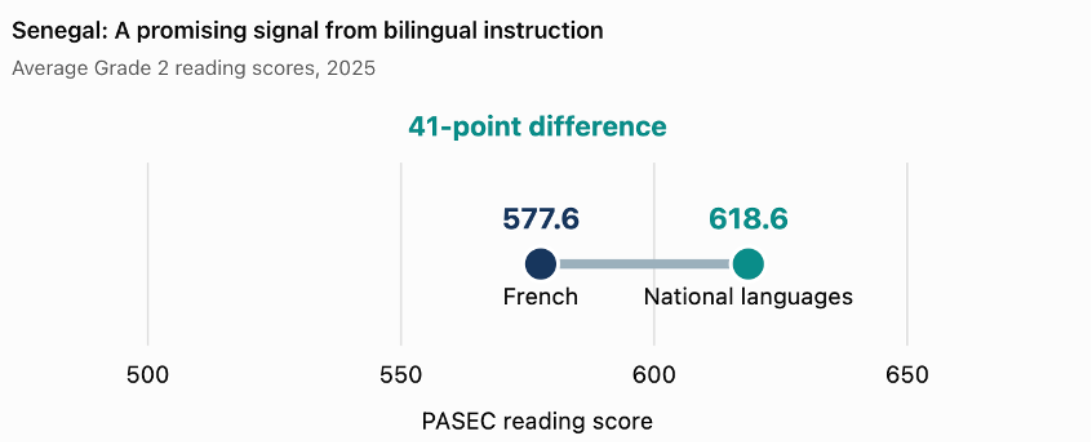
In Senegal, averages hide important differences among language groups. Senegal recorded large improvements in average reading score, rising from 557 in 2019 to 596 in 2025, equivalent to a 0.39 standard deviation improvement overall. For pupils assessed in national languages, who had benefited from a bilingual structured pedagogy reform, achievement was even higher, with an average score of 619, compared with 578 among those assessed in French [2]. The national-language group was predominantly drawn from more rural areas outside Dakar and Thiès, making its stronger performance particularly encouraging.
In this blog, we dig deep into two of the countries showing improvements. Côte d’Ivoire and Senegal have both introduced government-led structured pedagogy reforms grounded in approaches supported by global evidence. Senegal has expanded bilingual structured reading instruction in national languages, while Côte d’Ivoire has introduced structured pedagogy in early-grade reading and mathematics, supported by teacher training and coaching. Together, these experiences offer opportunities to examine how evidence-based instructional approaches are being implemented through government systems alongside improvements in learning outcomes.
We also point to additional opportunities for analysis, among researchers and policymakers, to make use of the rich PASEC data. This is in support of improving policies, practice and ultimately learning outcomes for children.
Côte d’Ivoire: Structured pedagogy for both reading and mathematics
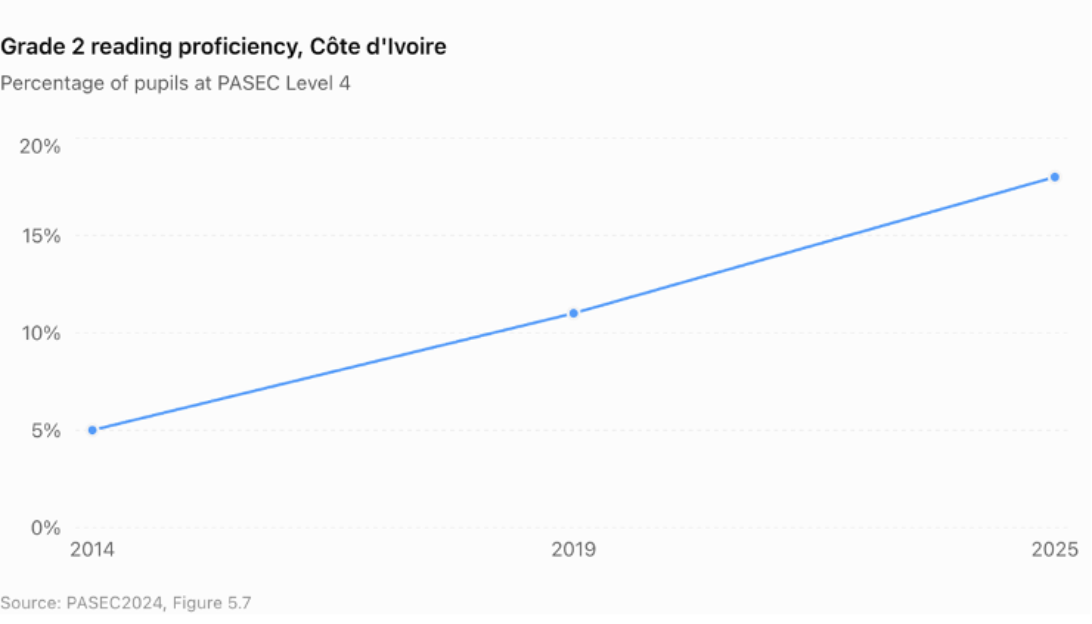
Côte d’Ivoire has made encouraging progress in foundational learning, although from a relatively low base. The share of Grade 2 pupils reaching PASEC Level 4 in reading increased from just 5% in 2014 to 11% in 2019 and 18% in 2025. In mathematics, the share reaching the highest proficiency level (Level 3) increased from 21% in 2019 to 25% in 2025.
Figure 4. Progress in early-grade reading proficiency in Côte d’Ivoire, 2014–2025
Source: PASEC (2026)
These gains have coincided with a sustained government effort to strengthen foundational learning. Prompted in part, by weak PASEC 2019 results, the Ministry of Education brought several earlier reading and numeracy initiatives together into a single national programme, the Programme National d’Amélioration des Premiers Apprentissages Scolaires (PNAPAS, or National Programme for the Improvement of Foundational Learning). PNAPAS is a structured pedagogy programme that combines explicit instruction, structured teaching materials, teacher training and ongoing coaching in both reading and mathematics. The 2024/25 school year was its first year of implementation in Grade 2 [3], and expansion to Grade 3 is now under way with national scale-up is planned. In parallel, the government has rolled out Teaching at the Right Level (TaRL) nationally in Grades 3–5 to support pupils who have not yet mastered foundational skills, though results specifically for the TaRL approach so far have been mixed [4].
These reforms align with rigorous evidence on how to improve foundational learning through embedding the core components of structured pedagogy into education systems at scale (Hwa, Kayton & Kaffenberger, 2024). Evidence on TaRL also highlights the core components that remedial programmes need to get right at scale, a useful benchmark as Côte d’Ivoire refines its approach (Kaffenberger et al., 2026). The next PASEC cycle will be important to assess if the expanded reform yields results.
Senegal: Building early grade reading through bilingual structured pedagogy
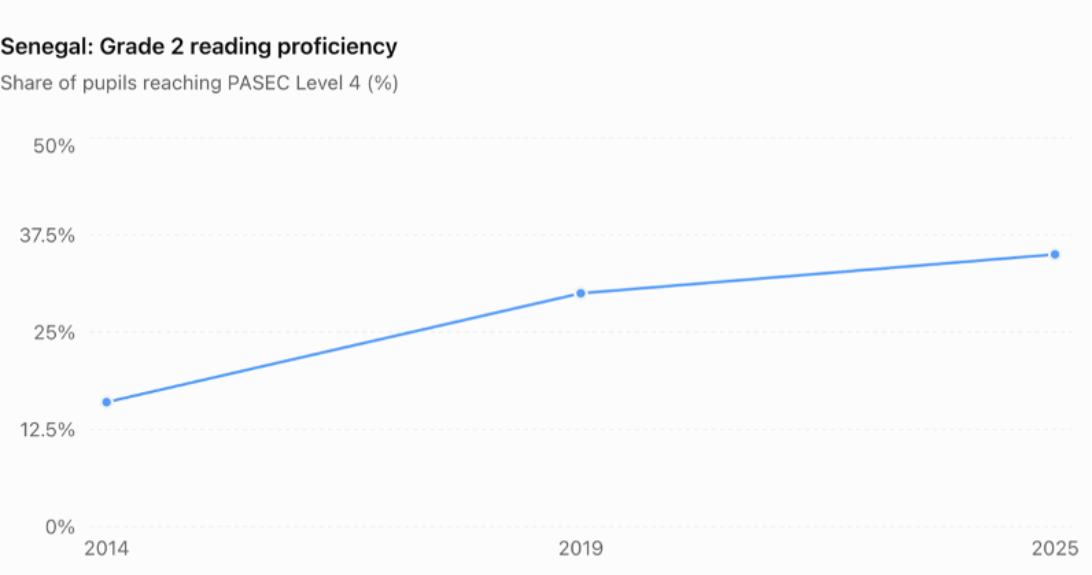
Senegal has made substantial progress in early-grade reading, with the share of Grade 2 pupils reaching PASEC Level 4 increasing from 16% in 2014 to 35% in 2025 (PASEC, 2026). This progress comes alongside government efforts to strengthen early literacy through bilingual structured pedagogy with the Modèle harmonisé d’enseignement bilingue au Sénégal (MOHEBS, or Unified Framework for Bilingual Education in Senegal) that was supported by Lecture Pour Tous (LPT, or Reading for All) and Renforcement de la Lecture Initiale pour Tous (RELIT, or Strengthening Early Reading for All). These initiatives had expanded structured reading and writing instruction in Grade 2 in national languages across nine of Senegal’s 14 regions by 2025 when the PASEC test happened.
Figure 5. Progress in early-grade reading proficiency in Senegal, 2014–2025 – Share of Grade 2 pupils reaching PASEC Level 4 in reading (%)
Source: PASEC (2026)
Figure 6. Average Grade 2 reading scores by language of assessment, 2025
Source: PASEC (2026)
The 2025 results offer particularly encouraging evidence. Pupils who had benefited from the bilingual structured pedagogy reform and were assessed in national languages, achieved an average reading score of 619, compared with 578 among pupils assessed in French who had not participated, a statistically significant difference of approximately 41 points (PASEC, 2026). The reform beneficiaries were predominantly from areas outside Dakar and Thiès, making them more rural than the French-medium group. Their stronger performance, despite this geographical disadvantage, provides a promising signal of the potential of bilingual structured pedagogy to improve foundational reading.
Mathematics performance remained broadly unchanged between 2019 and 2025, as did upper primary reading outcomes. MOHEBS beneficiaries had not yet reached Grade 6 by the 2025 assessment; how improved outcomes in early grade reading translate into later primary reading outcomes will be an area to watch in future PASEC rounds.
PASEC data are available: an invitation to researchers and policymakers
As a regionally owned assessment, PASEC provides something that national examinations and national assessments don’t always offer: comparable measures of learning across countries, and over time. It also collects contextual information on pupils, schools, teachers, and, as of the 2025 collection, parents. These data can help investigate early reading improvements in some countries, how mathematics outcomes relate to teacher knowledge and classroom conditions, and how learning gaps vary by gender, geography and socioeconomic background (PASEC, 2026). PASEC is regionally led through CONFEMEN and also provides countries with a shared basis for tracking learning against SDG 4.1.1 as the 2030 deadline approaches.
Researchers can explore the PASEC Data Portal and use AFLEARN’s practical guide , which includes guidance for working with PASEC datasets in Stata and R.
The new findings invite deeper work by researchers, national PASEC teams, governments and development partners. They also open new questions: Within countries, which groups of students experienced the largest gains, and which groups may need additional attention? Are there any bright spots of progress for mathematics, and if so, how do they differ from contexts that have stagnated? How do changes in average scores differ from changes in proportions achieving proficiency, and what does this suggest for where in the student distribution more improvement is needed? Open, well-documented data can help turn these questions into evidence that informs policy.
Additionally, the new parent questionnaire also opens questions about the home learning environment, parental education, and engagement with schooling. Analyses of gender, rural–urban and public–private differences could reveal whether national progress is reaching disadvantaged pupils. For example, the 2025 PASEC data finds that Côte d’Ivoire’s private-public gap at the beginning of primary is no longer statistically significant in reading or mathematics (PASEC, 2026).
Looking ahead
The gains in PASEC scores resemble gains in other regions as well. The Southeast Asia Primary Learning Metrics (SEA-PLM) revealed large learning gains in Cambodia, which has also prioritised evidence-backed instructional approaches. Recent Programme for International Student Assessment (PISA) results showed Philppines, Cambodia and Zambia all improving learning outcomes by a year’s worth of learning or more. All of these countries are prioritising improving foundational learning and implementing evidence-based programmes at scale in and through government systems.
Among PASEC countries, there are additional success stories: Guinea and Congo have also pursued instructional reforms. New programmes with elements of structured pedagogy in Guinea and curriculum revision with stronger teacher training in Congo, and both recorded large early-grade gains [5]. However, the PASEC report notes that Guinea’s newly introduced textbooks were rolled out after data collection and therefore cannot explain the learning gains observed in 2025 (PASEC, 2026).
The next steps for countries are practical ones: protect gains in early reading and support advanced reading and numeracy skills through the later grades. Regional assessments like PASEC give a snapshot of changes every few years. These can be complemented by frequent government use of learning assessments alongside classroom-level implementation data to identify which approaches are working, for whom, and under what conditions.
For policymakers, the findings should provide encouragement to build on progress by continuing to strengthen and scale evidence-backed approaches such as structured pedagogy and targeted instruction. This will ensure effective implementation to reach all children (Angrist et al., 2026).
Together, these efforts can help translate the progress captured by recent PASEC results into lasting improvements in learning for children.
References
PASEC. (2026). PASEC2024 – Bilan des acquis d’apprentissage du primaire en Afrique subsaharienne. CONFEMEN. https://pasec.confemen.org/fr/resultats/pasec-24-rapport
SEAMEO Secretariat & UNICEF. (2025). SEA-PLM 2024 main regional report: Children’s learning in six Southeast Asian countries. https://www.seaplm.org/images/PUBLICATION/2025/SEAPLM_2024_Main_Regional_Report.pdf
OECD. (2026). PISA 2025 results (Volume I): Future-ready students. PISA, OECD Publishing, Paris. https://doi.org/10.1787/73451bc5-en
Imam, M., Hwa, Y.-Y., & Kaffenberger, M. (2026). From evidence to action: SEA-PLM provides new data for informing policy. What Works Hub for Global Education. https://doi.org/10.35489/BSG-WhatWorksHubforGlobalEducation-BL_2026/025
Hwa, Y.-Y., Kayton, H. L., & Kaffenberger, M. (2024). Implementing structured pedagogy programmes at scale. What Works Hub for Global Education. https://doi.org/10.35489/BSG-WhatWorksHubforGlobalEducation-RI_2024/002
Angrist, N., & Kaffenberger, M. (2026). Adopting and adapting ‘what works’: Core components as a guide. What Works Hub for Global Education. https://doi.org/10.35489/BSG-WhatWorksHubforGlobalEducation-BL_2026/022
Angrist, N., Andrabi, T., Dercon, S., Djaker, S., Habyarimana, J., Kaffenberger, M., Leaver, C., Mangla, A., Mohohlwane, N. & Singh, A. (2026). An agenda for implementation science in education. Science, 393 (6816),1084-1087. https://doi.org/10.1126/science.aee7868
PASEC Data Portal. https://pasec.confemen.org/en/data-portal
AFLEARN PASEC Analysis Guide. https://datafirst-aflearn.github.io/pasec-guide/
Kaffenberger, M., Angrist, N., Hwa, Y.-Y., Kayton, H. L., Jukes, M., & Stern, J. (2026). Core components of teaching at the right level: Unpacking the black box of proven programmes into a set of ‘core components’ by systematically combining multiple sources of rigorous evidence with implementer insights. What Works Hub for Global Education. https://doi.org/10.35489/BSG-WhatWorksHubforGlobalEducation-WP_2026/001
[1] The sample in Guinea-Bissau was different from other countries as the average age of children was 10 years old as opposed to ~7 for the rest of the countries because of a later average school entry age. This means this result is not purely comparable to others.
[2] The 2019 assessment was conducted only in French (PASEC, 2026).
[3] The Grade 2 and Grade 1 books were distributed at the same time at the start of the 24/25 school year meaning that Grade 2 students had benefitted from only one year of support.
[4] Source: https://osf.io/preprints/edarxiv/d3hg4
[5] Though of course gains cannot be attributed to these particular programmes using PASEC data.


Discover more
What we do
Our work will directly affect up to 3 million children, and reach up to 17 million more through its influence.
Who we are
A group of strategic partners, consortium partners, researchers, policymakers, practitioners and professionals working together.
Get involved
Share our goal of literacy, numeracy and other key skills for all children? Follow us, work with us or join us at an event.