
Blog
Coaching at scale is doable, one tweak at a time
Michelle Kaffenberger and Noam Angrist
Kaffenberger, M. & Angrist, N. (2025). Coaching at scale is doable, one tweak at a time. What Works Hub for Global Education. https://doi.org/10.35489/BSG-WhatWorksHubforGlobalEducation-BL_2026/029
Coaching works – can it scale?
While teacher training is the main mechanism to introduce new pedagogical reforms into an education system, most general skills teacher trainings don’t work. In contrast, the most effective approaches for improving foundational learning involve ongoing coaching support for teachers. Coaching is considered an essential component in both targeted instruction programmes and structured pedagogy programmes and has a strong evidence base for how teachers change their behaviours and practices.
Yet coaching can be high cost and hard to implement since it often involves one-on-one regular interactions between coaches and teachers, making it challenging to scale nationally.
How can we make coaching lower cost, and enable effective coaching at scale in government education systems?
An established evidence base on coaching efficacy
The evidence base on coaching is now substantial. For instance, teachers receiving coaching visits more frequently group students by learning level and instruct them at that level in targeted instruction programmes. A randomised controlled trail (RCT) of a structured pedagogy programme compared a one-off intensive teacher training with a similar amount of instructional time delivered through school-based coaching visits and found that coaching had twice the impact on student learning. A randomised evaluation of the Kenya Primary Math and Reading (PRIMR) Initiative found that coaching was particularly effective when connected to concrete programming, such as teacher guides. A central mechanism for why coaching is effective is its ability to improve implementation fidelity and, in turn, learning outcomes.
A new set of effectiveness trials testing low-cost coaching for implementation at scale
New work is advancing the frontier of the coaching evidence, moving from efficacy to effectiveness evidence. This involves adaptive testing to tweak coaching model components and identify the most cost-effective approaches at scale. We highlight two types of adaptations: cost-reducing, which remove components to simplify the programme without losing impact, and effectiveness-enhancing, which aim to add an element to the programme at low marginal cost to improve impact.
Cost-reducing adaptations
- Meerkat Learning in Namibia has found that they can replace one of two in-person coaching visits with a virtual phone call and achieve similar student learning outcomes at lower cost. They tested this innovation using A/B testing approaches that compared two in-person visits with one in-person visit followed by a virtual phone call across an eight-week implementation cycle. Because the hybrid version achieved similar outcomes at lower cost it improved efficiency by 33%. Feedback from coaches and teachers indicated they appreciated the hybrid model. They reported that the phone calls enabled coaches to use existing data dashboards more consistently, and teachers felt less rushed and distracted on phone calls than when the coaching visit occurred in the classroom.
- Evidence from South Africa shows that some degree of in-person coaching visits continues to be crucial. Studies of fully virtual coaching find it is typically not effective for children’s learning improvements. Hybrid approaches that combine in-person visits with virtual follow up are strong contenders for effective implementation at scale.
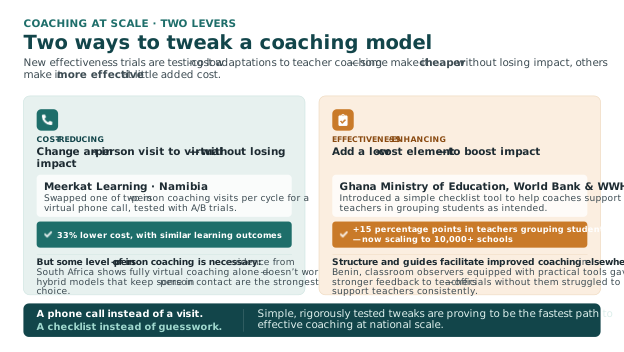
Figure 1: Two ways to tweak a coaching model
Effectiveness-enhancing adaptations
- A process evaluation of Benin’s early grade curriculum reform, which includes elements of structured pedagogy, revealed that feedback from classroom observations conducted by middle tier officials led to stronger teacher practices and implementation, but that the middle tier lacked practical tools needed to consistently provide instructional support. A key recommendation from the evaluation was to equip middle tier officials with practical tools to guide their classroom observations and follow up conversations with teachers in order to ultimately improve implementation and outcomes.
- In Ghana, teacher surveys and classroom observations revealed that teachers were not grouping students as frequently as intended by the government’s large-scale differentiated instruction programme. Through a collaboration with the Ghana Ministry of Education, World Bank, and the What Works Hub for Global Education, we tested a simple checklist tool for coaches to use to support teachers in grouping and instructing as intended. An A/B test found that teachers’ grouping of students increased by 15 percentage points as a result. The checklist tool is now being scaled up across the programme to over 10,000 schools.
Together, these tests point to two overall lessons:
- Virtual coaching can work as a complement to in-person coaching to reduce cost and sustain coaching effectiveness at scale
- Added structure and guides can facilitate improved coaching, just as teacher guides improve teaching
The way forward: continual learning and improvement
Implementation research on additional ‘tweaks’ is underway. Through Uborabora, school-based coaching, with head teachers and peer-teachers serving as coaches, is being tested – which could reduce the cost and increase the feasibility of coaching. In India, the Language and Learning Foundation, in collaboration with the What Works Hub for Global Education and Brink, is testing how to strengthen the instructional support middle tier officials provide to teachers – which would increase the effectiveness of coaching.
Simple changes at scale can make a world of a difference. A phone call instead of a visit. A checklist instead of guesswork. Small tweaks, tested rigorously can add up to real gains for coaches, teachers and students, and the evidence base is growing. If you have new findings or ongoing studies on how to implement coaching at lower cost and greater impact, we’d love to hear about them. And if you’re looking to apply these approaches to your own programme or policy design, we’re happy to help – reach out, and let’s talk.
References
Akyeampong, K., Andrabi, T., Banerjee, A., Banerji, R., Dynarski, S., Glennerster, R., Grantham-McGregor, S., Muralidharan, K., Piper, B., Ruto, S., Saavedra, J., Schmelkes, S. & Yoshikawa, H. (2023). Cost-effective approaches to improve global learning: What does recent evidence tell us are smart buys for improving learning in low- and middle-income countries? Global Education Evidence Advisory Panel. Washington, D.C.: World Bank Group. https://geeap.org/wp-content/uploads/2025/10/Cost-Effective-approaches-to-improve-Global-Learning-2023-English.pdf
Anaman, A., Sabarwal, S., Masood, S., Angrist, N. & Spivack, M. (2026). Improving implementation while scaling: Differentiated Learning in Ghana. What Works Hub for Global Education. https://doi.org/10.35489/BSG-WhatWorksHubforGlobalEducation-RI_2026/003
Angrist, N., Andrabi, T., Dercon, S., Djaker, S., Habyarimana, J., Kaffenberger, M., Leaver, C., Mangla, A., Mohohlwane, N. & Singh, A. (2026). An agenda for implementation science in education. Science, 393(6816), 1084-1087. https://www.science.org/doi/10.1126/science.aee7868
Angrist, N., Beatty, A. & Cullen, C. (2025). Iterative A/B Testing Toolkit. What Works Hub for Global Education. https://doi.org/10.35489/BSG-WhatWorksHubforGlobalEducation-RP_2025/004
Angrist, N., Beatty, A., Cullen, C. & Mukoyi Nkwane, T. (2026). Iterative A/B testing for social impact: Rigorous, rapid, regular. Stanford Social Innovation Review. https://doi.org/10.48558/1K00-YD44
Angrist, N., Cullen, C. & Magat, J. (2025). Cheaper (and more effective) by the dozen: Evidence from 12 randomised A/B tests optimising tutoring for scale. What Works Hub for Global Education. https://doi.org/10.35489/BSG-WhatWorksHubforGlobalEducation-WP_2025/001
Angrist, N., Djaker, S., Ho, S., Kaffenberger, M., Romero, G. & Sturla, K. (2026). Measuring implementation in education. What Works Hub for Global Education. https://doi.org/10.35489/BSG-WhatWorksHubforGlobalEducation-RI_2026/005
Angrist, N. & Kaffenberger, M. (2026). Adopting and adapting ‘what works’: Core components as a guide. What Works Hub for Global Education. https://doi.org/10.35489/BSG-WhatWorksHubforGlobalEducation-BL_2026/022
Banerjee, A., Banerji, R., Berry, J., Duflo, E., Kannan, H., Mukerji, S., Shotland, M. & Walton, M. (2017). From proof of concept to scalable policies: Challenges and solutions, with an application. Journal of Economic Perspectives, 31(4), 73-102. https://doi.org/10.1257/jep.31.4.73
Beg, S. A., Fitzpatrick, A. E. & Lucas, A. (2023). Managing to Learn. National Bureau of Economic Research. https://doi.org/10.3386/w31757
Beggs, C., Thukral, H. & Dintilhac, C. (2025). Improving foundational literacy outcomes: A brief on the components and cost of a ‘just enough’ model for government-led programming. What Works Hub for Global Education. https://doi.org/10.35489/BSG-WhatWorksHubforGlobalEducation-RP_2025/002
Cilliers, J., Fleisch, B., Kotze, J., Mohohlwane, N., Taylor, S. & Thulare, T. (2022). Can virtual replace in-person coaching? Experimental evidence on teacher professional development and student learning. Journal of Development Economics, 155, 102815. https://doi.org/10.1016/j.jdeveco.2021.102815
Cilliers, J., Fleisch, B., Prinsloo, C. & Taylor, S. (2020). How to improve teaching practice? An experimental comparison of centralized training and in-classroom coaching. Journal of Human Resources, 55(3), 926–962. https://doi.org/10.3368/jhr.55.3.0618-9538R1
Hobbiss, M., Sims, S. & Allen, R. (2021). Habit formation limits growth in teacher effectiveness: A review of converging evidence from neuroscience and social science. Review of Education, 9(1), 3–23. https://doi.org/10.1002/rev3.3226
Hwa, Y.Y., Kayton, H. L. & Kaffenberger, M. (2024). Implementing structured pedagogy programmes at scale. What Works Hub for Global Education. https://doi.org/10.35489/BSG-WhatWorksHubforGlobalEducation-RI_2024/002
Kaffenberger, M., Angrist, N., Hwa, Y.Y., Kayton, H.L., Jukes, M. & Stern, J. (2026). Core components of teaching at the right level: Unpacking the black box of proven programmes into a set of ‘core components’ by systematically combining multiple sources of rigorous evidence with implementer insights. What Works Hub for Global Education. https://doi.org/10.35489/BSG-WhatWorksHubforGlobalEducation-WP_2026/001
Piper, B., Zuilkowski, S. S., Dubeck, M., Jepkemei, E. & King, S. J. (2018). Identifying the essential ingredients to literacy and numeracy improvement: Teacher professional development and coaching, student textbooks, and structured teachers’ guides. World Development, 106, 324–336. https://doi.org/10.1016/j.worlddev.2018.01.018
Ricard, C., Charles, G., Frazier, J., d’Anglejan, L. & Chanou, P. (2026). Fidelity to design vs. fidelity to best practice: Lessons from our process evaluation of Benin’s curriculum reform. IDinsight. https://www.idinsight.org/article/fidelity-to-design-vs-fidelity-to-best-practice-lessons-from-our-process-evaluation-of-benins-curriculum-reform/

Discover more

What we do
Our work will directly affect up to 3 million children, and reach up to 17 million more through its influence.
Who we are
A group of strategic partners, consortium partners, researchers, policymakers, practitioners and professionals working together.
Get involved
Share our goal of literacy, numeracy and other key skills for all children? Follow us, work with us or join us at an event.