
Blog
Implementation science gains traction
Lily Kilburn
Kilburn, L. (2026). Implementation science gains traction. What Works Hub for Global Education. https://doi.org/10.35489/BSG-WhatWorksHubforGlobalEducation-BL_2026/031
What does it take to ensure every child learns?
It takes a laser focus on implementation at scale.
Implementation science needs to be a part of interventions at every stage, so that they can be fully understood, measured and continually refined to work for all children (Angrist, Djaker, et al, 2026; Anaman et al, 2026).
Two recent articles in Science and Nature shine a light on how education systems can unlock implementation science’s full potential.
Advancing the field of implementation science
An agenda for implementation science in education, a recent Science article, sets out a new way of understanding implementation science in global education (Angrist, Andrabi, et al., 2026) (Figure 1).
Written by ten education research and policy experts from across the What Works Hub for Global Education consortium, the article describes how education interventions can move through four phases, ranging from small-scale efficacy trials to practice at scale.
This framework aims to set a research agenda for implementation science in global education. Today, we still have many efficacy trials, which are designed to test proof of concept in small, controlled studies, but not enough effectiveness trials, which test whether interventions can work expansively, efficiently, and equitably. In other words, effectiveness trials are what we need to get interventions working for all children, sustained and embedded in real-world government systems.
Figure 1
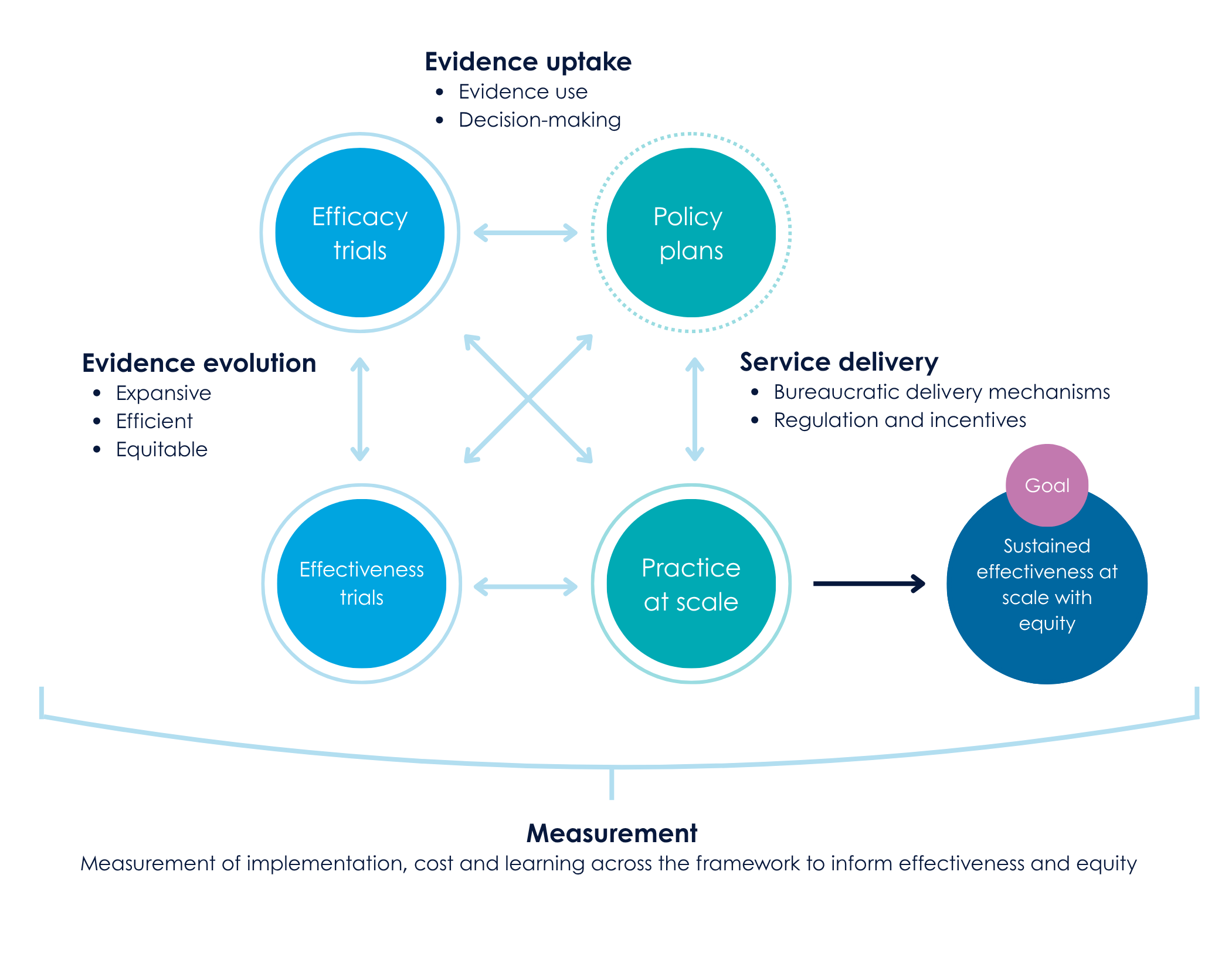
Figure adapted from Angrist, Andrabi, et al. (2026)
During effectiveness trials, techniques such as iterative A/B testing can help programmes to repeatedly tweak implementation to be more efficient at lower cost (Angrist, Cullen, et al., 2026). A major advantage is that iterative A/B testing is rapid, so it can make a change within months even when a programme is already scaled up (Angrist et al, 2024).
Bringing implementation science into the spotlight
The article calls for collective standards of reporting and measurement, and more institutions dedicated to implementation science.
As the authors say:
‘There is growing evidence on what works – now we need to translate that evidence into action and systematically study the process, so that we can do it repeatedly and at increasing scale to achieve effective, equitable, and enduring learning for all.’
Scaling across settings
Another recent article, in Nature, shares some remarkable data about how education systems can work rapidly and scale across diverse settings.
The Nature article, Mobile education builds resilience during shocks in five countries, presents results from large randomised controlled trials exploring education interventions during emergencies in India, Kenya, Nepal, the Philippines and Uganda (Angrist, Ainomugisha, et al., 2026). Such large and multi-setting trials in education are unusual – making their findings all the more notable.
The five randomised controlled trials found that tutoring via a combination of phone calls and SMS messages produced large and consistent learning gains. This held true even across very different study settings and where the tutoring was implemented at scale through government systems.
Strikingly, this approach was highly cost-effective: it delivered over three and a half learning-adjusted years of schooling per US $100 spent. That’s a cost-effectiveness rate in the top 10% of education interventions where learning-adjusted years of schooling have been analysed.
And because the tutoring was simple and could be implemented quickly (Angrist, Beatty, et al., 2026), it was well suited as a rapid response.
Reversing the ‘voltage drop’
The ‘voltage drop’ – a drop in effectiveness as programmes scale up – is an increasingly well-known problem.
Implementation science can help reverse the voltage drop, achieving a ‘learning curve’ where effectiveness improves as programmes scale up. The trials discussed in Nature are a good example of how this works (Angrist, Cullen, et al., 2023).
During the trials, implementers identified the core components of the interventions – what must be adopted and adapted to retain effectiveness. They also established ongoing monitoring loops that checked and improved implementation fidelity over time.
The results were impressive. For example, accuracy of instruction targeting improved from 58% to 81% in the intervention in the Philippines.
A change in mindset: implementation as a priority
We now know that structured pedagogy, teaching at the right level and other strategies can be highly effective in improving learning (Taylor et al., 2025; Kaffenberger et al., 2026). The task ahead is to ensure that such effective interventions work in multiple contexts, for all children, in real time, and in a way that lasts. That means consistently drawing on implementation science evidence to keep learning going while programmes scale up. And it means moving and adapting fast, while building efficient interventions that are rooted in government systems and ready to endure shocks (Angrist, Evans, et al., 2023).
The goal is sustained effectiveness at scale with equity. Implementation science can help catalyse this change.
References
Angrist, N., Andrabi, T., Dercon, S., Djaker, S., Habyarimana, J., Kaffenberger, M., Leaver, C., Mangla, A., Mohohlwane, N. & Singh, A. (2026). An agenda for implementation science in education. Science, 393(6816), 1084-1087. https://www.science.org/doi/10.1126/science.aee7868
Angrist, N., Djaker, S., Ho, S., Kaffenberger, M., Romero, G. & Sturla, K. (2026). Measuring implementation in education. What Works Hub for Global Education. https://doi.org/10.35489/BSG-WhatWorksHubforGlobalEducation-RI_2026/005
Anaman, A., Sabarwal, S., Masood, S., Angrist, N. & Spivack, M. (2026). Improving implementation while scaling: Differentiated Learning in Ghana. What Works Hub for Global Education. https://doi.org/10.35489/BSG-WhatWorksHubforGlobalEducation-RI_2026/003
Angrist, N., Cullen, C. & Magat, J. (2025). Cheaper (and more effective) by the dozen: Evidence from 12 randomised A/B tests optimising tutoring for scale. What Works Hub for Global Education. https://doi.org/10.35489/BSG-WhatWorksHubforGlobalEducation-WP_2025/001
Angrist, N., Beatty, A., Cullen, C. & Matsheng, M. (2024). A/B testing in education: rapid experimentation to optimise programme cost-effectiveness. What Works Hub for Global Education. https://doi.org/10.35489/BSG-WhatWorksHubforGlobalEducation-RI_2024/001
Angrist, N., Ainomugisha, M., Bathena, S. P., Bergman, P., Crossley, C., Cullen, C., Letsomo, T., Matsheng, M., Panti, R. M., Sabarwal, S., & Sullivan, T. (2026). Mobile education builds resilience during shocks in five countries. Nature, 657, 689–696. https://doi.org/10.1038/s41586-026-10990-x
Angrist, N., Beatty, A., Cullen, C. & Mukoyi Nkwane, T. (2026). Iterative A/B testing for social impact: Rigorous, rapid, regular. Stanford Social Innovation Review. https://doi.org/10.48558/1K00-YD44
Angrist, N., Cullen, C., Ainomugisha, M., Bathena, S. P., Bergman, P., Crossley, C., Letsomo, T., Matsheng, M., Panti, R. M., Sabarwal, S., & Sullivan, T. (2023). Learning curve: Progress in the replication crisis. AEA Papers and Proceedings, 113, 482–488. https://doi.org/10.1257/pandp.20231009
Taylor, S., Mohohlwane, N., Bohmer, B. & Murru, A. (2025). Key findings from a series of studies on structured learning programmes in South Africa. What Works Hub for Global Education. https://doi.org/10.35489/BSG-WhatWorksHubforGlobalEducation-RI_2025/004
Kaffenberger, M., Angrist, N., Hwa, Y.Y., Kayton, H.L., Jukes, M. & Stern, J. (2026). Core components of teaching at the right level: Unpacking the black box of proven programmes into a set of ‘core components’ by systematically combining multiple sources of rigorous evidence with implementer insights. What Works Hub for Global Education. https://doi.org/10.35489/BSG-WhatWorksHubforGlobalEducation-WP_2026/001
Angrist, N., Evans, D., Filmer, D., Glennerster, R., Rogers, H., & Sabarwal, S. (2023). How to improve education outcomes most efficiently? What Works Hub for Global Education. https://doi.org/10.35489/BSG-WhatWorksHubforGlobalEducation-WP_2023/002
Kilburn, L. (2026). Implementation science gains traction. What Works Hub for Global Education. https://doi.org/10.35489/BSG-WhatWorksHubforGlobalEducation-BL_2026/031
People

Lily Kilburn
Discover more

What we do
Our work will directly affect up to 3 million children, and reach up to 17 million more through its influence.
Who we are
A group of strategic partners, consortium partners, researchers, policymakers, practitioners and professionals working together.
Get involved
Share our goal of literacy, numeracy and other key skills for all children? Follow us, work with us or join us at an event.