
Equitable Learning blog
Spotting the gap, closing the gap: how we are beating learning inequity in Iringa
Meshack Petro Mbilinyi, Wilbrod Francis Yanga, Jovina Tibenda and Alastair Rodd
Mbilinyi, M. P., Yanga, W. F., Tibenda, J. & Rodd, A. (2026). Spotting the gap, closing the gap: how we are beating learning inequity in Iringa. What Works Hub for Global Education. https://doi.org/10.35489/BSG-WhatWorksHubforGlobalEducation-BL_2026/028
When educational programmes scale up, they often hit a hidden wall. On paper, average growth looks good; beneath the surface, a persistent group of vulnerable learners is left behind.
This is the challenge the Iringa region[1] of Tanzania faced. Thanks to the persistent application of structured pedagogy, Iringa’s reading scores had come to outpace the national average. Yet beneath the strong averages, a stubborn reality remained: roughly 20% of learners were still failing to meet national standards by the end of second grade (King S. et al, 2022).
In education, missing the second-grade literacy milestone can be an equity crisis. Early reading skills are sequential, with each skill building on top of the one preceding it. Children who miss a step can plateau and get stuck because classroom instruction moves too fast for them to keep up (Annie E. Casey Foundation, 2010). When learning relies heavily on textbooks, this gap widens even faster (Abdul Latif Jameel Poverty Action Lab, 2022). Simply put, if a child cannot read at grade level by the end of second grade, they rarely catch up.
National exams in Tanzania are not administered until the fourth grade. By then, it is often too late to catch a struggling reader.
With nearly 500 primary schools spread across Iringa – 70% of them in rural settings – Iringa’s leadership set out to design a system that could catch learning deficits early and allocate management attention and resources where they were needed most.
The plan: catch them early
Beginning in January 2025, with funding from the Hempel Foundation, the Regional Academic Office (RAO) in Iringa launched a simple yet powerful solution. In the first month of second grade, teachers gave a group-administered literacy assessment (GALA) to every student. This allowed them to immediately spot the children at risk of falling behind.
Any student who scored under 50% on an invented-word decoding subtask was flagged for remedial support. Crucially, to address equity, the RAO focused on underperforming schools.[2] Schools with five or more eligible learners were formally enrolled in a structured, region-supported catch-up programme. This directed the broader school community’s attention to systemic issues, such as chronic pupil absenteeism, while also providing direct support to struggling children. For schools with fewer than five at-risk learners, ward education officers instructed head teachers to guide second-grade teachers on addressing those specific learning gaps within standard instruction, ensuring that the vast majority of learners did not slip through the cracks.
Inside the catch-up ‘classroom’: humanising the data
Rather than being left behind in crowded classrooms, struggling students were offered focused after-school remediation classes. Here, age and grade level take a back seat to skill mastery. The teacher focuses on phonemic awareness: recognising letters, blending sounds, segmenting syllables and building fluent decoding skills.
Teachers use Tangerine®, a simple open-source micro-assessment platform, to place each student in the skill group that best matches their needs. The platform operates fully offline in rural areas, processing biweekly check-ins and moving learners to the next skill group once they demonstrate mastery. It also flags students who need extra help and unlocks targeted lessons and educational games to keep learning both personal and evidence-based.
Within these small, collaborative groups, students learn through peer-supported play under the watchful eye of a teacher. This design helps create an environment in which mistakes are treated as a natural component of learning rather than as shameful failures. This boosts student confidence, reduces the fear of stigma and encourages persistence.
The proof: dramatic progress
When the group-administered literacy assessment (GALA) was re-administered at the end of the 2025 academic year, the data painted a clear picture of equity-driven success (RTI International, n.d.). Across targeted subtasks – invented-word decoding and reading comprehension – the results were encouraging. In schools that did not require catch-up programmes (where students had already mastered baseline skills), performance remained high and stable. Meanwhile, students enrolled in the catch-up classes showed steep growth trajectories, narrowing the gap with their higher-performing peers.
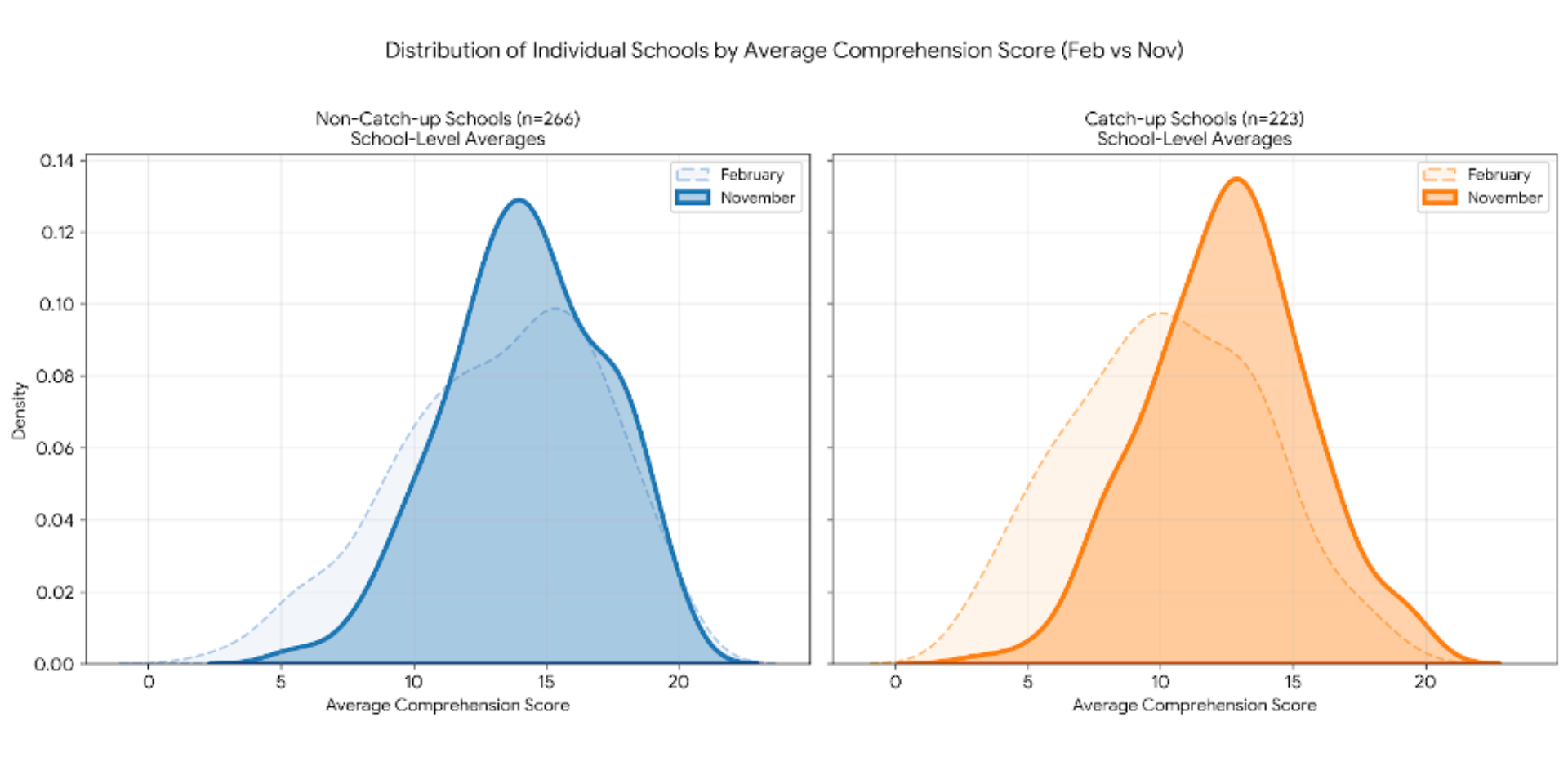
As importantly, school-level averages confirmed that the programme successfully corrected rural-urban inequities. Plotting the density of school averages from February to November 2025 reveals that the curve for underperforming catch-up schools shifted rightward and ‘bunched’ alongside the top-performing institutions. In other words, the programme lifted the floor for the entire region, marking a broader systemic success.
Figure 1. A comparison of average school reading performance
While control schools (left) remained steady, target intervention schools (right) showed strong forward progress, suggesting that the lowest-performing schools benefited the most from early intervention.
Rurality in Iringa is closely associated with poverty and with the use of KiHehe rather than Kiswahili at home. Reflecting these disadvantages, the proportion of second-grade learners identified for catch-up classes increased with remoteness, from just 8% in schools located within 10 kilometres of a district[3] headquarters (the largest urban centre in a district) to 29% in schools located more than 50 kilometres away.
Demonstrating the systemic impact of the programme, catch-up learners across all distance categories demonstrated substantial improvements in reading comprehension. As might be expected, the largest gains were recorded in schools closest to urban centres, where average comprehension scores increased from 9 to 13. However, learners in the most remote schools (those located more than 50 kilometres from an urban centre) also made strong progress, with average scores rising from 6.5 to 10. Importantly, 51% of all catch-up learners were enrolled in these remote schools, highlighting the programme’s ability to reach and improve learning outcomes for children facing the greatest educational disadvantage.
Furthermore, this approach had a gender-neutral impact. While girls maintained a slight historical baseline advantage, both boys and girls in the catch-up programme experienced similar rates of growth, confirming that the targeted approach did not inadvertently worsen traditional gender disparities.
Figure 2. Learning growth in invented-word decoding by gender
Both boys and girls enrolled in the catch-up classes achieved nearly identical growth from February to November 2025, suggesting that the programme supported equitable progress.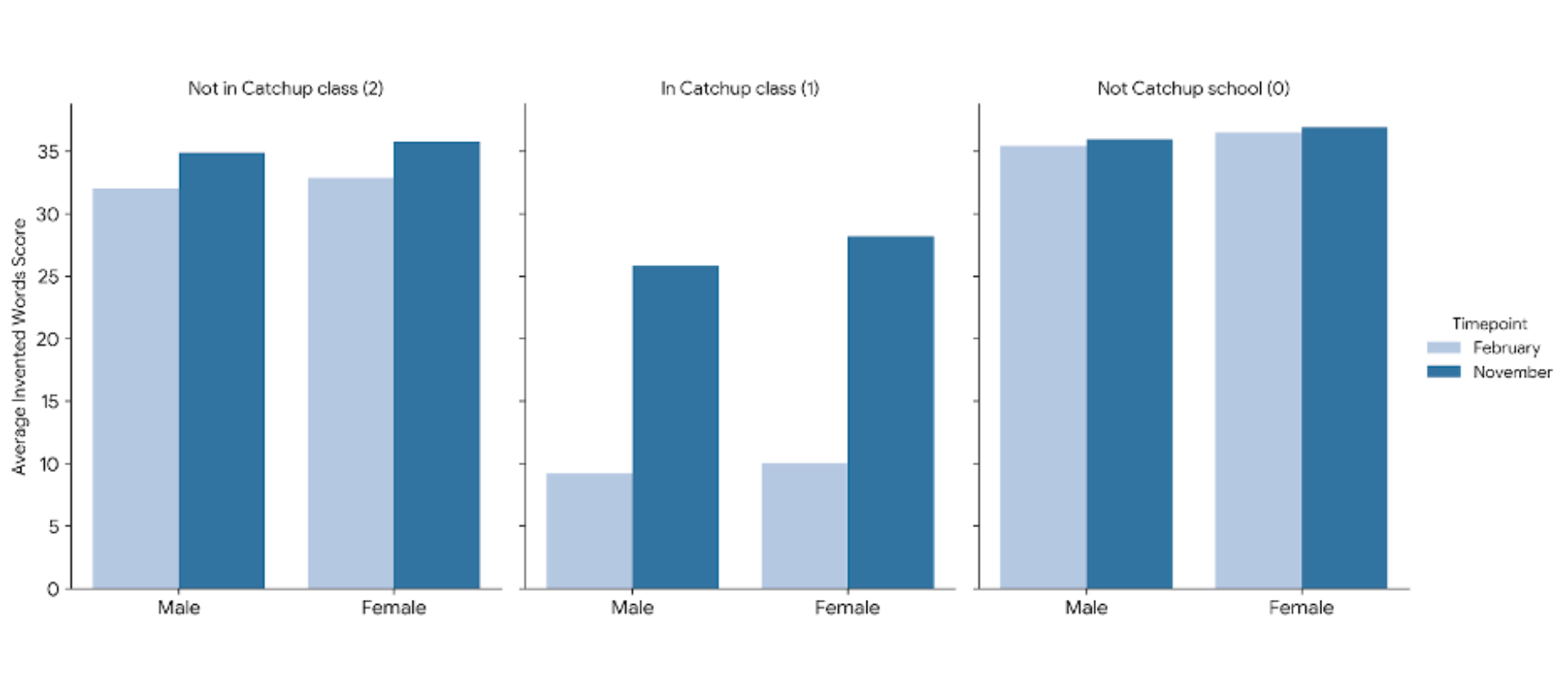
A model for institutional equity?
What makes the Iringa initiative intriguing is that it required three overlapping attitudinal changes to confront the reality that a minority of high-performing environments were masking stagnation elsewhere (Strigel et al., 2026).
A transformational shift in teacher attitudes
Giving children extra time to practice was only half the battle. The real magic happened because of a shift in teaching culture. Teachers changed their practice, including how they responded to mistakes. They stopped using errors as a reason to penalise students and started treating them as a natural part of learning. This changed the classroom dynamic. As students stopped fearing failure, they felt more supported, stayed persistent and, ultimately, learned to read.
“Teacher says Sawa, lakini jaribu hivi… Yes, but try this way… and shows me the right sound – I don’t feel bad because she smiles.
When I say moto instead of mto, teacher puts her finger under the letter and we fix it together.”
Grade 2 learner describing teacher feedback (Tawi Consult., 2025)
Caregiver and community engagement
Attitudinal change was achieved outside the classroom as well. Armed with continuous assessment data, teachers could work directly with parents and caregivers to build a support system for vulnerable learners. Through low-cost outreach strategies, including invitations to observe sessions, progress notes sent home and in-person demonstrations of Tangerine data to show concrete gains, over 90% of learners said that their parents encouraged them to attend the catch-up classes.
“The teacher called me and showed me on the tablet how my daughter moved from not knowing letters to reading words. I now make sure she attends every day.”
Mother, focus group discussion (Tawi Consult., 2025)
Local communities and school committees were inspired by the visible progress among students and began to play an active role in sustaining the programme. Today, parents collaborate to fund and replace worn-out reading kits, provide meals for after-school sessions and work with schools to reduce student absenteeism.
While most learners made progress, around 12% of those enrolled in the catch-up programme did not improve on either the invented-word or comprehension assessments. Nevertheless, these children were not overlooked – they were identified through the programme and received targeted attention from teachers, schools and district officials. Teacher interviews suggest that many of these children faced significant barriers beyond the classroom, including domestic violence, caregiver absence due to work, nomadic lifestyles and undiagnosed learning difficulties. In one remote school, two learners remained in the Letter Sound group because one was experiencing family separation and the other had suspected learning difficulties. Although specialist support was unavailable locally, district officials worked with parents to identify appropriate assistance. In another school, a learner’s frequent absence to herd goats prompted the teacher and school committee to engage with the family in order that the child could attend school more regularly. These examples illustrate that catch-up programmes can do more than improve learning outcomes – they can help schools identify children at greatest risk of being left behind and mobilise support to address the barriers limiting their learning.
Strategic regional oversight
Scaling this equity-driven model required deliberate, institutional backing from educational leadership. The Iringa RAO recognised that learning inequities could be addressed through carefully targeted additional support and committed to funding the use of GALA twice a year and to using the data to identify struggling schools.
This provided the structure, direction and district-level attention needed for schools and teachers to succeed. The key attitudinal change was the willingness of leadership to direct resources towards learning inequities, regardless of the context in which those inequities originated.
A call to action
Iringa has stepped up and shown that learning inequity does not have to be permanent. With the right data, early identification and a supportive classroom culture, every child can become a reader. Educators and policymakers should not wait for high-stakes exams in later grades to identify children who are struggling. They should look at data early and shift attention away from the high performers and towards those who are falling behind before it is too late.
References
Abdul Latif Jameel Poverty Action Lab. (2022, August). Teaching at the Right Level to improve learning. https://www.povertyactionlab.org/case-study/teaching-right-level-improve-learning
Annie E. Casey Foundation. (2010). Early warning! Why reading by the end of third grade matters. https://www.aecf.org/resources/early-warning-why-reading-by-the-end-of-third-grade-matters [this is a report]
King, S., Betts, K., Rodd, A., & Neupane, S. (2022). Is generalized impact of learning outcomes explained by positive deviance? The challenge of social norms on the scaling of early grade reading programs. Research on Improving Systems of Education. https://riseprogramme.org/sites/default/files/inline-files/Is%20Generalized%20Impact%20of%20Learning%20Outcomes%20Explained%20by%20Positive%20Deviance.pdf
RTI International. (n.d.) Final report: Reading recovery activity. https://static1.squarespace.com/static/6514416d40a14750441d84ed/t/697cc13ab706cc7fbddd7eb1/1769783610155/ReadingRecoveryActivity_FinalReport_31Dec_25.pdf
Strigel, C., Tibenda, J., Rodd, A., & King, K. M. (2026, June 8). Tanzania Reading Recovery Activity. SharEd. https://shared.rti.org/tanzania-reading-recovery-activity
Tawi Consult (2025, November) Final Performance Evaluation of the Reading Recovery Activity (unpublished final draft)
[1] Iringa region, located in Tanzania’s Southern Highlands, has a rural economy centred on smallholder farming and a GDP per capita slightly higher than the national average. Although the district has a low poverty rate, 65% of households live just above the poverty line and face a risk of transitory poverty.
[2] In Iringa, learners with disabilities are supported in special needs schools. These schools were not included in this programme.
[3] The Iringa region has five administrative District, which for education administration are sub-divided into wards. Each ward has between 3 and 6 primary schools.



Discover more
What we do
Our work will directly affect up to 3 million children, and reach up to 17 million more through its influence.
Who we are
A group of strategic partners, consortium partners, researchers, policymakers, practitioners and professionals working together.
Get involved
Share our goal of literacy, numeracy and other key skills for all children? Follow us, work with us or join us at an event.