
Blog
‘Systems strengthening’ in education: A core components approach
Michelle Kaffenberger
Kaffenberger, M. 2026. ‘Systems strengthening’ in education: A core components approach. What Works Hub for Global Education. Blog. BL_2026/016. https://doi.org/10.35489/BSG-WhatWorksHubforGlobalEducation-BL_2026/016
That foundational learning is low in many countries is now widely acknowledged. In addition, there is growing consensus on approaches that can improve learning outcomes, with structured pedagogy and targeted instruction both considered ‘Great Buys’ by the Global Education Evidence Advisory Panel (GEEAP). In the context of declining ODA and tight fiscal conditions, there is increasing emphasis among funders and donors on strengthening government systems, rather than direct delivery, to support improved learning outcomes. The burning question in many contexts today is how to support systems to design and deliver evidence-based policies and programmes to achieve improved learning outcomes at scale and through government systems.
At the What Works Hub for Global Education, we’ve been analysing the evidence to identify the core components of targeted instruction and structured pedagogy1– the components that are most essential for achieving impact at scale and in government systems. Core components support systems strengthening and implementation at scale in at least three ways.2 Core components help:
- Prioritise what is most important to build into the system
- Prioritise what is most important to measure to ensure impact
- Make the concept of systems strengthening more concrete.
Prioritising what is most important to build into the system
To identify the core components of teaching at the right level and structured pedagogy, we undertook a meticulous review of the evidence, including comparing treatment arms within studies and findings across studies to see how impacts differ depending on what is included in a programme’s package. To fill in gaps, we also spoke with implementers to include their perspective and expertise on priority components.
For teaching at the right level, we identified nine core components across three levels of the system that are the top priorities for achieving impact (Figure 1) (the core components of structured pedagogy are forthcoming).
Figure 1: Core components of teaching at the right level
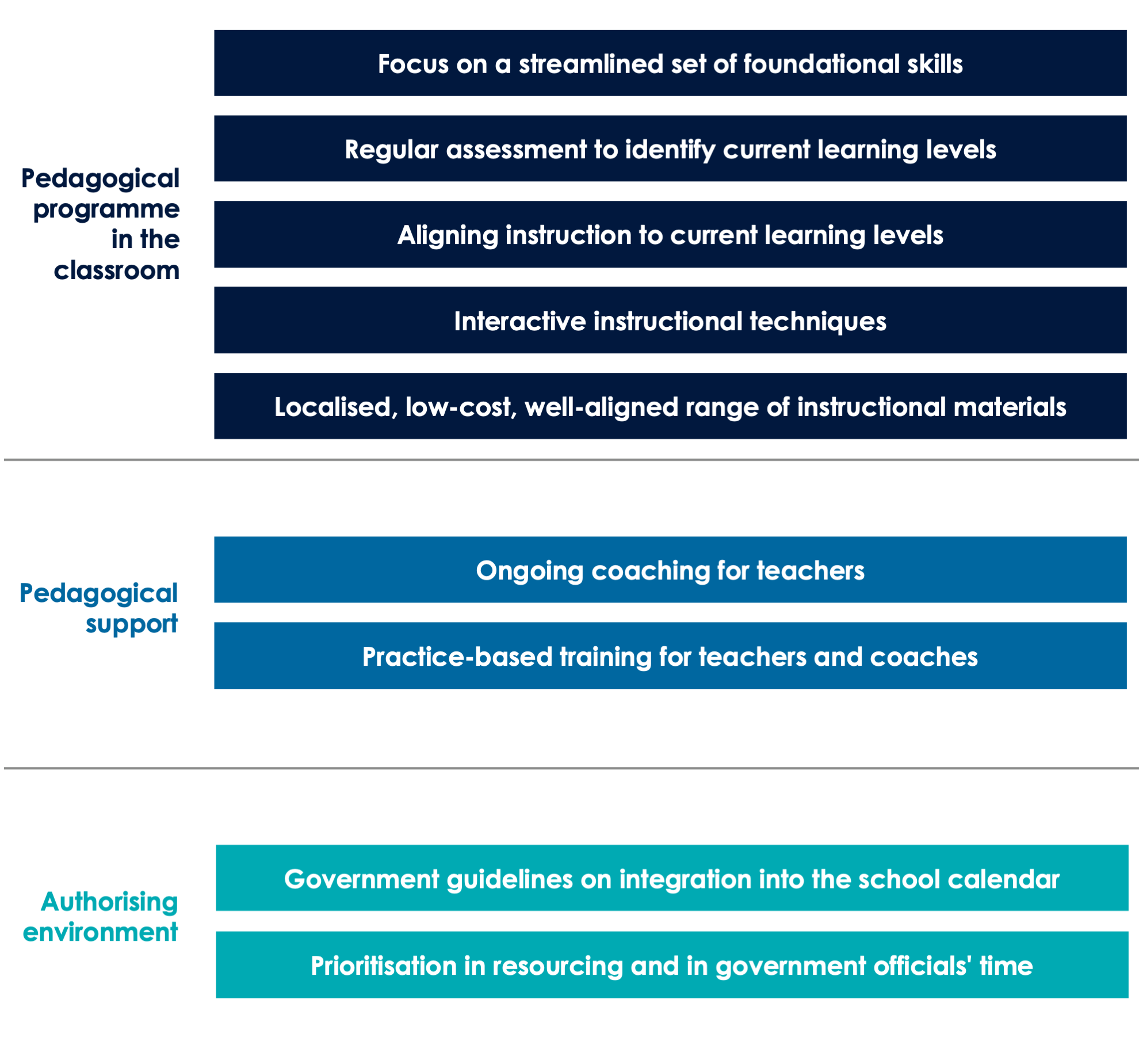
At the classroom level, teachers and facilitators need to focus on prioritised foundational skills, assess and group students to align instruction, implement interactive pedagogical techniques, and use localised materials adapted for their context. At the pedagogical support or middle tier level, practice based training and ongoing coaching for teachers are essential for impact. The latter is a particularly important finding: coaching tends to be relatively costly and challenging to administer, but comes through as essential for impact. We are working on a synthesis brief pulling together the latest evidence on innovations to coaching to make it more manageable in terms of both cost and feasibility.
Finally, at the authorising environment, political commitment comes through in the form of guidelines for integration into the school calendar, and prioritisation in resourcing and officials’ time to ensure effective implementation.
While these may seem relatively straightforward, they provide an important framework for reviewing policy plans to check if essential components are in place. In an informal review of World Bank project appraisal documents (PADs), for instance, we found variation in alignment with the core components. A Cambodia PAD focused on a teaching at the right level programme included most core components – providing a strong, evidence-based foundation. Core components can help further strengthen such plans: for instance, the Cambodia plans include diagnostic assessments, and core components help specify that those should be conducted regularly. Similarly, the plans include support for teachers, and core components specify that should be through regular, ongoing coaching.
Ensuring effective policy plans, which prioritise essential components, is a critical first step in strengthening systems to deliver quality learning for all children.
Prioritising what is most important to measure to ensure impact
The second way core components support education system strengthening is through helping to prioritise what to measure, monitor, and iterate to ensure and maximise impact. At the WWHGE, we have been developing a framework for measuring implementation, in support of improved implementation fidelity and impact. Aligned with this call for greater measurement of implementation, the core components help implementers, including government implementers, prioritise what to measure and thus pay most attention to.
Appendix D in the implementation measurement note provides an example of mapping an organisation’s existing monitoring tools to the core components. The mapping identifies gaps, where a core component is not currently captured and measured, and therefore indicators could be added. It also identifies components that are more than adequately captured and therefore indicators could be reduced or streamlined.
Core components also help prioritise what to act on for iteration and adaptation. In a recent collaboration with the Government of Ghana and the World Bank, we undertook implementation research to identify opportunities to improve implementation of a differentiated learning programme. Surveys and classroom observations identified a few areas for possible attention.
One was tightly aligned with a core component: Teachers were grouping students and aligning instruction less frequently than intended by the programme. This insight informed an A/B test aimed at improving implementation fidelity. We tested providing coaches with a simple checklist tool to check, and then support, teachers in their grouping and aligning instruction. The checklist yielded large results, increasing grouping frequency by 15 percentage points.
As a result of this iteration, both coaching and teachers’ grouping of students, two core components for effectiveness, were strengthened in support of improved government delivery and greater impact.
Making the concept of systems strengthening more concrete
Finally, core components make the concept of system strengthening more concrete. The current emphasis in the sector on strengthening systems to deliver quality education is well-deserved, but many discussions about system strengthening remain conceptual. Core components can help make those discussions – and plans – more concrete.
For instance, it would be widely agreed that strengthening teachers’ pedagogical techniques is an important element of systems strengthening for improved learning. But what does that mean in practice? In the context of an evidence-aligned remediation programme, the core components show the programme should include strengthening teachers’ ability to use regular assessment to align instruction to children’s learning levels and teach using interactive instructional techniques. And, supporting teachers to achieve this should involve practice-based training and ongoing coaching.
As another example, strengthened political commitment to improving foundational learning is a common feature of systems approaches. But how is that defined? The core components provide indicators that, again in the context of an evidence-aligned remediation programme, include government guidelines on integration into the school calendar and prioritisation in financial resources and government officials’ time. If these are in place, there is reasonable assurance that political commitment is strong, and if they are not, political commitment may need attention.
At the WWHGE, our intellectual framework prioritises ensuring policy plans are more evidence based, and that evidence-based policy plans in turn are implemented with fidelity. The core components support our work in these areas, and I hope they will help others as well to design strong policies and programmes, measure and iterate in support of implementation fidelity, and ultimately support strong education systems to deliver foundational learning for all children.
Footnotes
1. This link is for an early synthesis brief on the components of structured pedagogy; the full paper articulating the core components will come out in the next few months.
2. This blog draws from a presentation I gave on a CIES panel on systems strengthening alongside friends and colleagues Dhir Jhingran (Language and Learning Foundation), Ben Piper (Gates Foundation), Parmod Kumar (Government of Haryana), Jen Swift-Morgan (Prevail), and Dayoung Lee (Dalberg).
References
Africa Solutions Media Hub. (2025, November 5). ADEA Triennale 2025: Governments, philanthropy unite to end learning poverty. https://africasolutionsmediahub.org/2025/11/05/adea-triennale-2025-governments-philanthropy-unite-to-end-learning-poverty/
Anaman, A., Sabarwal, S., Masood, S., Angrist, N. & Spivack, M. 2026. Improving implementation while scaling: Differentiated Learning in Ghana. What Works Hub for Global Education. Insight note. RI_2026/003. https://doi.org/10.35489/BSG-WhatWorksHubforGlobalEducation-RI_2026/003
Angrist, N., Djaker, S., Ho, S., Kaffenberger, M., Romero, G. & Sturla, K. 2026. Measuring implementation in education. What Works Hub for Global Education. Insight note. RI_2026/005. https://doi.org/10.35489/BSG-WhatWorksHubforGlobalEducation-RI_2026/005
Angrist, N., Evans, D. K., Filmer, D., Glennerster, R., Rogers, H., & Sabarwal, S. (2025). How to improve education outcomes most efficiently? A review of the evidence using a unified metric. Journal of Development Economics, 172, Article 103382. https://doi.org/10.1016/j.jdeveco.2024.103382
Global Education Evidence Advisory Panel. (2023). 2023 cost-effective approaches to improve global learning: What does recent evidence tell us are “smart buys” for improving learning in low- and middle-income countries? World Bank Group. https://documents1.worldbank.org/curated/en/099420106132331608/pdf/IDU-977f73d7-22b1-4777-980c-c5a14598eef8.pdf
Hwa, YY., Kayton, H. L., and Kaffenberger, M. 2024. Implementing structured pedagogy programmes at scale. What Works Hub for Global Education. Synthesis brief, 2024/002. https://doi.org/10.35489/BSG-WhatWorksHubforGlobalEducation-RI_2024/002
International Development Committee. (2026). UK aid and development assistance in a fracturing world: Strengthening resilience and cooperation (HC 1835; Eleventh Report of Session 2024–26). UK Parliament. https://publications.parliament.uk/pa/cm5901/cmselect/cmintdev/1835/report.html
Kaffenberger, M., Angrist, N., Hwa, Y.Y., Kayton, H.L., Jukes, M. & Stern, J. 2026. Core components of teaching at the right level: Unpacking the black box of proven programmes into a set of ‘core components’ by systematically combining multiple sources of rigorous evidence with implementer insights. What Works Hub for Global Education Core Components Synthesis. 2026/001. https://doi.org/10.35489/BSG-WhatWorksHubforGlobalEducation-WP_2026/001
Mawejje, J. (2025). Fiscal vulnerabilities in low-income countries: Evolution, drivers, and policies. World Bank. https://doi.org/10.1596/978-1-4648-1968-1
UNICEF. (2025). Education aid cuts: A broken promise to children [Funding cut analysis]. https://www.unicef.org/documents/education-aid-cuts
World Bank. (n.d.). Country learning poverty briefs. Retrieved June 3, 2026, from https://www.worldbank.org/en/topic/education/brief/country-learning-poverty-briefs
People

Michelle Kaffenberger
Discover more

What we do
Our work will directly affect up to 3 million children, and reach up to 17 million more through its influence.
Who we are
A group of strategic partners, consortium partners, researchers, policymakers, practitioners and professionals working together.
Get involved
Share our goal of literacy, numeracy and other key skills for all children? Follow us, work with us or join us at an event.