
Blog
Closing the feedback loop: what large-scale classroom monitoring looks like in Ghana
Marco Valenza, Aliou Diallo, Guillermo Romero, Sam Ho and Christin McConnell
Valenza, M., Diallo, A., Romero, G., Ho, S. & McConnell, C. 2026. Closing the feedback loop: what large-scale classroom monitoring looks like in Ghana. What Works Hub for Global Education. Blog. BL_2026/014. https://doi.org/10.35489/BSG-WhatWorksHubforGlobalEducation-BL_2026/014
As countries work to strengthen foundational learning at scale, education policymakers face a critical question: how can new approaches reach every classroom while maintaining quality? Answering this question requires evidence generated where learning happens – in classrooms across the country.
Ghana’s Differentiated Learning Plus (DL+) programme provides a compelling example of how such evidence can be embedded into national education systems and what it takes to make that evidence actionable at the classroom level.
Building system-wide evidence on targeted instruction
DL+ is a targeted instruction initiative led by Ghana’s Ministry of Education and implemented in grades 2–6 across more than 500 schools in 50 districts, with plans to expand nationwide to 15,000 schools. Building on earlier Differentiated Learning pilots, DL+ has evolved into a more data-driven model that integrates real-time assessment data, play-based and Universal Design for Learning (UDL) approaches, and strengthened instructional support, especially for large class sizes. Based on this implementation experience, the Government of Ghana is now scaling DL+ nationwide as its core model for all public primary schools.
At the heart of this effort are real-time data systems. School Improvement and Support Officers (SISOs) and Headteachers regularly collect classroom monitoring data and student learning results using digital tools. The data are consolidated into a national dashboard accessible to decision-makers from the Ministry of Education in Accra down to school leaders across the country.
Over two school years, this system has generated a large amount of information on how students are progressing and, importantly, on the teaching practices shaping that progress. More than 8,300 classroom observations have been recorded, and data quality checks have confirmed its reliability. A few insights include:
- Coverage was universal – all DL+ schools recorded at least two classroom observations, though the frequency of visits did vary considerably across districts, with some receiving far more than others.
- The data show progress in foundational literacy and numeracy – by the end of the 2024–25 school year, the share of students reaching the highest proficiency level had grown from 33 to 42% in English and from 24 to 37% in maths.
Figure 1
Source: DL+ classroom observation forms, 2024–25.
Reach via large-scale monitoring systems is necessary, but not sufficient. Beyond coverage, the question becomes: how can observers, in this case SISOs or Headteachers, be supported to turn classroom observations into feedback that helps improve targeted instruction?
What observation feedback reveals
In addition to structured monitoring indicators, DL+ observers submit open-ended comments describing teacher strengths and areas for improvement. These entries are designed to guide coaching conversations between observers and teachers. A review of these comments reveals three things:
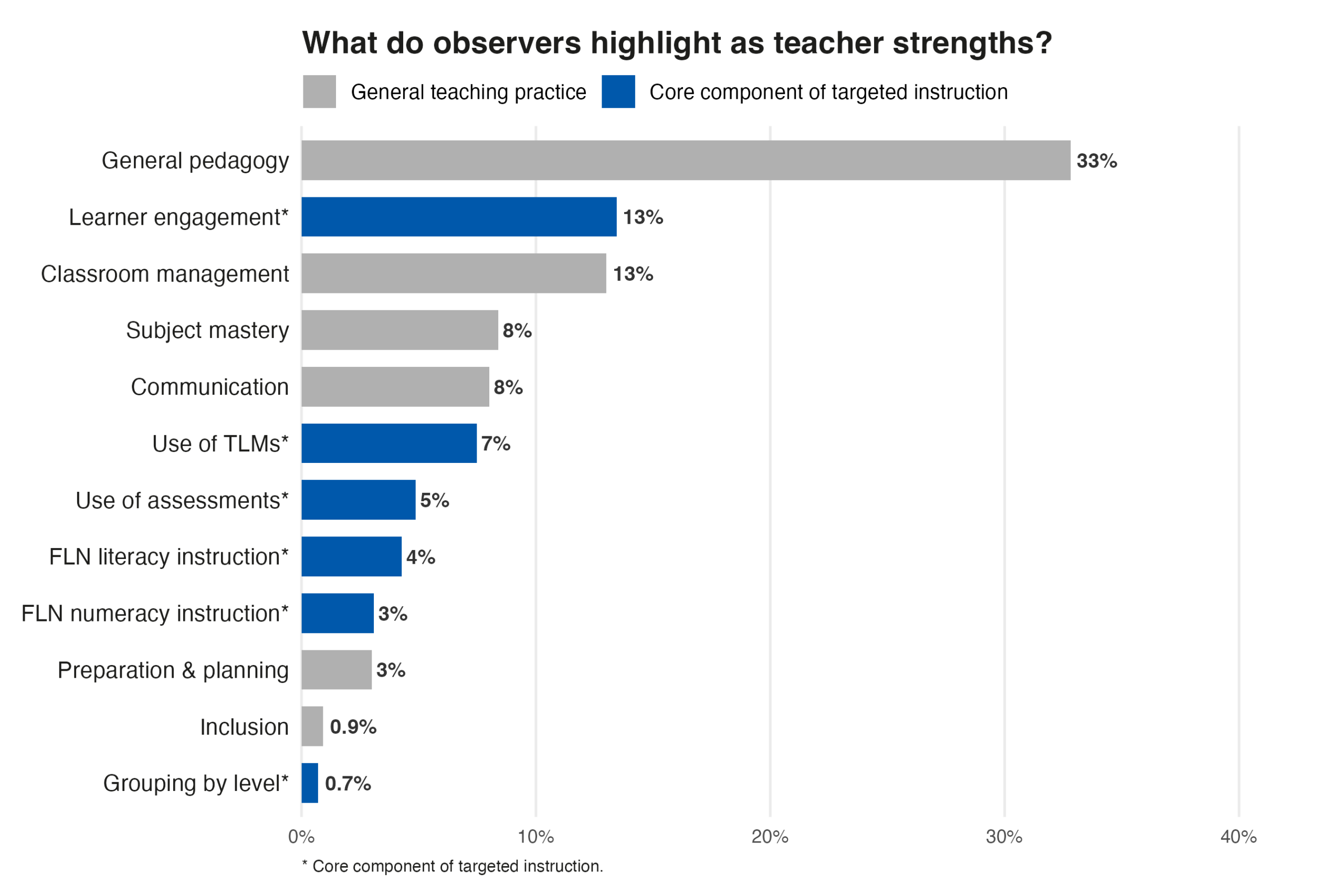
- Most feedback is pedagogically relevant. The vast majority of observer comments describe teaching practices observed in the classroom, from general pedagogy to classroom management and communication. However, as Figure 2 shows, about one in three observations specifically referenced a core component of targeted instruction.
- Among the core components, some appeared far less frequently than others (also seen in Figure 2). Most notably, grouping learners by level – a practice central to how DL+ works – was mentioned in fewer than 1% of comments describing teacher strengths, and was equally absent from improvement comments. Differentiating activities and ensuring inclusive instruction consistent with Universal Design for Learning principles were similarly underrepresented. This matters, as these are precisely the practices that, when implemented consistently, have been proven to drive learning gains.
Figure 2
Source: DL+ classroom observation forms, 2024–25.
- Improvement entries identified what needed to change but not how. Between 67 and 76% of improvement comments followed this pattern. For example, feedback often noted that teachers should improve ‘questioning’ or ‘writing’, but without suggesting concrete strategies to implement these adjustments – as illustrated from real quotes in the table below.
| Example 1: Questioning | Example 2: Written practice | Example 3: Modelling | |
|---|---|---|---|
| Partially actionable: 67-76% of entries |
‘Questioning skills’ | ‘Writing’ | ‘Delivery method’ |
| Actionable: 21-28% of entries |
‘Call different learners when teacher asks questions’
‘Limit chorus answers’ |
‘Allow the learners to write their example on the board to check their spellings’ | ‘Teacher should first demonstrate competencies before asking the pupils to practice’ |
Source: DL+ classroom observation forms, 2024–25.
These patterns suggest that while observers are often able to identify areas for improvement, translating these observations into actionable guidance remains a challenge.
From diagnostic evidence to actionable feedback
Ghana’s Ministry of Education has built an impressive data architecture for DL+, mobilising its field officers and school leaders to collect classroom observation data at scale. Teachers have also played a crucial role in this effort, administering individual assessments in crowded classrooms and entering results digitally despite time constraints and connectivity challenges.
As DL+ expands nationwide, the experience so far offers at least three lessons for strengthening system-embedded evidence so that it can inform local action.
- Operational support is what keeps the system running. Ensuring that field officers have reliable transport and clear targets for school visits is essential for maintaining consistent observation coverage. Simple tracking mechanisms, such as regular progress reports on visits conducted, can help identify schools receiving less coaching support.
- Observers need clear guidance on what to look for in targeted instruction classrooms. Open-text fields can provide rich insights that complement standardised monitoring indicators, but only if observers share a common understanding of the core practices they are expected to identify. These include differentiating activities by learning level, using level-appropriate materials, and supporting learners with special needs.
- Monitoring should translate into actionable feedback. Observation comments are most valuable when they guide concrete improvements in classroom practice. Simple, structured tools can help bridge that gap, particularly for some of the underrepresented core practices shown in Figure 2. For example, a coaching checklist developed in the context of Ghana’s DL scale-up targeting key practices such as grouping increased implementation fidelity by 15 percentage points, at a very low cost. Providing observers with structured guidance and regular feedback on the actionability of their reports can help strengthen the link between monitoring and instructional coaching.
Turning evidence into stronger learning
Embedding evidence generation into national education systems does more than produce data; it builds capacity. Over time, school leaders and field officers who collect and discuss classroom observations regularly develop a sharper eye for what high-quality targeted instruction looks like in practice, and a stronger ability to coach teachers toward it.
As this diagnostic capacity becomes integrated into regular coaching and supervision, monitoring systems can move beyond tracking implementation to actively improving it. In doing so, they help ensure that every classroom delivers on the promise of stronger literacy and numeracy for every child.
References
Anaman, A., Sabarwal, S., Masood, S., Angrist, N. & Spivack, M. 2026. Improving implementation while scaling: Differentiated Learning in Ghana. What Works Hub for Global Education. Insight note. RI_2026/003. https://doi.org/10.35489/BSG-WhatWorksHubforGlobalEducation-RI_2026/003
Arthur, A. 2025. Inspiring learning through Differentiated Learning Plus (DL+): Liberty’s story of innovation in Kumasi, Ghana. UNICEF Ghana. Blog post. 23 September 2025. https://www.unicef.org/ghana/blog/inspiring-learning-through-differentiated-learning-plus-dl
Kaffenberger, M., Angrist, N., Hwa, Y.Y., Kayton, H.L., Jukes, M. & Stern, J. 2026. Core components of teaching at the right level: Unpacking the black box of proven programmes into a set of ‘core components’ by systematically combining multiple sources of rigorous evidence with implementer insights. What Works Hub for Global Education Core Components Synthesis. 2026/001. https://doi.org/10.35489/BSG-WhatWorksHubforGlobalEducation-WP_2026/001
Sachdeva, S., Gombas, A. & Arthur, A. 2024. Tackling the learning crisis: Data-driven decision-making in Ghana’s education system. UNICEF Ghana. Article. 23 August 2024. https://www.unicef.org/ghana/stories/tackling-learning-crisis-data-driven-decision-making-ghanas-education-system
Discover more

What we do
Our work will directly affect up to 3 million children, and reach up to 17 million more through its influence.
Who we are
A group of strategic partners, consortium partners, researchers, policymakers, practitioners and professionals working together.
Get involved
Share our goal of literacy, numeracy and other key skills for all children? Follow us, work with us or join us at an event.