
Blog
Scaling a playful math curriculum to strengthen foundational numeracy: Introducing the ‘Every Child Counts’ Implementation Toolkit
Vatsala Sharma, Parikrama Chowdhry and Varsha Hari Prasad

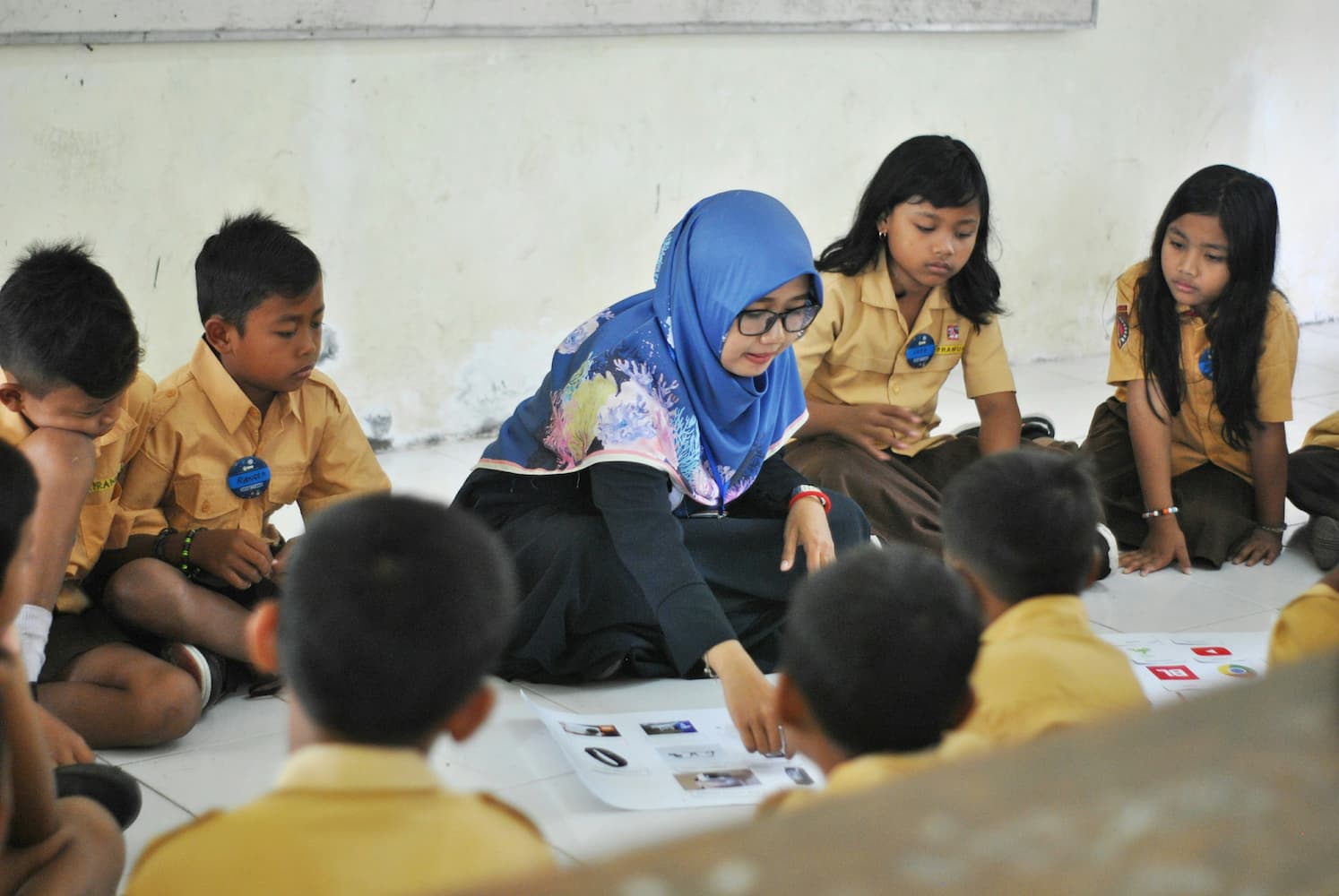
School children play the ‘number comparison’ math game in Delhi, India, in 2025. Photo credit: Matthew Edmundson, J-PAL
With a quick look, can you tell which of the following boxes has more dots?
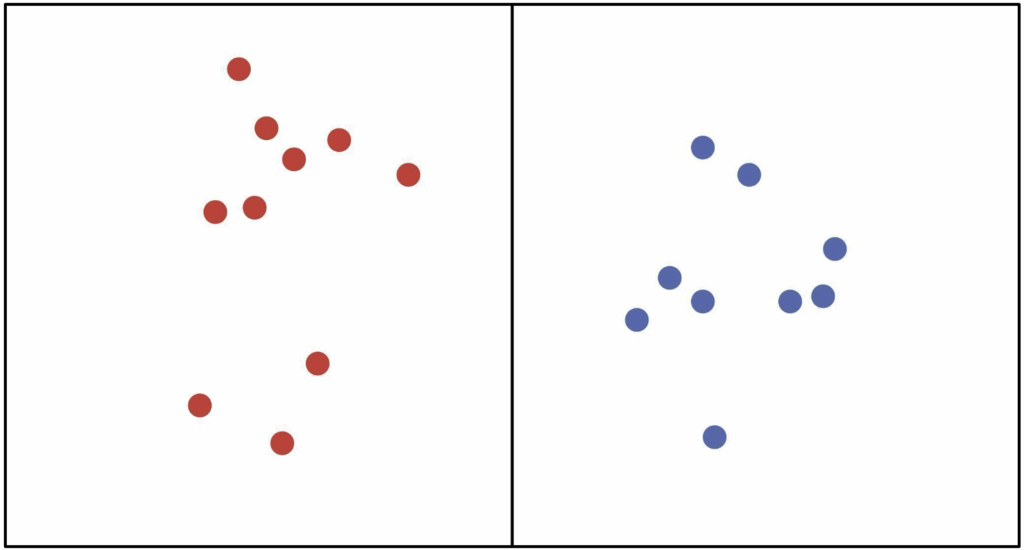
If you answered yes (and you answered ‘red’), that is correct – what you’ve just demonstrated is an example of intuitive or non-symbolic math. Research with infants provides evidence that they have an intuitive grasp of numbers, geometry and language, which grows over their preschool years.
An urgent crisis and a unique solution – math games
The world is facing an urgent foundational literacy and numeracy crisis, worsened by the Covid pandemic. As organisations and governments around the world mobilise to address this crisis, J-PAL South Asia has been working since 2020 to scale Every Child Counts, a unique curriculum that builds on 50 years of cognitive science research. It taps into young children’s intuitive, non-symbolic understanding of mathematics, skills they naturally possess, and helps bridge the gap to formal math taught in classrooms. These skills not only lay the groundwork for academic success but also develop cognitive abilities like logical reasoning, problem-solving, and analytical thinking that children carry far beyond the classroom.
This work has culminated in the launch of the Every Child Counts Implementation Toolkit: a practical guide grounded in J-PAL South Asia’s experience evaluating and scaling the curriculum across India. The toolkit was officially unveiled at the India Scale-Up Summit 2025, hosted by ASPIRE, where policymakers, practitioners and researchers convened to share insights on scaling evidence-based solutions.
The toolkit offers insights for governments, NGOs, funding agencies and other institutions into the curriculum’s theory and evidence, details on classroom implementation, key ingredients for successful scaling and more. Download the guide (PDF).
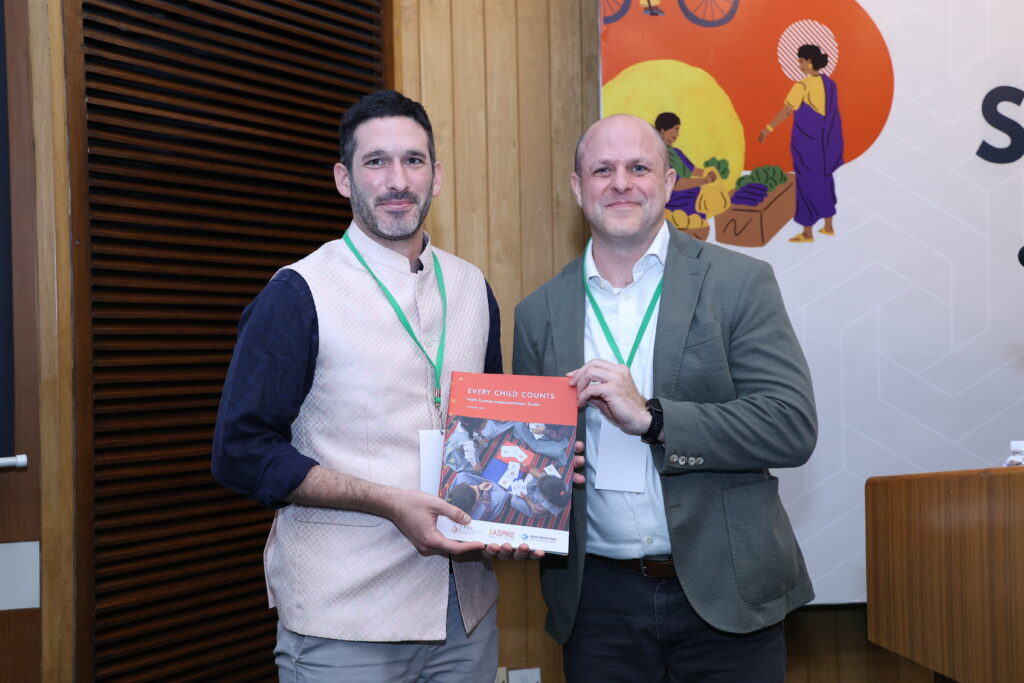
Noam Angrist, Academic Director of the What Works Hub for Global Education, and John Floretta, Global Deputy Executive Director of J-PAL, pose with the Every Child Counts Toolkit in Delhi, India in September 2025. Photo credit: J-PAL
At its core, the Every Child Counts curriculum consists of four math games played three times a week for less than an hour, and designed to be implemented in regular preschool and early primary classrooms. From 2019 to 2025, the curriculum reached over 33,000 children across 1,300 schools. By 2027, it is on track to reach nearly 40,000 schools and 500,000 students annually across four states in India through both government and NGO-led implementation. As Every Child Counts continues to scale, it’s becoming even more cost-effective, making it a powerful solution for governments, NGOs and donors seeking scalable solutions to the foundational literacy and numeracy crisis.
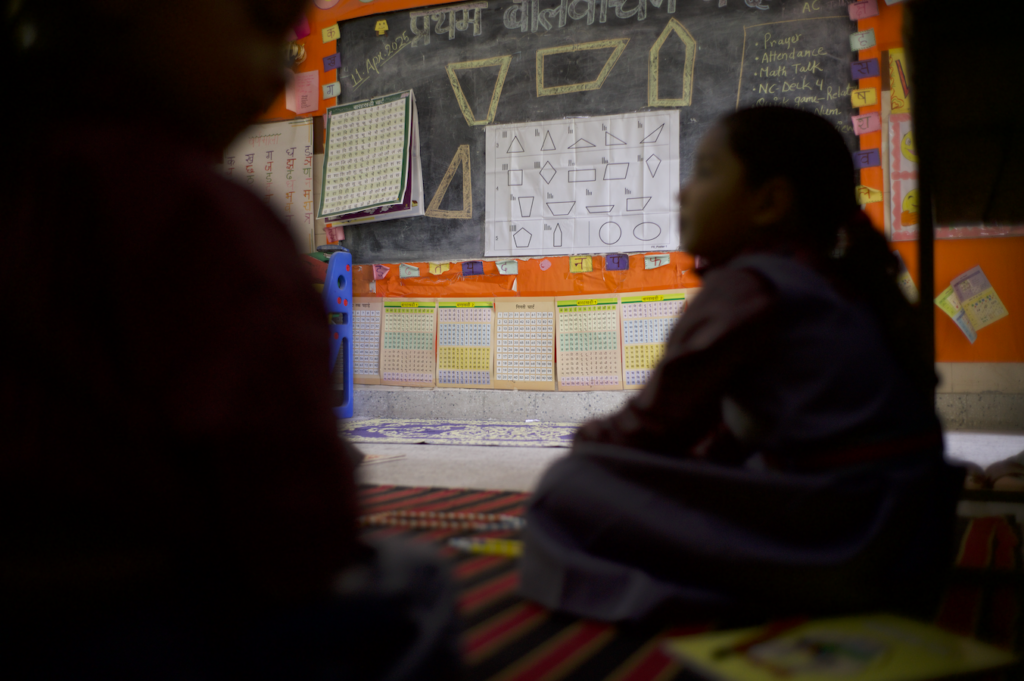
Instructions for the ‘Reading Maps’ math game are posted on the board of a classroom in Delhi, India in 2025. Photo credit: Matthew Edmundson, J-PAL
We invite you to explore the toolkit (PDF), share it with your networks, and consider how Every Child Counts could be adapted to your context.
What’s in the toolkit?
The toolkit is designed for a range of audiences, including:
- Explorers: Organisations and individuals seeking new programmes to implement and want to learn if Every Child Counts aligns with their goals and context. This includes senior government officials, NGOs aiming to expand their programming, donors etc.
- Programme owners: Strategic partners who will lead the programme (raising funds, building government partnerships, and managing implementation) in their geographies. This includes NGOs, governments and think tanks/consultants working with both.
- Programme implementers: Implementing organisations responsible for delivering Every Child Counts in collaboration with strategic partners. This includes operational, as well as monitoring and evaluation staff from governments and NGOs.
Inside the toolkit, you’ll find:
- The theory of change and evidence behind why Every Child Counts works
- A deep dive into the four math games and how they’re played
- Guidance on teacher roles and classroom materials
- Criteria to assess whether your context is a good fit for the programme, and insights into core elements that drive successful implementation and scale-up
- Insights from J-PAL South Asia’s experience scaling the curriculum through governments and NGOs
- Insights into major cost areas and how to embed them into government systems.
We extend our sincere thanks to the What Works Hub for Global Education for supporting the creation of this guide. We would also like to thank our funding partners: J-PAL’s Innovation in Government Initiative, USAID Development Innovation Ventures, and ASPIRE at J-PAL South Asia, for their sustained support in scaling Every Child Counts.
Interested in learning more? Contact:
Vatsala Sharma,
Policy Manager, J-PAL South Asia. vasharma@povertyactionlab.org
Sharma, V., Chowdhry, P. & Hari Prasad, V. 2025. Scaling a playful math curriculum to strengthen foundational numeracy: Introducing the ‘Every Child Counts’ Implementation Toolkit. What Works Hub for Global Education. Blog. 2025/028. https://doi.org/10.35489/BSG-WhatWorksHubforGlobalEducation-BL_2025/028



Organisation(s)

Discover more
What we do
Our work will directly affect up to 3 million children, and reach up to 17 million more through its influence.
Who we are
A group of strategic partners, consortium partners, researchers, policymakers, practitioners and professionals working together.
Get involved
Share our goal of literacy, numeracy and other key skills for all children? Follow us, work with us or join us at an event.