
Blog
How to best target remedial instruction? Precise proficiencies
Noam Angrist
Angrist, N. (2026). How to best target remedial instruction? Precise proficiencies. What Works Hub for Global Education. https://doi.org/10.35489/BSG-WhatWorksHubforGlobalEducation-BL_2026/023
There is growing interest in scaling evidence-backed targeted instruction approaches. The approach has been tested in several countries, pioneered initially in India, and spreading to Ghana, Botswana, Zambia, Madagascar, among many other countries. When implemented with high fidelity, the approach consistently generates large and cost-effective learning improvements.
What is the best way of implementing this effective approach in practice? This piece draws on the latest evidence and experience to inform this question and operationalise several core components. Governments are trying different ambitious models at scale which are increasingly integrated into national structures, including efforts in the Philippines, Rwanda, Cambodia, and Ghana, leading the way for sustainable scale models.
How targeted instruction works
The idea behind targeted instruction is profound yet simple: rather than teach a once-size-fits-all grade-level curriculum which is often pitched beyond student’s zone of proximal development (eg teaching division in grade 4 when only 15% of students can do division and many cannot even do basic addition), teach to their actual learning level.
In practical terms, this means assessing children’s learning quickly and cheaply, seeing what they know and don’t know, regrouping classrooms by learning level rather than grade, and teaching to this level. This repeats on a dynamic cycle, ideally every 15-30 days, so students rapidly and regularly progress, rather than getting stuck at one level, and often occurs during a dedicated hour during the school day.
Figure 1: Dynamic regular assessment and grouping
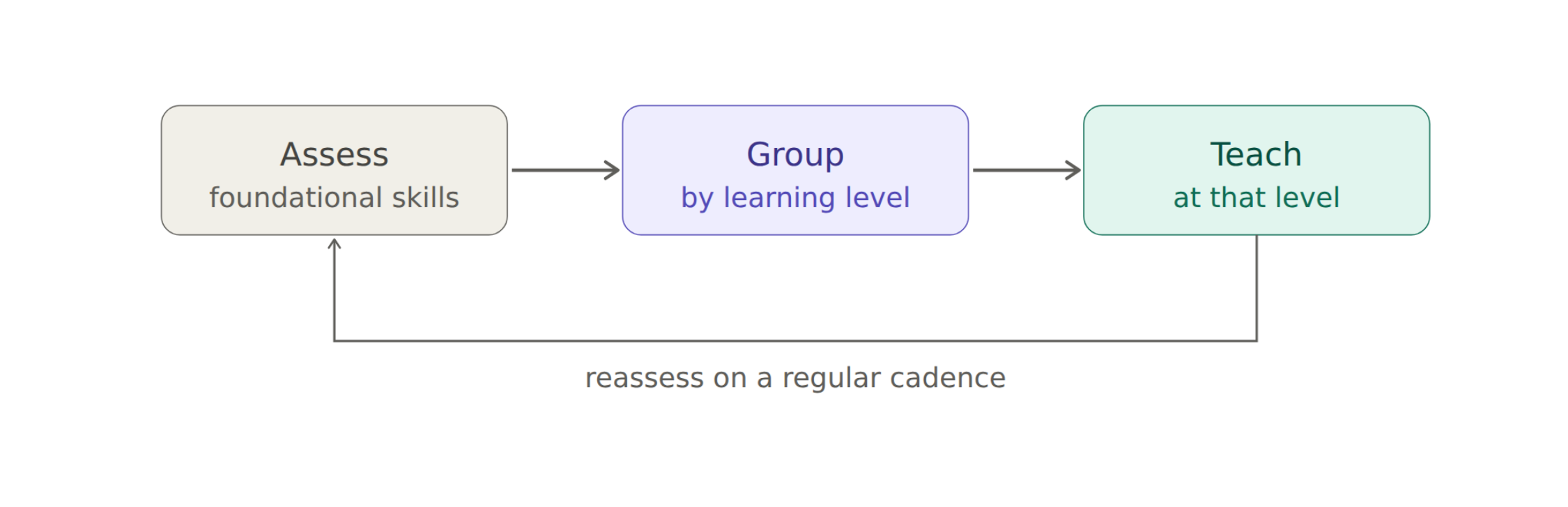
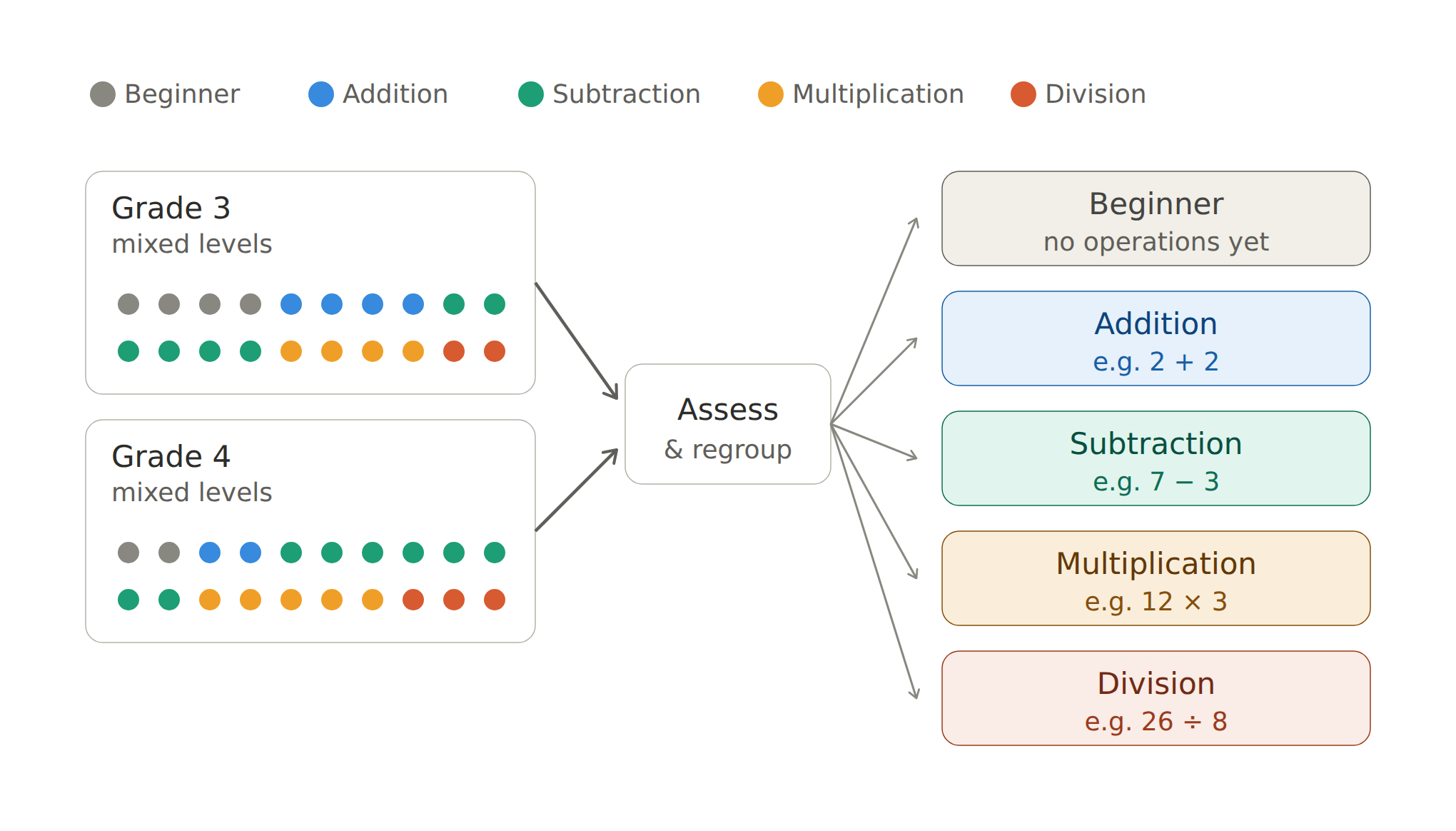
So, instead of a Grade 3 and 4 class, you might now have an ‘addition’ or a ‘subtraction’ class. Ideally, tests and grouping are done rapidly and dynamically, enabling continued progress. Table 1 and Figure 1 visualise this approach, moving from grade-level instruction – with many students behind grade-level expectations and with a lot of heterogeneity in learning level – to targeted instruction – with students taught at their actual learning level and in a more homogenous group.
Table 1: Targeting instruction shifts instruction from grade (horizontal) to level (vertical)
| No operations | Addition | Subtraction | Multiplication | Division | |
| Grade 3 | 20% | 20% | 30% | 20% | 10% |
| Grade 4 | 10% | 10% | 40% | 25% | 15% |
Figure 2: Visualising the shift from grades to levels
Governments are trying multiple models to operationalise this evidence-backed principle in ways that leverage existing systems and structures. Some of the most essential classroom core components of this approach are:
- Focus on a streamlined set of foundational skills
- Regular assessment to identify current learning levels
- Aligning instruction to current learning levels (eg grouping students by levels)
Making the best assessment
In terms of assessment, to operationalise these core components, one could use an existing exam (eg exams already baked into the national education system) or a bespoke tailored exam (eg ASER or EGRA or a specific subset of items from these tests). If one is using an existing exam, it is best to ensure the exam is focused on a consistent set of foundational skills and to retrieve test item-level information to facilitate precise proficiency-based grouping. If this is not possible, it might make sense to introduce a new test which focuses on foundational skills, can be done quickly and cheaply, and can enable retrieval of item level information to facilitate proficiency based grouping. When deploying assessments to target instruction, the typical approach increasingly used by governments often leverages existing exams due to cost and integration with system structures. Below we list recommendations to design and deploy the best assessment.
Table 1: Typical assessment attributes and recommendations to maximise targeted instruction
| Typical Assessment Attributes | Recommendations for assessment and grouping |
| Covers many skills (eg geometry, etc.) | Focus on foundational skills (eg basic operations) |
| Once-off or annual | Dynamic and regular (eg termly or bi-termly) |
| Broad test scores bands (eg < 50 or > 50) | Specific item levels and precise proficiency groups to differentiate and target instruction (eg ‘addition’ , ‘subtraction’ , ‘multiplication’ , ‘division’ ) |
Making the link: from assessment to grouping
Any targeted instruction reform would be a positive step, but for those minded to make the approach work best, below are several practical recommendations for grouping. While grouping based on broad-based cutoff scores (eg < 50% = group 1) has been shown to be effective in some cases, dynamic, regular, precise proficiency-based grouping focused on foundational skills is the most pressure-tested model. (eg ‘addition’ groups which quickly progress to ‘subtraction’ ). Rather than a few coarse groups, it is best to have as many groups as possible, to try to proxy specific proficiencies based on scores, or, ideally, to use specific test items to create precise proficiency groups. Figure 3 and Table 2 visualise a continuum of grouping approaches. In practice, proxy proficiencies might be the most scalable approach (similar to proxy means testing in social protection), but where possible, grouping based on precise proficiencies is optimal.
Figure 3: Multiple models to target instruction
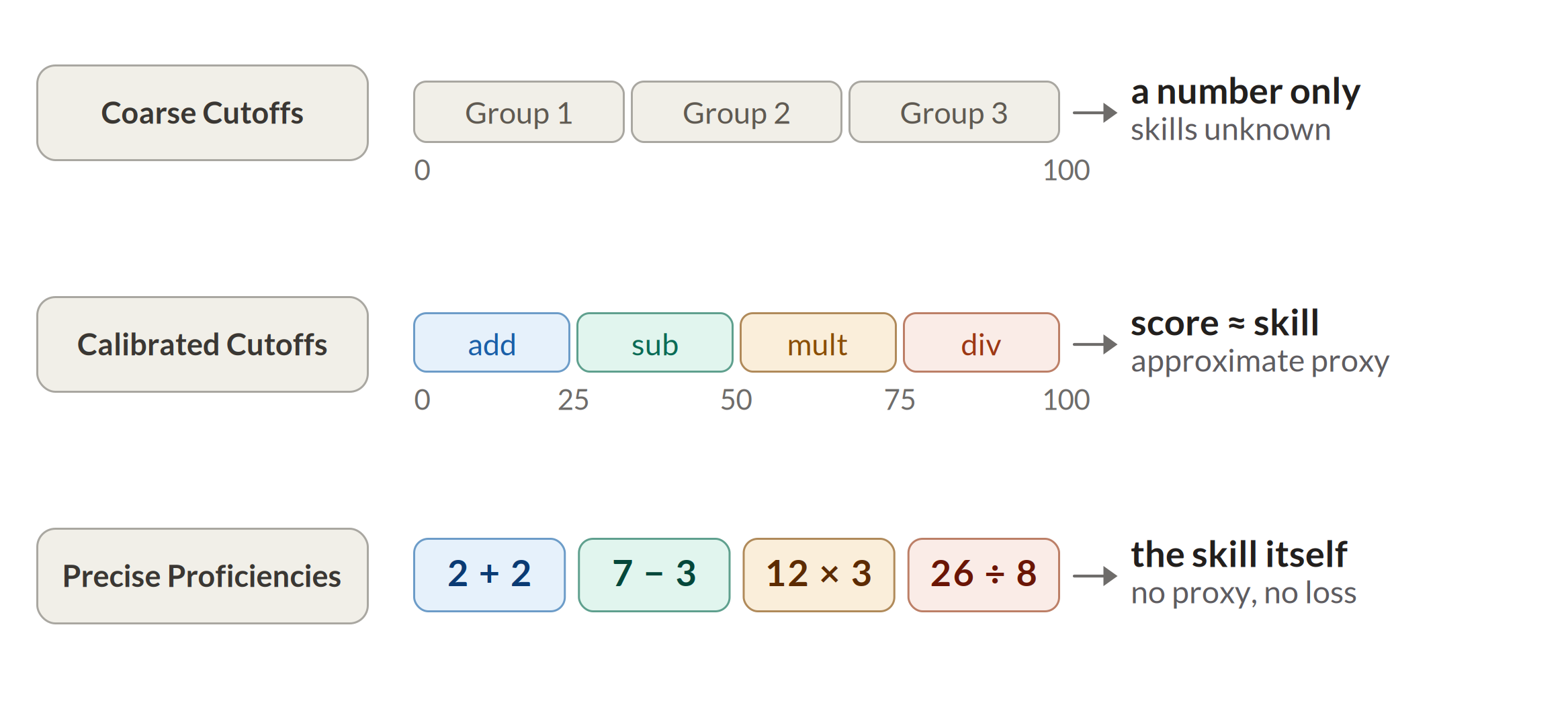 Table 2: The many ways to assess and group
| Approach | Assessment cutoff or item | Resulting group |
| Coarse cutoffs
Coarse cutoffs yield fewer groups so differentiation could still be challenging; proficiency and learning objectives are not as clear |
< 33 | Group 1 |
| 33–66 | Group 2 | |
| > 66 | Group 3 | |
| Calibrated cutoffs
Calibrated cutoffs (or proxy proficiency) groups generate more differentiation; proxy proficiencies can clarify foundational skills focus |
< 25 | ≈ Addition |
| 25–50 | ≈ Subtraction | |
| 50–75 | ≈ Multiplication | |
| > 75 | ≈ Division and up | |
| Precise proficiencies
Precise proficiency groups grouping and instruction generates the most differentiated groups and clearest focus on a set of specific foundational skills |
2 + 2 | Addition |
| 7 − 3 | Subtraction | |
| 12 × 3 | Multiplication | |
| 26 ÷ 8 | Division |
Tips and Tools
As the movement to scale targeted instruction continues to take off, several tools and guides have been made available, including example assessments in numeracy and literacy. Resources also include overviews, webinars, overall guidance, a suite of resources, and detailed guides. The examples in this piece focused on numeracy, but similar principles apply in literacy.
If you or a partner, especially in the context of large-scale and sustainable government rollouts, is interested in technical assistance to operationalise any of these principles, please reach out and we will connect you with our teams working on this topic as well as partners working at the cutting edge of targeted instruction at scale.
References
Abdul Latif Jameel Poverty Action Lab (J-PAL). n.d. Teaching at the right level (TaRL) webinar series. https://www.povertyactionlab.org/page/teaching-right-level-tarl-webinar-series
Anaman, A., Sabarwal, S., Masood, S., Angrist, N. & Spivack, M. (2026). Improving implementation while scaling: Differentiated Learning in Ghana. What Works Hub for Global Education. https://doi.org/10.35489/BSG-WhatWorksHubforGlobalEducation-RI_2026/003
Angrist, N. & Meager, R. (2023). Implementation matters: Generalising treatment effects in education. What Works Hub for Global Education. https://doi.org/10.35489/BSG-WhatWorksHubforGlobalEducation-WP_2023/001
Banerjee, A.V., Cole, S., Duflo, E. & Linden, L. (2007). Remedying education: Evidence from two randomized experiments in India. Quarterly Journal of Economics 122(3): 1235–1264. https://academic.oup.com/qje/article-abstract/122/3/1235/1879525
Banerjee, A., Banerji, R., Berry, J., Duflo, E., Kannan, H., Mukerji, S., Shotland, M. & Walton, M. (2017). From proof of concept to scalable policies: Challenges and solutions, with an application. Journal of Economic Perspectives 31(4): 73–102. https://www.aeaweb.org/articles?id=10.1257/jep.31.4.73
Brookings Institution. (2023). Scaling teaching at the right level (TaRL) in Botswana. https://www.brookings.edu/wp-content/uploads/2023/05/Scaling-TaRL-in-Botswana-_-Report-_-Web.pdf
Duflo, E., Dupas, P. & Kremer, M. (2011). Peer effects, teacher incentives, and the impact of tracking: Evidence from a randomized evaluation in Kenya. American Economic Review 101(5): 1739–1774. https://www.aeaweb.org/articles?id=10.1257/aer.101.5.1739
Global Partnership for Education. n.d. Rwanda: Supporting students to stay on track through remedial education. Blog. https://www.globalpartnership.org/blog/rwanda-supporting-students-stay-track-through-remedial-education
Innovations for Poverty Action. n.d. Differentiated learning. https://poverty-action.org/differentiated-learning
Kaffenberger, M., Angrist, N., Hwa, Y.Y., Kayton, H.L., Jukes, M. & Stern, J. (2026). Core components of teaching at the right level: Unpacking the black box of proven programmes into a set of ‘core components’ by systematically combining multiple sources of rigorous evidence with implementer insights. What Works Hub for Global Education. https://doi.org/10.35489/BSG-WhatWorksHubforGlobalEducation-WP_2026/001
Maruyama, T. & Igei, K. (2024). Community-wide support for primary students to improve foundational literacy and numeracy: Empirical evidence from Madagascar. Economic Development and Cultural Change 72(4). https://www.journals.uchicago.edu/doi/full/10.1086/726178
Pratham. n.d. Teaching at the right level. https://www.pratham.org/about/teaching-at-the-right-level/
Republic of the Philippines. (2024). Republic Act No. 12028, Academic Recovery and Accessible Learning (ARAL) Program Act. https://lawphil.net/statutes/repacts/ra2024/ra_12028_2024.html
TaRL Africa. n.d. The TaRL approach. https://teachingattherightlevel.org/the-tarl-approach/
TaRL Africa. n.d. TaRL classroom methodology. https://teachingattherightlevel.org/the-tarl-approach/tarl-classroom-methodology/
TaRL Africa. n.d. Where we support: Zambia. https://teachingattherightlevel.org/where-we-support/zambia/
TaRL Africa. (2024). Cinyanja literacy assessment tool (Set 1–3). https://teachingattherightlevel.org/wp-content/uploads/2025/06/CINYANJA-LITERACY-ASSESSMENT-TOOL-SET-1-3-2024.pdf
UNICEF. n.d. Teaching at the right level (TaRL). Foundational Literacy and Numeracy Hub. https://www.unicef.org/flnhub/teaching-right-level-tarl
UNICEF. n.d. Teaching at the right level: Module 1. Foundational Literacy and Numeracy Hub. https://www.unicef.org/flnhub/media/2071/file/Module1.pdf.pdf
What Works Hub for Global Education. n.d. Teaching at the right level. https://www.wwhge.org/resources/teaching-at-the-right-level/
World Bank. (2025). Cambodia Basic Education Improvement Project (P508313): Project appraisal document. Report No. PADHI01117. Washington, D.C.: World Bank. https://documents1.worldbank.org/curated/en/099081225092029814/pdf/BOSIB-d8efcebf-ebaf-4a92-b398-ff854a89e457.pdf
Angrist, N. (2026). How to best target remedial instruction? Precise proficiencies. What Works Hub for Global Education. https://doi.org/10.35489/BSG-WhatWorksHubforGlobalEducation-BL_2026/023
People

Noam Angrist
Discover more

What we do
Our work will directly affect up to 3 million children, and reach up to 17 million more through its influence.
Who we are
A group of strategic partners, consortium partners, researchers, policymakers, practitioners and professionals working together.

Get involved
Share our goal of literacy, numeracy and other key skills for all children? Follow us, work with us or join us at an event.