
GEDSI blog
What implementation science misses without teachers with disabilities
Emma Cameron, Katie Godwin and Nidhi Singal
Cameron, E., Godwin, K. & Singal, N. 2026. What implementation science misses without teachers with disabilities. What Works Hub for Global Education. Blog. BL_2026/024. https://doi.org/10.35489/BSG-WhatWorksHubforGlobalEducation-BL_2026/024
Inclusive education policy has rightly focused on expanding access and improving learning for all students, including those with disabilities. But this focus has overlooked a critical dimension of inclusion: teachers themselves. The gap is highlighted in a recent report by the Learning Generation Initiative, the Cambridge Network for Disability and Education Research (CaNDER) and the University of Cambridge, A Missing Link for Inclusive Education.
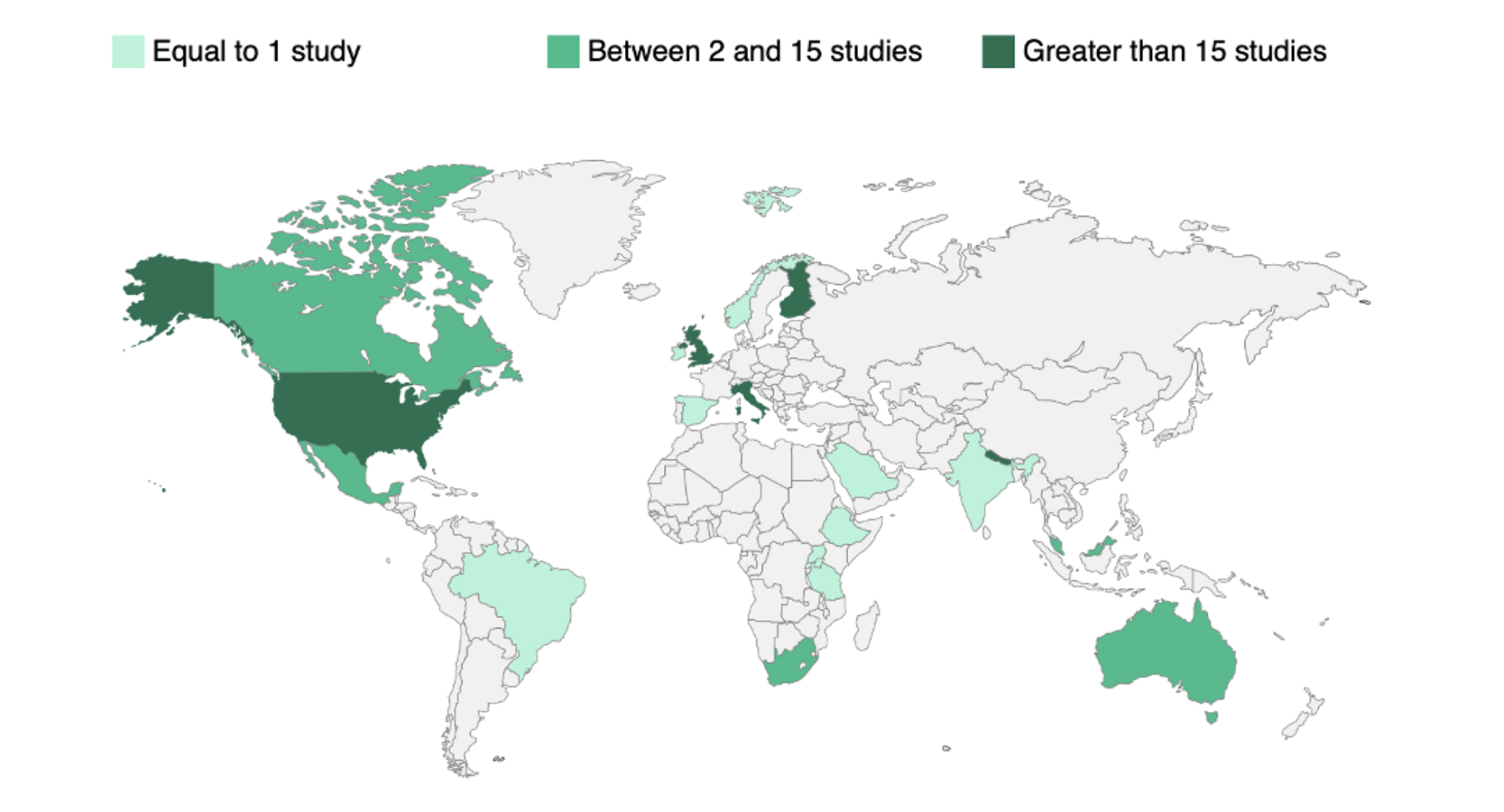
The report presents a literature review of a total of 87 articles that had a focus on teachers with disabilities working in mainstream settings and those undertaking teacher preparation programmes (covering 1990–2024). The review highlights a disproportionate concentration of research within specific regions, such as North America and Western Europe, with a notable gap in evidence from low- and middle-income countries as shown in figure 1.
Figure 1: Number of studies on teachers with disabilities by country (1990–2024)
The report supplemented the literature review with an analysis of global frameworks, and a review of datasets and education policies across seven countries – India, Kenya, Ghana, Tanzania, Rwanda, Sierra Leone and South Africa – to examine the inclusion of teachers with disabilities in national education planning.
The report argues that teachers with disabilities remain ‘a missing link’ – present in education systems, yet largely invisible in policy, data systems, and workforce planning. This invisibility has implications far beyond workforce equity. It also creates a gap for implementation science research. The What Works Hub for Global Education defines implementation science as understanding how evidence-based education reforms are implemented, adapted and scaled effectively in real-world systems. Teachers are at the centre of implementation, but they are not a homogenous group. Overlooking teachers with disabilities limits our understanding of how reforms are experienced across diverse contexts, what barriers emerge during implementation, and what adaptations are needed for interventions to succeed at scale. Including teachers with disabilities in implementation science research therefore strengthens both the design of interventions and the evidence needed to improve implementation over time. If teachers are the primary implementers of instructional reforms and education interventions at scale, then overlooking disability within the teaching workforce limits our understanding of how implementation works in practice, crucially when efforts are geared towards development inclusive education systems.
Make the workforce visible
One of the clearest messages from the report is that teachers with disabilities often go unseen. While education management information systems (EMIS) often track students with disabilities, far fewer systems collect consistent data on teacher disability status. Where data do exist, definitions vary and reporting is inconsistent.
This absence is consequential. Without disability-disaggregated data on teachers, it is hard to understand whether reforms reach the full workforce or to identify barriers shaping how they are delivered. It obscures patterns in recruitment, retention, and access to professional development, limiting our ability to design inclusive implementation strategies – ultimately leaving some teachers and learners behind.
Without data on disability, teachers with disabilities are unlikely to be meaningfully involved in designing and assessing inclusive interventions.
Implementation conditions shape who can implement
Implementation frameworks often examine ‘context’ – including school climate, leadership support, infrastructure, and resources. However, these conditions are not experienced equally across the workforce.
Consider professional development programs delivered in inaccessible venues, printed materials that cannot be used with assistive technologies, or digital platforms incompatible with screen readers. In such cases, challenges in intervention adoption or fidelity may be attributed to teacher capacity or resistance, when in fact they stem from design choices that fail to account for workforce diversity.
The report highlights the lived experiences of teachers with disabilities, documenting stigma, inaccessible infrastructure, limited accommodations, and exclusion from leadership pathways. As Fevan, a teacher from Ethiopia, explains, ‘infrastructural inaccessibility is the core barrier which hinders participation and success’ (p.42).
Evidence from Tanzania’s MEWAKA (Teachers’ Continuous Professional Development) programme reinforces this point. Research found that digital materials and online platforms were not fully accessible to teachers with visual and hearing impairments, and participation often depended on informal peer support rather than inclusive design. When inclusion is not considered and built in from the outset, implementation can exacerbate existing inequalities.
Scaling and the risk of reproducing exclusion
Scaling education interventions often prioritise efficiency, standardisation, and cost-effectiveness. Yet without attention to workforce diversity, scaling can unintentionally reproduce exclusion.
The report highlights barriers across the teacher pipeline – from entry into pre-service training to progression into leadership roles – that limit the participation of teachers with disabilities in decision-making spaces. This matters because leadership shapes implementation climate, interprets policy, and sustains reform. When teachers with disabilities are excluded from leadership pathways, opportunities to normalise inclusive practices and challenge stigma are diminished.
Disability, is in itself not a homogeneous category. While the challenges faced by teachers with disabilities in Rwanda were around accessing school due to associated extra costs, in Sri Lanka teachers with visual impairments highlighted the significant lack of access to adaptive and accessible teaching and learning materials. Disability also intersects with other dimensions of inequality. For example, women with disabilities in the teaching workforce may also face gender-based discrimination, and even violence from students. However, research has rarely examined these intersections in depth. For research to be GEDSI-informed, it must ask: Do implementation and scale-up strategies reproduce existing biases and exclusions within the workforce?
Without deliberate attention to these dynamics, scaling risks reinforcing the very inequities that inclusive education seeks to dismantle.
Methodology matters
The report also highlights an important evidence gap. In many contexts, there are limited data on teachers with disabilities and little research examining their experiences. As a result, teachers with disabilities often remain invisible in both policy and research.
This matters for implementation science research. Without disability-disaggregated data on teachers, researchers cannot examine whether outcomes differ for teachers with disabilities or identify barriers that affect programme uptake, participation and sustainability. Therefore, quantitative studies should, where feasible, collect and analyze disability-disaggregated data among teachers.
At the same time, many of the barriers described in the report – including stigma, informal discrimination, and unsupportive school leadership – are unlikely to be captured through quantitative measures alone. Participatory and qualitative approaches are essential for understanding how and why implementation succeeds or breaks down in different contexts.
Participatory methodologies, in particular, offer a pathway to move beyond studying teachers with disabilities as subjects of research toward engaging them as co-creators of knowledge. Teachers with disabilities are critical for identifying barriers to intervention uptake, suggest adaptations that improve accessibility, and highlight challenges that may otherwise be overlooked during programme design and delivery.
Accessibility must also extend to the research process itself. Surveys, consent procedures, training, and dissemination formats should be designed to ensure that teachers with disabilities can meaningfully participate. Research teams also benefit from greater inclusion of researchers with disabilities, whose perspectives can strengthen both design and interpretation.
Rethinking inclusion in implementation science
The central message of A Missing Link for Inclusive Education is that teachers with disabilities are essential to achieving genuinely inclusive systems. They serve as role models and advocates for students, challenge stigma, and expand perceptions of who can lead and teach. These ripple effects, as Paramjeet, a teacher from India says, ‘Will also encourage and motivate students with disabilities to be committed and dream to be like us’ (p.50).
These findings also have important implications for implementation science research.
Without disability-disaggregated data, researchers cannot understand whether interventions are reaching and supporting the full teaching workforce, identify implementation barriers experienced by teachers with disabilities, or determine where adaptations are required. This limits the ability of implementation science to generate practical evidence that strengthens programmes as they are delivered and scaled. This has implications not only for inclusive education policy, but for our understanding of how education reform succeeds or fails. Recognising teachers with disabilities presence, experience, and impact is not peripheral to scaling change. It is central to understanding how change happens in real systems that seek to provide quality education for all.


Discover more

What we do
Our work will directly affect up to 3 million children, and reach up to 17 million more through its influence.
Who we are
A group of strategic partners, consortium partners, researchers, policymakers, practitioners and professionals working together.
Get involved
Share our goal of literacy, numeracy and other key skills for all children? Follow us, work with us or join us at an event.