
Blog
Shaping the future of education through a world better led, served and governed: the case for evidence labs
Michael Lundgren, Donika Dimovska, Samuel Kembou, Yasmine Bekkouche and Rachel Hinton
Lundgren, M., Dimovska, D., Kembou, S., Bekkouche, Y. & Hinton, R. 2025. Shaping the future of education through a world better led, served and governed: the case for evidence labs. What Works Hub for Global Education. Blog. 2025/026. https://doi.org/10.35489/BSG-WhatWorksHubforGlobalEducation-BL_2025/026
The current international aid environment demands a focus on evidence and impact. This was made clear at the recent Education World Forum (EWF) in London – the world’s largest gathering of education and skills ministers – where data and evidence use emerged as a defining theme. At a time of declining aid, when governments need innovative solutions to maximise the impact of their investments, the Jacobs Foundation and the What Works Hub for Global Education discussed with ministers an innovative model: Education Evidence Labs (EdLabs).

What are EdLabs?
EdLabs are policy labs for education. Juan Hernandez, senior director of Innovations for Poverty Action’s Embedded Labs Program, provided an overview in conversation with the What Works Hub for Global Education on the sidelines of EWF. ‘What we want to address is how we can bring data and evidence into the decision-making process of the government’, he said. ‘Embedded Labs generate evidence about what works and what doesn’t work [in education], and that evidence is used by governments to implement policies at scale.’ As noted in Angrist et al. (2025), ‘Edlabs prioritize function over form, taking on diverse organizational setups, such as physical spaces and personnel embedded within government agencies or close evidence brokering relationships in a tightly knit government-research-nonprofit partnership.’
EdLabs respond to context
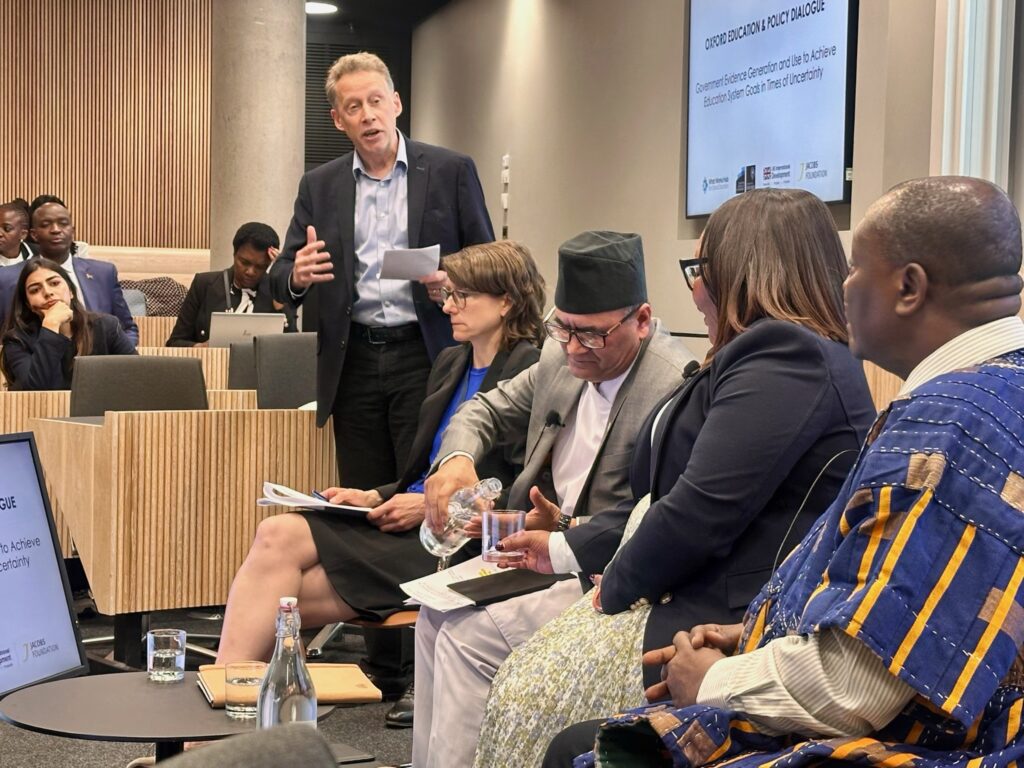
One key principle of EdLabs is that they are responsive to country context. For instance, the Jacobs Foundation’s ‘EdLabs Alignment Framework’ recommends that before defining its main activities, an EdLab must conduct a context analysis and stakeholder mapping. The context-sensitive flexibility of the EdLabs model was highlighted at a post-EWF event: the Oxford Education and Policy Dialogue panel ‘Shaping the future of education: through a world better led, served and governed’, which was co-sponsored by the Jacobs Foundation and the Hub and hosted at the Blavatnik School of Government. Panellists from Ghana and South Africa illustrated how EdLabs can be tailored to meet specific country needs.
Ghana’s Education Evidence and Data Lab
Ghana’s Ministry of Education is launching an EdLab, called the Ghana Education Evidence and Data Lab or GEEDLab, to solve education data problems unique to Ghana. Speaking at the Oxford Education Forum, Professor George Oduro, technical advisor to the Minister of Education, laid out the ministry’s goal: ‘To establish a very strong digital ecosystem that will support quality basic education.’ Ghana’s education data currently sits in siloes. It is not uncommon to find the ministry’s management information system providing one number for a statistic like enrollment, while the Ghana Education Service provides an entirely different number.
The ministry envisions a future in which, as Prof. Oduro put it, ‘At the click of a button in the minister’s office or in a head teacher’s office, [we] will be able to see all the [education] data.’ Ghana’s exposure to strategic partners in the What Works Hub for Global Education, including the Jacobs Foundation, is helping the Ministry of Education build data synergies so that policy and classroom practice can draw on the same data and evidence base.
Ghana provides an example of how governments can identify key issues then responsively design their EdLab. Ghana’s Ministry of Education designed their GEEDLab to break down information siloes and make efficient use of data. South Africa, meanwhile, has identified foundational learning as a key government priority. An EdLab embedded in the Department of Basic Education (DBE) delivers in-house research, monitoring and evaluation services for education interventions.
South Africa: A national focus on foundational learning
South Africa’s EdLab, the Research Coordination, Monitoring and Evaluation Directorate, reflects the government’s main priority: improving foundational literacy and numeracy. Intentionally embedded in the Department of Basic Education, the EdLab is an autonomous entity and trusted source of information. When data sources provide conflicting results, like dropout rates which differ between household surveys and administrative records, the EdLab can reconcile these discrepancies, validate the data, and translate findings into action. Honorable Minister of Basic Education Siviwe Gwarube, speaking at the Oxford Education Forum, said she values the EdLab’s autonomy because it empowers the team to communicate difficult truths: ‘They will talk to us about how interventions that [the DBE] have put money behind are not working.’ This ensures that changes in implementation can be made to improve value for money.
The EdLab suggests reforms based on local and global evidence of best practice. Crucially, though, having the EdLab within the department means the researchers understand the South African context. ‘They are able to go to provinces and go into schools,’ said Honorable Minister Gwarube. ‘They can see…[if there are] contextual differences in certain provinces,’ and then tailor solutions accordingly. South Africa’s EdLab is therefore well-positioned to help the government maximise its investments in foundational literacy and numeracy.
Ministers call for greater investment in research
The world is waking up to the need for data and evidence in education policy. Honorable Minister Gwarube put it best: ‘In a context of stagnating economic growth and shrinking public resources, gone are the days when interventions can be led by the whims of politicians. They need to be led by evidence.’ The Jacobs Foundation and What Works Hub for Global Education are leading the way, enabling the voices of Ministers to be heard with their call for greater investment in data and research in high-visibility settings like the Education World Forum. As Ghana and South Africa’s experiences prove, EdLabs provide a flexible model for catalysing reform and turning research evidence into policy action.
Lundgren, M., Dimovska, D., Kembou, S., Bekkouche, Y. & Hinton, R. 2025. Shaping the future of education through a world better led, served and governed: the case for evidence labs. What Works Hub for Global Education. Blog. 2025/026. https://doi.org/10.35489/BSG-WhatWorksHubforGlobalEducation-BL_2025/026





Discover more

What we do
Our work will directly affect up to 3 million children, and reach up to 17 million more through its influence.
Who we are
A group of strategic partners, consortium partners, researchers, policymakers, practitioners and professionals working together.
Get involved
Share our goal of literacy, numeracy and other key skills for all children? Follow us, work with us or join us at an event.