
GEDSI blog
From reflection to routine: embedding gender responsiveness in foundational learning
Shweta Singh
Singh, S. 2026. From reflection to routine: embedding gender responsiveness in foundational learning. What Works Hub for Global Education. Blog. BL_2026/006. https://doi.org/10.35489/BSG-WhatWorksHubforGlobalEducation-BL_2026/006
Efforts to advance gender equality, disability and social inclusion (GEDSI) in education often begin with intention: new policies, revised curricula or sensitisation workshops. Yet at scale, these intentions frequently stall at the point of practice. In foundational literacy and numeracy (FLN), where classroom routines are fast-paced and deeply habitual, equity is shaped less by stated commitments than by everyday decisions – who speaks, who is encouraged, whose absence is unnoticed, and what is treated as ‘normal’ in teaching and mentoring spaces.
Language and Learning Foundation (LLF) is an education non-profit working to strengthen FLN in government schools in India by partnering directly with state and district education systems. LLF supports teachers, academic mentors and institutions such as the State Institute of Educational Management and Training to improve classroom practice through teacher professional development, mentoring structures and learning materials. Central to LLF’s approach is the belief that lasting change must travel through existing public systems, rather than being implemented alongside them.
As LLF’s work expanded across multiple states, it became clear that improving learning outcomes alone does not automatically address deeper inequities in participation, voice and classroom culture. Gender norms – often operating implicitly – shape how authority is exercised, how learners are positioned and how opportunities are distributed, particularly in the foundational years. Addressing these dynamics requires more than conceptual agreement; it requires understanding how gender responsiveness can be implemented within the real constraints of large public systems. This realisation led LLF to frame gender not as an add-on theme, but as an implementation challenge.
What is Demo-G?
To explore this challenge, LLF initiated Demo-G – the Demonstration with a Gender Perspective. Demo-G is not a stand-alone project or a parallel programme. It is a pilot demonstration embedded within LLF’s regular foundational literacy and numeracy work, designed to learn what it takes to integrate a gender perspective into everyday teaching, mentoring and system routines at scale.
Implemented in real government settings – such as Niyamatabad Block in Uttar Pradesh – Demo-G works with existing system actors: teachers, head teachers, academic mentors and block- and district-level officials. Rather than delivering a finished ‘model’, the demonstration functions as a learning site. Early activities, including teacher orientations, are treated as diagnostic and formative spaces to surface readiness, resistance and the institutional conditions that shape practice.
Crucially, Demo-G does not assume that gender responsiveness can be achieved through one-time sensitisation. Instead, it examines how norms around authority, discipline, participation and care interact with school routines and professional hierarchies – and how these can be gradually reshaped.
Gender as an implementation problem
At the centre of Demo-G is a simple but often overlooked insight: conceptual agreement does not reliably translate into professional practice. In high-pressure institutional environments, ideas remain abstract unless they are absorbed into routines, supported by relationships and reinforced through feedback and review mechanisms.
LLF therefore approached Demo-G using principles aligned with implementation science – particularly iterative adaptation and rapid-cycle learning. Rather than protecting a fixed design, the team adapted facilitation strategies, sequencing and prompts in response to what unfolded on the ground, while holding steady to the intent of gender responsiveness.
This orientation towards ‘learning’ allowed LLF to observe how gender norms operate in real classrooms and training spaces, and to refine design choices that could realistically travel through the system.
Learning before scaling: why we began with orientation, not training
LLF’s gender journey has unfolded alongside large-scale foundational literacy and numeracy system support in multiple states. Early internal reflections made one thing clear: conceptual agreement on gender did not automatically translate into professional practice – for our teams or for system actors.
In response, we began with light-touch orientations rather than prescriptive training. These orientations were designed as diagnostic spaces to surface how gender norms operate in everyday professional life: who speaks, who hesitates, how authority is exercised and which inequities are normalised as ‘discipline’ or ‘procedure’.
This framing was central to the Demonstration with Gender Perspective (Demo-G) pilot in Niyamatabad Block, Chandauli district, Uttar Pradesh.
A moment from the field: the Demo-G teacher orientation
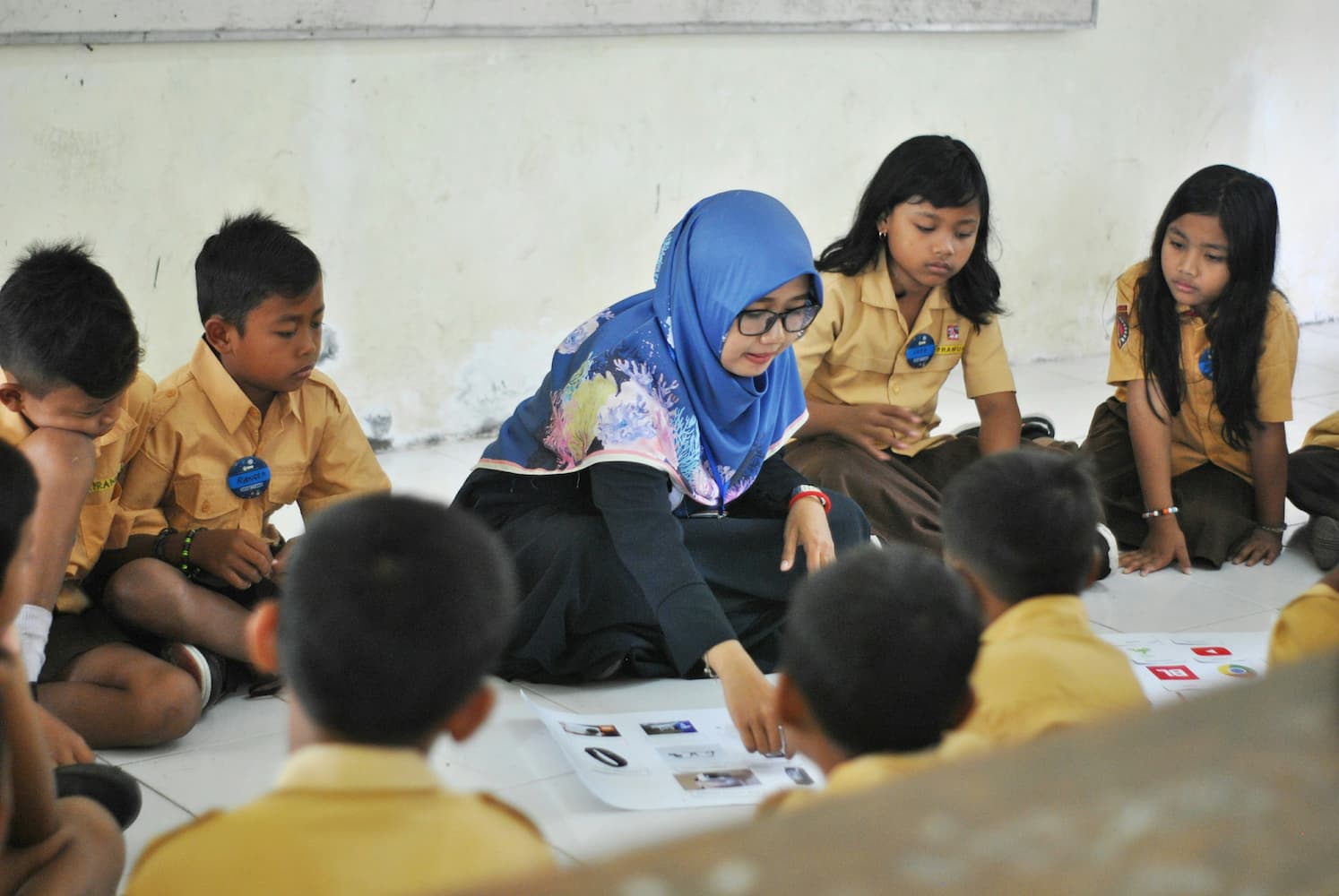
In March 2025, LLF conducted a two-day gender-responsive orientation with 440 government schoolteachers and head teachers (Grades 1–3) in Niyamatabad. The orientation was not intended to ‘teach gender concepts’ but to understand how teachers interpret fairness, participation and authority within their classrooms. Several moments during the orientation proved formative.
Mixed-gender seating, introduced as a routine facilitation practice, generated immediate resistance – often articulated through the language of classroom order and discipline. Notably, similar guidance was accepted when voiced by male officials but openly questioned when articulated by women facilitators, revealing how gendered authority operates even among educators. Male participants often depicted linear life trajectories with few constraints, while women teachers marked multiple points of restriction – around mobility, education and domestic responsibility. These differences did not surface through direct questioning, but through structured reflection sessions.
At the same time, engagement deepened when discussions were anchored in concrete classroom practices: who answers questions, how groups are formed, which examples are used in teaching materials. Gender, when connected to pedagogic decision-making rather than moral positions, provoked less defensiveness and more curiosity.
Adapting in real time: iterative learning as implementation practice
Crucially, the orientation design did not remain fixed.
Across batches, the facilitation team engaged in iterative, practice-based learning, drawing on systematic observation, participant responses and daily facilitator debriefs rather than post-hoc evaluation alone. After each batch, facilitators documented reflections on engagement levels, resistance points, group dynamics and psychological safety. These observations – triangulated with participant questions and discussion patterns – served as qualitative evidence to inform rapid adaptations. Activities were re-sequenced, group sizes adjusted and reflective prompts reframed in response.
One notable shift was changing the closing question from “What will I change?” to “What support do I need to bring change?” This adaptation emerged from repeated observations that participants expressed intent but struggled to act within institutional constraints. Reframing the question redirected reflection from individual resolve to organisational conditions and enablers, deepening analytical engagement.
These were not cosmetic tweaks. They reflected a deliberate practice of adaptive implementation, aligned with implementation science principles that prioritise feasibility, relevance and uptake while holding steady to the intent of gender responsiveness. This approach also shaped facilitator deployment. Pairings were adjusted based on observed room dynamics and language fluency, and local team members with established relationships were brought into facilitation roles where trust and credibility proved critical for participation.
From classroom learning to system leverage: the role of the middle layer
While the teacher orientation surfaced how gender norms operate at the classroom level, it also clarified a structural reality: teachers do not change practice in isolation. Their everyday decisions are shaped by mentoring cycles, observation routines and the expectations set by the academic middle layer. Academic facilitators across state, district and sub-district levels play a pivotal role in strengthening teacher capacity and sustaining quality classroom practice.
In Uttar Pradesh, this middle layer includes institutions such as District Institute of Education and Training and Academic Resource Persons – government-appointed academic mentors who support teachers through classroom observation, feedback and training cascades. Academic Resource Persons function as the connective tissue between policy intent and classroom practice.
Recognising this, LLF began engaging State Institute of Educational Management and Training not only as a training partner but also as a co-design collaborator. Rather than delivering a fixed module, LLF and State Institute of Educational Management and Training jointly discussed how gender responsiveness could realistically enter existing training architectures, time allocations and mentoring expectations.
These conversations became a form of institutional advocacy. Through iterative dialogue and alignment, additional training time was negotiated for Academic Resource Persons – creating space to deepen reflection rather than compressing gender into token sessions. This alignment unexpectedly opened new pathways: the work expanded beyond the original schedule, as planned into district- and block-level engagements, eventually leading to 2-day sessions on gender-inclusion as part of dedicated Academic Resource Persons training in all districts.
This progression illustrates a core implementation insight: scale is enabled not only by design quality, but by institutional alignment and ownership within the system’s middle layer.
What the orientation revealed about scale and readiness
The Demo-G orientation offered several insights that continue to shape LLF’s approach:
- Readiness varies by role and context. Head teachers, early-grade teachers and mentors engage differently with gender reflection, requiring differentiated pathways rather than uniform training.
- Resistance is often structural, not ideological. Appeals to ‘rules’ or ‘discipline’ frequently mask discomfort with shifts in power or proximity.
- Reflection precedes practice but does not guarantee it. Observable routines – seating, questioning, task allocation – are more reliable indicators of inclusion than stated beliefs.
- Authority and identity matter. Who facilitates, how they speak, and how they are positioned within the system significantly shapes what can be said and heard.
These observations underscored the limits of one-off sensitisation and reinforced the need for gender responsiveness to be embedded within mentoring, review, and support structures.
Moving from reflection to routine
For LLF, embedding gender responsiveness in foundational literacy and numeracy is less about achieving consensus and more about shaping conditions: routines, language, relationships and feedback loops that make inclusive practice possible under pressure.
Implementation science has helped us name this work as a departure from linear roll-out, into an ongoing process of learning, adaptation and institutional negotiation. The Demo-G orientation in Niyamatabad, together with subsequent system-level work through State Institute of Educational Management and Training and Academic Resource Persons mentoring structures, functioned not as endpoints but as linked learning sites. Together, they continue to recalibrate how LLF designs for institutional uptake, routinisation and scale.
As education systems strive to deliver equity alongside learning outcomes, the challenge is not whether gender matters, but how it is made actionable in the ordinary moments of teaching and support. Our experience suggests that the answer lies in treating gender not as an add-on, but as a practice to be implemented, tested and sustained – one routine at a time.
The author would like to acknowledge the broader and significant role that the academic facilitators at various levels of government system (state, district, sub-district) play in strengthening teacher capacity.
People

Shweta Singh
Organisation(s)

Discover more

What we do
Our work will directly affect up to 3 million children, and reach up to 17 million more through its influence.
Who we are
A group of strategic partners, consortium partners, researchers, policymakers, practitioners and professionals working together.
Get involved
Share our goal of literacy, numeracy and other key skills for all children? Follow us, work with us or join us at an event.