
Blog
From learning gains to value for money: What we learned from foundational learning camps in Nepal and Tanzania
Yuyan Jiang
Jiang, Y. 2026. From learning gains to value for money: What we learned from foundational learning camps in Nepal and Tanzania. What Works Hub for Global Education. Blog. BL_2026/021. https://doi.org/10.35489/BSG-WhatWorksHubforGlobalEducation-BL_2026/021
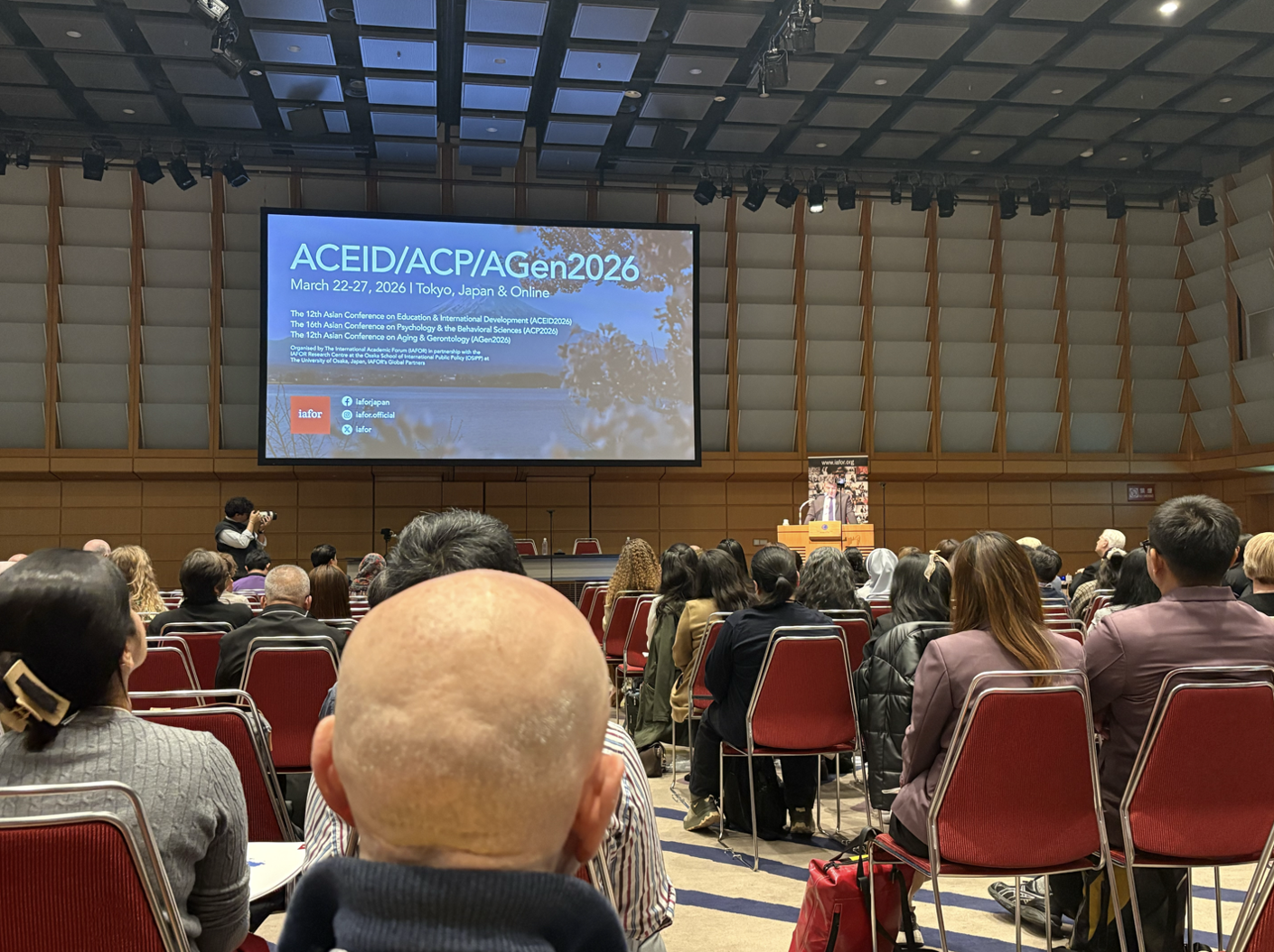
At the Asian Conference on Education & International Development (ACEID), held in Tokyo, Japan, in March 2026, I presented recent work with Dr Najme Kishani (PAL Network) and Professor Ricardo Sabates (University of Cambridge) on the cost-effectiveness of foundational learning interventions. The conference brought together researchers and practitioners across education and development, with sessions covering topics on learning outcomes, inequality and scalable policy solutions. This provided a useful setting to reflect not just on whether interventions work, but how they perform in real-world contexts.
The presentation focused on evidence from learning camps targeting rural communities in Nepal and Tanzania as part of the My Village programme. These camps provide targeted small-group support to improve children’s foundational literacy and numeracy skills. Rather than asking only whether these programmes improve learning, our work asks a more policy-relevant question: how much learning do they generate per dollar spent?
Why focus on foundational learning?
Despite major improvements in school access over the past two decades, foundational learning remains a persistent challenge. Many children complete primary school without mastering basic literacy and numeracy skills. This is especially pronounced in rural and marginalised communities, where constraints such as poverty, geography and limited school quality interact.
Programmes based on Teaching at the Right Level (TaRL) and accelerated learning approaches have shown that aligning instruction with children’s actual learning levels, rather than their age or grade, can generate substantial improvements. However, while many interventions show promise in improving foundational skills, little is known about their relative cost-effectiveness when implemented across different countries or regions and through different delivery systems.
What we did differently
Our study combines impact evaluation with detailed costing, allowing us to move beyond effectiveness alone and assess value for money in a comparative way.
We analyse learning camps implemented in:
- Nepal (Sarlahi, Makwanpur, Surkhet) using a community-led model, and
- Tanzania (Ludewa, Gairo, Kisarawe) using a school-led model.
The core pedagogy is the same across both settings: children are assessed, grouped by ability and taught using targeted instruction in short, intensive cycles. What differs is how the programme is delivered. In Tanzania, the camps were school-led. Instruction took place in schools and involved trained volunteers working alongside government teachers, typically within structured cycles aligned with the school calendar. In Nepal, the programme adopted a community-led model designed to overcome barriers to school access. Learning camps were primarily held in community spaces and were often scheduled before or after regular school hours.
We link household survey data, learning assessments and programme participation records with an ingredients-based costing approach, following methodologies developed by the Abdul Latif Jameel Poverty Action Lab (J-PAL) and the Strategic Impact Evaluation Fund (SIEF) at the World Bank. An ingredients-based costing approach estimates programme costs by identifying and valuing each input required for delivery, such as staff time, training, materials, and transport. We then estimate impacts on numeracy and literacy skills using a difference-in-differences framework with a reweighting approach to balance the treatment and control groups.
This allows us to compare:
- Learning gains (in standard deviation units), and
- Cost-effectiveness (learning gains per $100 spent).
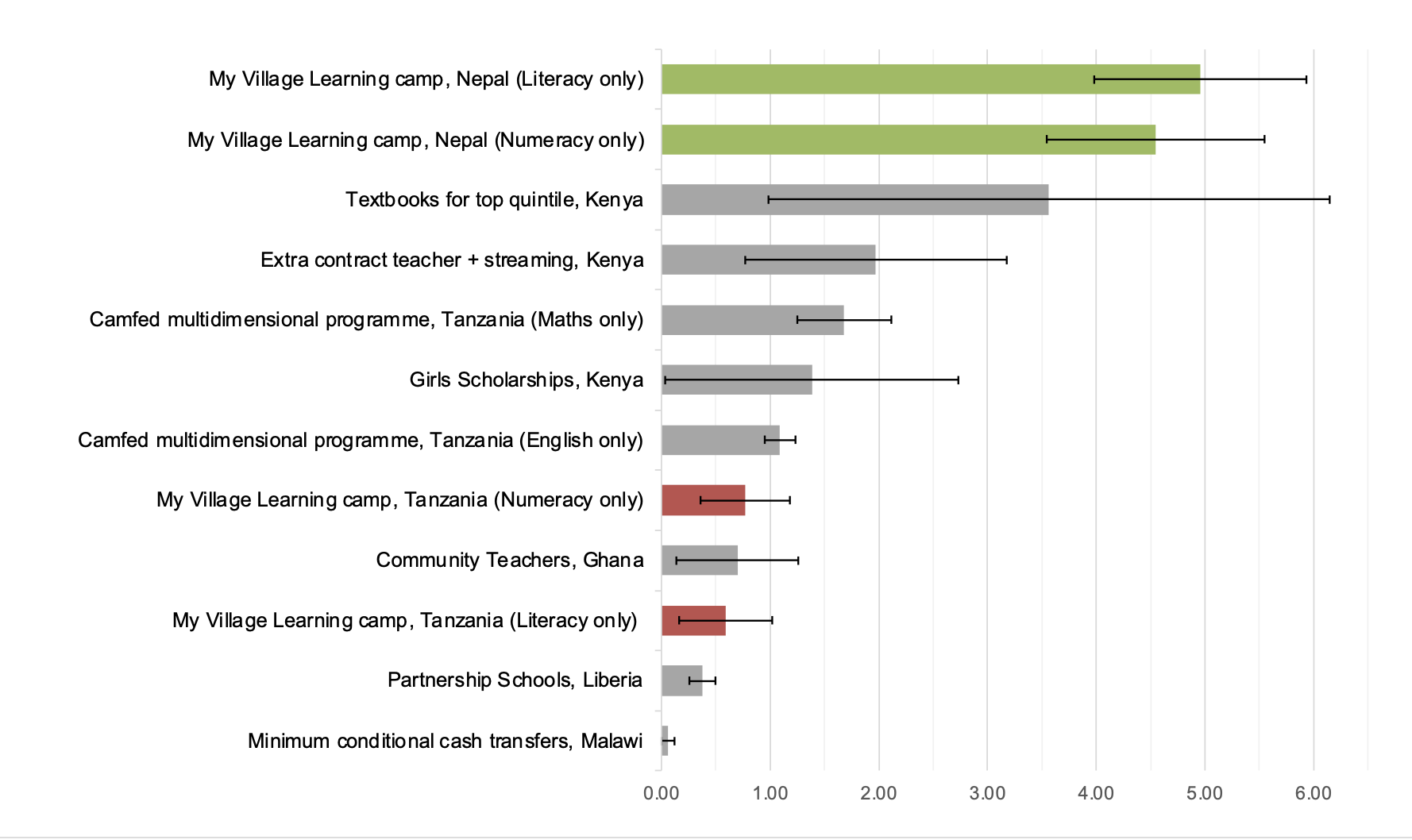
Figure 1. Comparison of the literacy and numeracy learning gains achieved per $100 spent per child across My Village learning camps and selected educational interventions from previous studies.
What we found
-
The programmes improve learning but not equally everywhere
We find significant gains in both literacy and numeracy, particularly in Nepal. Improvements are strongest among younger boys and children from poorer households. For example, in Tanzania, positive gains in numeracy are found only among boys aged 5–9. In Nepal, boys in the poorest wealth quintile (Q1) who attended the camps achieved gains of approximately one proficiency level in both literacy and numeracy (five-point proficiency scale) relative to non-attendees. Our findings suggest that targeted, level-based instruction is particularly effective for children who are furthest behind.
-
Costs are similar but outcomes are not
Per-child costs are broadly comparable across the two countries (total costs around $10–14 per participant). However, differences in learning gains are substantial, which leads to large variation in cost-effectiveness.
-
Cost-effectiveness varies sharply across contexts
When translated into learning per $100 spent, the contrast is clear. Nepal shows consistently high returns, with some districts achieving large improvements, while results in Tanzania are more mixed and vary significantly across districts.
This highlights a simple but important point: cost-effectiveness is driven more by impact on learning than by cost differences.
What does this mean for ‘what works’?
A key takeaway, both from our study and from broader discussions at the conference, is that identifying ‘what works’ is not just about finding effective interventions, but understanding where and why they work.
-
Implementation matters as much as design
The same model can produce very different outcomes depending on delivery quality and local conditions. Scaling should therefore prioritise adaptation, not just replication.
-
Cost-effectiveness should inform decisions
In resource-constrained settings, policymakers face real trade-offs. The relevant question is not simply whether an intervention works, but whether it delivers sufficient learning relative to its cost.
-
Equity and efficiency can align
Our results show that programmes often generate the largest gains among poorer and younger children. However, reaching the most marginalised groups can also increase costs and reduce measured cost-effectiveness. High cost-effectiveness may be achieved in more accessible areas, but the greatest social value may lie in reaching harder-to-reach populations. As a result, cost-effectiveness metrics should be interpreted alongside equity considerations, rather than used in isolation.
Looking ahead
Improving foundational learning at scale will require not just more interventions, but better decisions about where and how to invest. Future work should focus on understanding why similar programmes perform differently across contexts, and how delivery models can be adapted to maximise impact for individual contexts.
The discussions at ACEID reinforced the importance of connecting rigorous evidence with practical policy questions. Bringing together perspectives from different contexts made it clear that while the challenges are shared, the solutions need to be grounded in local realities.
People

Yuyan Jiang
Discover more

What we do
Our work will directly affect up to 3 million children, and reach up to 17 million more through its influence.
Who we are
A group of strategic partners, consortium partners, researchers, policymakers, practitioners and professionals working together.
Get involved
Share our goal of literacy, numeracy and other key skills for all children? Follow us, work with us or join us at an event.