
Equitable Learning blog
Equity begins with understanding: Why the language of instruction is at the heart of learning
Mamadou Amadou Ly
Ly, M.A. 2026. Equity begins with understanding: Why the language of instruction is at the heart of learning. What Works Hub for Global Education. Blog. BL_2026/020. https://doi.org/10.35489/BSG-WhatWorksHubforGlobalEducation-BL_2026/020
Equity does not begin when an education system achieves scale; it begins when every child can understand the language in which they are taught.
Over the past two decades, many countries have made remarkable progress in terms of access to education. Today, more children attend school than ever before. Yet, behind this apparent success lies a more troubling reality: millions of children spend several years in the classroom without acquiring fundamental skills in reading, writing, or mathematics.
This observation reveals one of the greatest challenges in contemporary education: access to school does not guarantee learning. And when learning fails to take place, it is almost always the same children who pay the price.
The false paradox of access without learning
Education systems are often evaluated based on their capacity to enrol children rather than on their ability to ensure that those children actually learn. As a result, rising enrolment rates can coexist with learning gaps that persist or even widen.
National averages often mask vastly different realities. Behind an average score lie children who are making rapid progress alongside others who begin falling behind as early as their first years of schooling. Once this learning lag takes hold, it becomes increasingly difficult to overcome.
The challenge, therefore, is no longer merely to get children into school. It is to ensure that every child can understand, participate, and make progress right from their very first years of learning.
An often invisible exclusion: The language of instruction
Learning inequalities tend to follow the same fault lines, including poverty, place of residence, gender, and disability. In rural and impoverished areas, there is often a dearth of qualified teachers, limited educational materials, and a lack of appropriate support at school and at home. In Senegal, children living in such areas frequently face an additional challenge to learning: a mismatch between the language of instruction and the language they speak at home.
In Senegal, children begin school in a language they do not speak or speak only with very limited proficiency. From their first day of class, they are required to simultaneously learn a new language and learn how to read, write, and count.
For many of these children, this dual task is extremely difficult. Imagine a child asked to solve a math problem without understanding the instructions. Or to read a text in a language they almost never hear at home. The resulting difficulties are often interpreted as a lack of ability, even though they primarily reflect a barrier to comprehension.
This form of exclusion is particularly insidious because it is rarely visible in educational statistics. The child is physically present in the classroom. They are officially enrolled in school. Yet they remain excluded from the learning process. A recent study in Senegal conducted by the American Institutes for Research found that among a sample of second and fourth grade students, over 70% could not speak or understand French as well as their mother tongue language (Dalberg Research & American Institutes for Research, 2024). French, for the majority of Senegalese children, can be considered a foreign language.
Understanding before learning
Research conducted in various contexts demonstrates that instruction delivered in a language the child understands fosters the acquisition of fundamental skills, particularly in reading (Bellanca & Brandt, 2010; Bulat et al., 2017).
When students are able to draw upon their existing linguistic knowledge, they devote their cognitive energy to grasping concepts rather than to deciphering an unfamiliar language. They participate more actively, build confidence, and make faster progress.
This does not imply that national or international languages used within educational systems should be abandoned. On the contrary, these languages often play an essential role in further education and professional integration.
However, learning these languages is more effective when it is built upon a solid foundation established in a language familiar to the child.
Making equity a design principle
Equity requires more than the equal distribution of resources. It entails identifying the specific obstacles that certain groups of children face and addressing them in a targeted manner.
Too often, equity is treated as a secondary concern, pursued only after a reform has demonstrated its effectiveness at scale. This logic must be inverted.
Equity must be embedded from the very moment of a reform’s design. Policies, programmes, and pedagogical approaches must be conceived with the needs of the children furthest removed from learning as their starting point.
The fundamental question is how to design solutions from the outset that work for the children facing the greatest obstacles, rather than how to reach all children after a program has already been developed.
Since 2009, Associates in Research and Education for Development (ARED) has been advancing a bilingual instruction model for Senegalese primary schools that is grounded in the international research base on reading acquisition and additive bilingualism. Teachers in the programme use mother tongue languages across primary school subjects, with a focus on strengthening literacy skills across the curriculum, while introducing French as a foreign language.
Key innovations in the bilingual model include (1) multilingual instruction that ensures early reading success and promotes literacy through math and science study, (2) comprehensive teacher training, (3) engagement from the Ministry of Education and community leaders, and (4) rigorous evaluation. Research on ARED’s bilingual model has shown a clear impact on reading and math scores for primary school children compared with standard Senegalese primary schools (Associates in Research and Education for Development, n.d.). The results of ARED’s programme have supported the adoption and nationwide scaling of a harmonised bilingual curriculum by the Ministry of Education.
Equity begins with understanding
When we speak of equity in education, we often talk about funding, infrastructure, or access to schooling. While these dimensions are essential, they are not enough.
Equity begins when every child can understand what is happening in their classroom.
An education system cannot be considered equitable if some students are excluded from learning simply because the language used in school is foreign to them. Recognizing this reality is an essential first step towards closing learning gaps.
If we want all children to learn, we must start by giving them the means to understand. Learning does not begin with physical presence in school; it begins with understanding.
References
Associates in Research and Education for Development. (n.d.). Welcome to our publishing area. https://ared-edu.org/en/edition-2/
Bellanca, J., & Brandt, R. (2010). 21st century skills: rethinking how students learn. Solution Tree.
Bulat, J., Dubeck, M., Green, P., Harden, K., Henny, C., Mattos, M., Pflepsen, A., Robledo, A., & Sitabkhan, Y. (2017). What works in early grade literacy instruction (Knowledge and Practice in International Development Occasional Paper). RTI Press. https://doi.org/10.3768/rtipress.2017.op.0039.1702
Dalberg Research & American Institutes for Research. (2024). Strengthening bilingual and multilingual learning systems in Francophone Africa: Evidence from Senegal. Global Partnership for Education Knowledge and Innovation Exchange. https://air.org/sites/default/files/2024-05/KIX-Strengthening-Bilingual-Education-Senegal-Brief-May-2024.pdf
People
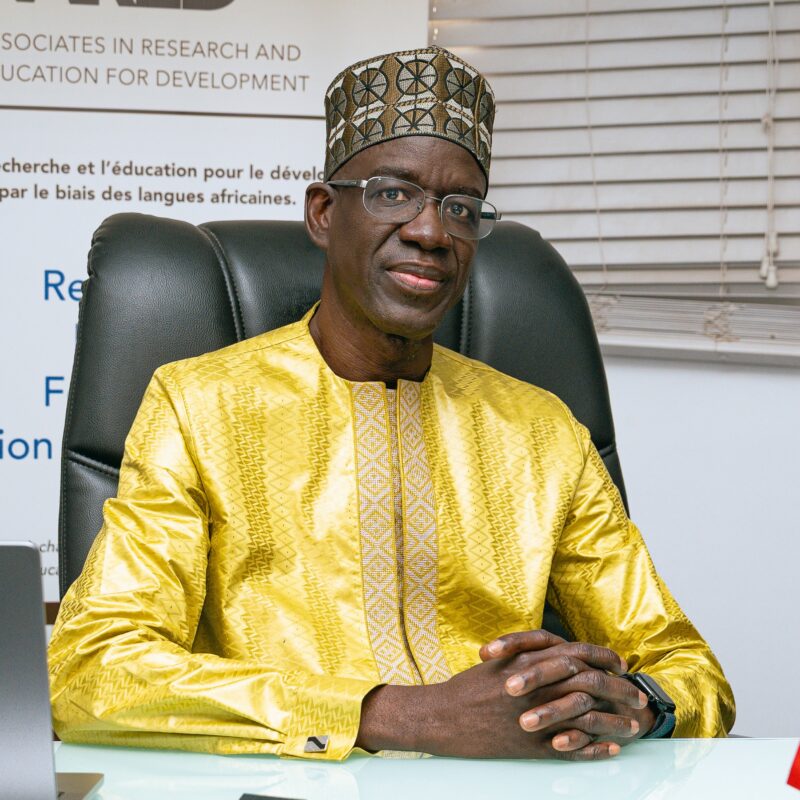
Mamadou Amadou Ly
Discover more
What we do
Our work will directly affect up to 3 million children, and reach up to 17 million more through its influence.
Who we are
A group of strategic partners, consortium partners, researchers, policymakers, practitioners and professionals working together.
Get involved
Share our goal of literacy, numeracy and other key skills for all children? Follow us, work with us or join us at an event.