
Blog
5 keys to Ed Lab success: Core themes from the Embedded Evidence Lab 5th Cross-Country Learning Exchange in Nairobi
Juan Hernández-Agramonte Caballero, Will Sims, Gloria Mbera and Swathi Attavar
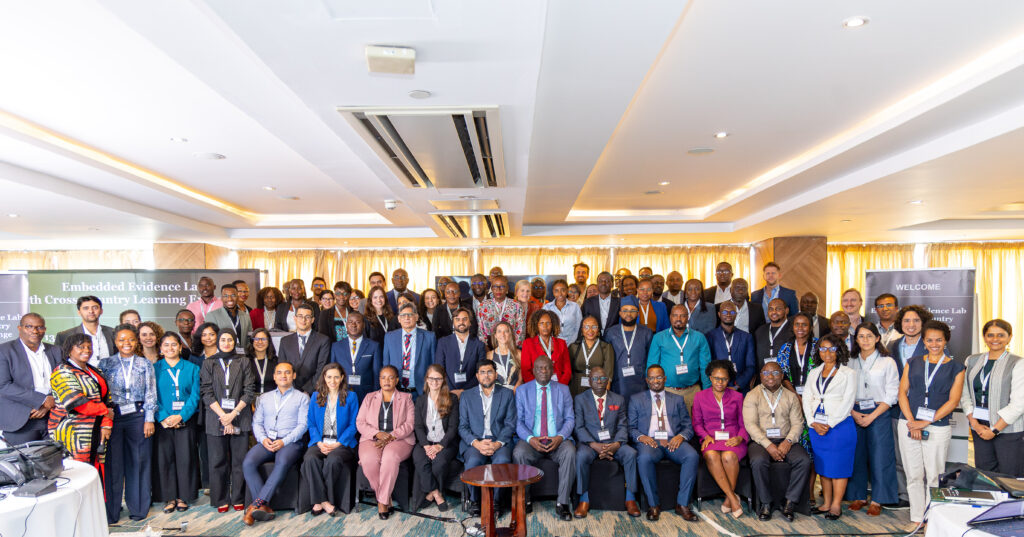
In October 2025, policymakers, researchers and practitioners from across Africa, Asia and Latin America gathered in Nairobi for the fifth Cross-Country Learning Exchange (CCLE) – a three-day conference focused on how governments can make data and evidence an integral part of education decision-making.
Co-hosted by Kenya’s Ministry of Education, Innovations for Poverty Action (IPA), and the What Works Hub for Global Education, the event brought together representatives from 16 Embedded Evidence Labs from around the world including Kenya, Rwanda, South Africa, India, Colombia, Nigeria, Tanzania, Botswana, Côte d’Ivoire, Uganda, Peru, Ghana, the Philippines, Zambia, Pakistan and Sierra Leone. Participants shared lessons, innovations and challenges in strengthening the use of data in policy and practice. Throughout the conversations, several key themes emerged to characterise the present and future of Education Labs (Ed Labs).
Theme 1: A focus on strengthening government systems
The event opened with a clear and unifying message: strengthening education outcomes requires building evidence-based government systems, not just delivering individual research projects.
In their opening remarks, Bethany Park, Global Managing Director Advisory, Policy, and Strategy at IPA and Becky Hatch, Director of Policy and Partnerships, What Works Hub for Global Education emphasised that while both the demand and technical capacity to use evidence in policymaking already exist, the real challenge lies in connecting and scaling what works across government.
This theme resonated throughout the panel discussions, where government officials from Ed Lab partnerships in India, Pakistan, Tanzania and Botswana highlighted the importance of aligning purpose across ministries and sustaining efforts to embed data use into everyday decision-making. Joel Justine Mhoja, National MEWAKA Coordinator at Tanzania’s PMO-RALG, noted that ‘projects succeed when they are co-created with the government and embedded in national priorities.’ Speakers also reflected on the role of technical partners in supporting this institutionalisation process – helping governments build lasting systems that continue to use data and evidence long after individual projects end. Whitney Tate, Executive Director, Georgetown University and Teresa Lezcano, Associate Director of Policy, J-PAL Africa, pointed to Embedded Labs as a key mechanism for strengthening government capacity, not only to use current data but to future-proof teams for emerging tools, including AI.
‘Governments are now in the driver’s seat, with technical partners offering advice and support from the passenger’s seat,’ said Loïc Watine, former IPA Chief Research and Policy Officer.
Theme 2: Shared learning across contexts
Despite representing vastly different contexts, Ed Lab teams discovered they faced remarkably similar obstacles – and opportunities. This created unexpected moments of connection and collaborative problem-solving throughout the three days. Representatives from the labs shared stories of successfully embedding evidence use within government systems:
- Rwanda’s Ed Lab demonstrated how sustained collaboration across ministries has enabled the scaling of teacher performance initiatives.
- South Africa’s Department of Basic Education reflected on how embedding research within government structures enhances credibility and continuity.
- Colombia’s ICBF Lab shared how its Apapacho programme – focused on early childhood development – has scaled through iterative learning and partnership.
- Botswana’s Teaching at the Right Level (TaRL) initiative underscored the importance of shared ownership – teachers, parents and policymakers working together under the motto ‘Every learner must succeed.’
Together, these experiences highlighted the value of cross-country learning in helping Labs accelerate progress toward a shared vision of evidence-informed education policy.
Theme 3: Local adaptation is critical
While the event drew a global audience and focused on sharing trans-national learning, there was also clear understanding that local considerations and adaptations are key for ensuring uptake and impact. A highlight of the event was the extensive engagement with the Kenya Education Evidence Hub (EEH) – an Embedded Lab within the Kenya Ministry of Education. EEH has developed and sustained collaboration with the Ministry of Education on topics relevant to Kenyan education priorities, including adapting global approaches and structures to deliver concrete progress that is aligned with local needs. Its work includes supporting the development of Kenya’s National Education Sector Strategic Plan (NESSP) 2023–2027, strengthening data capacity across directorates through a tailored roadmap, and advancing the Kenya Education Management Information System (KEMIS) – a unified platform linking schools, agencies and learners to improve planning and transparency.
Kenya’s experience with the EEH exemplifies how locally focused partnerships, data systems and capacity building can help strengthen opportunities for learners across the globe.
Theme 4: Achieving policy impact is not a linear process
Across these experiences, one theme stood out: achieving impact is not linear. It is relational, adaptive and deeply rooted in systems that learn as they go. As Kenya’s Principal Secretary for Education, Julius Bitok, reminded participants, transforming education is not a single event, but ‘a continuous process of reflection, reinvention and renewal.’
Juan Hernández-Agramonte, Senior Director of IPA’s Embedded Evidence Labs, highlighted how Embedded Labs like Minedu Lab in Peru have helped governments design, test and implement education reforms through an iterative process: mapping policy challenges, generating evidence, and applying data to decision-making. The lesson, he said, is that ‘using evidence requires trust, alignment and a shared vision’ to be able to endure the ups and downs of a policy adoption cycle as leadership changes or governments transition.
This perspective was echoed by government partners like Akash Shankar, Chief Executive Officer, Chitradurga Zilla Panchayat, India, who noted: ‘evidence uptake requires persistence and prioritising Ed Lab functions like aligning district and mid-tier education officials, building regular habits of reviewing data and improving implementation monitoring.’
Theme 5: The promising future of Ed Labs
As participants returned to their respective countries, with new connections and ideas, a shared sense of purpose stood out: despite persistent challenges and global headwinds, there is significant opportunity to continue to increase the impact and reach of Education Labs. Across discussions, Ed Lab teams and government counterparts explored practical pathways to strengthen education systems – from improving Education Management Information Systems (EMIS) and reinforcing monitoring, evaluation, and learning functions, to embedding evidence more directly into day-to-day implementation. In some cases, government officials announced plans to launch new Education Labs at sub-national levels, signalling growing political commitment to institutionalising data and evidence use. Advancement of tools such as global repositories of education evidence is further strengthening the effectiveness of teams across the globe.
The Nairobi CCLE was more than a conference – it was a moment of collective reflection on how far the global evidence movement has come. From Peru to Pakistan, Côte d’Ivoire to Kenya, Embedded Education Labs are proving that when data and evidence use is built into the fabric of government systems, education policies can move beyond reform to lasting transformation.
Hernández-Agramonte Caballero, J., Sims, W., Mbera, G. & Attavar, S. 2026. 5 keys to Ed Lab success: Core themes from the Embedded Evidence Lab 5th Cross-Country Learning Exchange in Nairobi. What Works Hub for Global Education. Blog. BL_2026/004. https://doi.org/10.35489/BSG-WhatWorksHubforGlobalEducation-BL_2026/004




Discover more

What we do
Our work will directly affect up to 3 million children, and reach up to 17 million more through its influence.
Who we are
A group of strategic partners, consortium partners, researchers, policymakers, practitioners and professionals working together.
Get involved
Share our goal of literacy, numeracy and other key skills for all children? Follow us, work with us or join us at an event.