
Equitable Learning blog
Why even the best reading programmes leave many children behind
Marcia Davidson and Fredi Merhatsidk
Davidson, M. & Merhatsidk, F. 2026. Why even the best reading programmes leave many children behind. What Works Hub for Global Education. Blog. BL_2026/019. https://doi.org/10.35489/BSG-WhatWorksHubforGlobalEducation-BL_2026/019
Progress that matters – and a gap we must close
Some of the most rigorously evaluated large-scale reading programmes have demonstrated what is possible. A study identifying eight of the strongest programmes across low- and middle-income countries – among them Kenya’s Tusome programme, Tanzania’s Effective and Quality Universal Primary Education in Tanzania (EQUIP-T) programme (Oxford Policy Management, 2019), Ghana’s Learning programme and Senegal’s Lecture Pour Tous (Reading for All) – documented effect sizes of 0.5 to 1.2 standard deviations in oral reading fluency during implementation (Stern et al., 2023). Although most of these programmes have since concluded, and questions remain about whether gains have persisted, the evidence they generated continues to shape the field and shows what structured literacy teaching, well-designed materials and sustained teacher support can achieve.
Yet the data from these same programmes reveal a consistent and troubling pattern: even at programme end, a significant proportion of the most disadvantaged students could not read a single word. In Tusome, that figure stood at 19% of grade 2 students – and among those learning in Kiswahili as a second language, it was 29%. Across EQUIP-T, Ghana Learning and other programmes in the Stern et al. study, zero scores fell substantially but did not disappear. A wider analysis of over 500,000 students across 48 countries and 96 languages confirmed that even in the strongest programmes, between 20% and 32% of students remain unable to read by programme end (Crawford et al., 2025). These children are overwhelmingly the poorest, the most linguistically marginalised and those learning in a language they do not speak at home.
The question for the field is not whether these programmes work – the evidence is clear that they do. It is why some children are not yet benefiting, and what more we can do to reach them.
Two thresholds, one design gap
To understand the equity gap, we need to look at how reading works. Reading comprehension is the product of two components: (1) the ability to decode written words and (2) oral language understanding. Oral language understanding includes vocabulary, knowledge of how words are built (morphology) and how sentences are structured (syntax). Together, these two components form what is known as the ‘simple view of reading’ (Gough & Tunmer, 1986), a view that is often expressed as decoding × language comprehension = reading comprehension. Because the relationship is multiplicative, a weakness in either component means that the result is zero, no matter how strong the other component is.
The simple view of reading · Gough & Tunmer (1986)
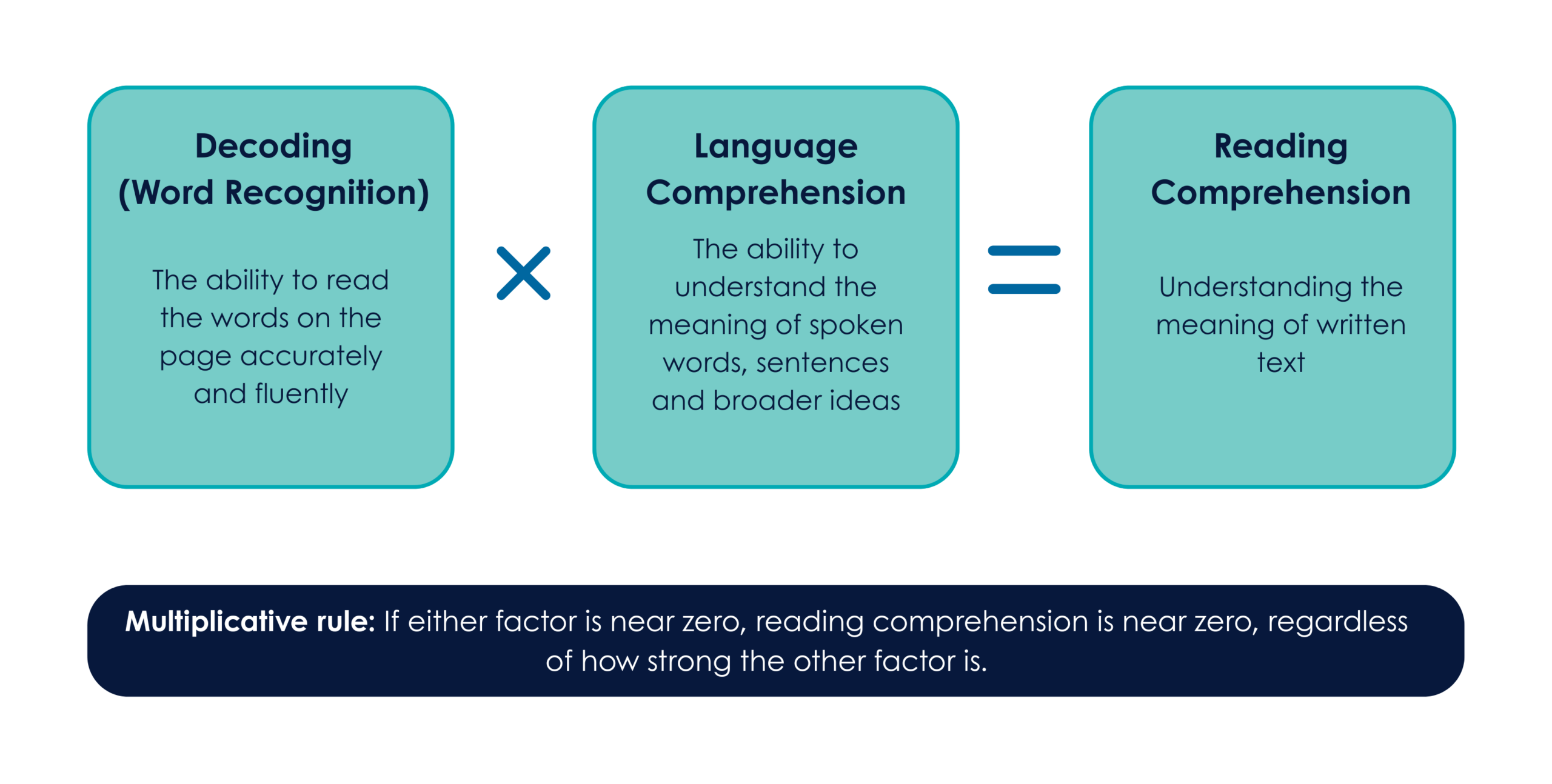
Figure 1: The simple view of reading. Source: Created by authors based on Gough & Tunmer (1986)
Effective reading programmes have been highly successful at building decoding skills. But for children who arrive at school with limited oral language in the language of instruction – particularly those learning in a second or additional language – even strong decoding gains may not translate into reading with understanding. The oral language side of the equation, especially vocabulary, may remain too low to support comprehension. The implication is that oral language development must be strengthened alongside decoding instruction.
Research has established critical thresholds on both sides. On decoding, a South African study of nearly 14,200 children found that students reading below 20 correct words per minute cannot meaningfully comprehend text and need more than seven times the instructional time of their peers to catch up (Ardington et al., 2021). On vocabulary, readers need to understand 95–98% of the words in a text in order to attain adequate comprehension (Hu & Nation, 2000; Laufer & Ravenhorst-Kalovski, 2010). Among all the language abilities children need for reading comprehension, vocabulary is the one we understand best: we know how much children need, and we know what teachers can do about it.
South African data put the vocabulary gap in concrete terms. At the end of grade 3, learners studying English as a first additional language knew only 27% of the 60 most common words needed for grade 4 textbooks, compared with 60.6% for native speakers on the same test (Pretorius & Stoffelsma, 2017). A child’s vocabulary at the start of the school year strongly predicts how much vocabulary they will gain during that year. Because children who begin with stronger vocabularies tend to gain more words, while those who start with weaker vocabularies gain fewer, the gap between them widens with every passing year.
What the evidence shows
A Kenyan study shows clearly why decoding alone is not enough for some learners. A randomised controlled trial with 322 multilingual grade 1 children found that systematic phonics instruction produced large gains in phonological awareness, with effect sizes of 0.57 to 0.92 and strong transfer across languages (Wawire & Kim, 2018). Yet these gains produced no improvement in actual word reading. The children could manipulate sounds and map letters to those sounds, but they could not read with understanding. They lacked the vocabulary, knowledge of word structure and grammatical grounding in Kiswahili – which was not their mother tongue – to connect the sounds they decoded to meanings they knew.
This is not an argument against phonics instruction, which has been shown to produce impressive gains. It is a demonstration of what needs to be added for children who arrive with limited oral language in the language of instruction. Phonological awareness transfers across languages, but vocabulary does not. Programmes can build on decoding gains by pairing them with explicit vocabulary instruction from the earliest grades.
Ethiopia illustrates the same dynamic on a national scale. Reforms over the past decade have expanded structured literacy teaching across more than 50 languages of instruction, with national assessments confirming measurable gains in foundational skills (EEAE, 2021, 2023; RTI International, 2016-2022). Yet those same assessments show how far there is still to go: in 2021, grade 2 students in Sidaamu Afoo classrooms averaged just 7 correct words per minute, well below the 20 words per minute threshold for meaningful comprehension. By 2023, only 4% of grade 2 students in Sidama classrooms could read more than 45 correct words per minute.
These gaps are deepest among learners from low-literacy households and those who transition to Amharic or English before reaching adequate vocabulary levels in either language. The foundational skills gains are real. The task now is to translate them into reading with understanding.
Building on what works
The evidence points clearly towards adding oral language development to what reading programmes are already doing well, rather than replacing existing approaches. The field has demonstrated that it can build decoding skills at scale. The next step is to apply that same precision and rigour to oral language development. This has practical implications for curriculum design, teacher support and how we measure success.
For curriculum design, explicit teaching of vocabulary, morphology and syntax should sit alongside phonics from the first day of school. When a child encounters a word in a text, she needs to recognise not just its sound but its meaning, its grammatical role and how it connects to other words she knows. For multilingual programmes, vocabulary must be explicitly taught in each language a child is expected to read in – unlike phonological skills, word meanings do not transfer across languages. Structured routines for discussing words, building concept knowledge and hearing rich language modelled by teachers are not extras; they are essential components of a complete reading programme.
For teacher support, ongoing in-classroom coaching is already producing strong results. The Global Education Evidence Advisory Panel found effect sizes nearly three times larger than those associated with one-off training events – 0.32 versus 0.11 standard deviations (GEEAP, 2025). Extending this coaching to include explicit vocabulary and oral language routines would give teachers the confidence and skills to reach learners who are currently making limited progress. Small shifts in daily instruction – such as pre-teaching key words, building concept maps and encouraging structured discussion – can make a significant difference for the children who need it most.
Making the invisible visible
Reading programmes are working. The task now is to make them work for everyone. The evidence from Kenya, Tanzania, South Africa and Ethiopia shows that decoding gains are achievable at scale and that adding deliberate oral language support can help translate those gains into reading with understanding for most marginalized children. The two goals are complementary, not competing.
Three practical steps can help us go further:
- Evaluation frameworks should report zero-score rates – the proportion of students who cannot read a single word – alongside average gains. Disaggregating these rates by language background and household income has shown that national averages can mask rates two to three times higher among the most marginalised learners. Making these data visible is the first step towards demanding accountability for all children.
- Oral vocabulary instruction should be planned and budgeted as a core programme component from day one, not an optional add-on.
- Teacher coaching should include the same emphasis on building oral language as it does on phonics instruction.
We have strong foundations to build on, and the progress already achieved is real. Millions of children are learning to read because of the work this field has done. The challenge – and the opportunity – is to ensure that the considerable investment in reading programmes delivers for every learner, not just the majority.
References
Ardington, C., Wills, G., Pretorius, E., Mohohlwane, N., & Menendez, A. (2021). Benchmarking oral reading fluency in the early grades in Nguni languages. International Journal of Educational Development, 84, Article 102433. https://doi.org/10.1016/j.ijedudev.2021.102433
Crawford, M., Raheel, N., Korochkina, M., & Rastle, K. (2025). Inadequate foundational decoding skills constrain global literacy goals for pupils in low- and middle-income countries. Nature Human Behaviour, 9, 74–83. https://doi.org/10.1038/s41562-024-02028-x
Ethiopian Education Assessment and Examinations Agency (EEAE). (2021). Early grade reading assessment national report.
Ethiopian Education Assessment and Examinations Agency (EEAE). (2023). Early grade reading assessment national report.
Global Education Evidence Advisory Panel (GEEAP). (2025). Effective reading instruction in low- and middle-income countries: What the evidence shows. Foreign, Commonwealth & Development Office; World Bank; UNICEF. https://geeap.org/wp-content/uploads/2025/12/Effective-Reading-Instruction-in-Low-and-Middle-Income-Countries-What-the-Evidence-Shows-EN.pdf
Gough, P. B., & Tunmer, W. E. (1986). Decoding, reading, and reading disability. Remedial and Special Education, 7(1), 6–10. https://doi.org/10.1177/074193258600700104
Hu, M., & Nation, I. S. P. (2000). Unknown vocabulary density and reading comprehension. Reading in a Foreign Language, 13(1), 403–430. https://doi.org/10.64152/10125/66973
Laufer, B., & Ravenhorst-Kalovski, G. C. (2010). Lexical threshold revisited. Reading in a Foreign Language, 22(1), 15–30. https://doi.org/10.64152/10125/66648
Oxford Policy Management. (2019). EQUIP-Tanzania impact evaluation: Endline quantitative technical report, Volume II. Rawle, G. et al. Oxford: Oxford Policy Management. https://www.opml.co.uk/sites/default/files/migrated_bolt_files/opm-ie-el-quant-report-vol-ii-final-sent.pdf
Pretorius, E. J., & Stoffelsma, L. (2017). How is their word knowledge growing? Exploring grade 3 vocabulary in South African township schools. South African Journal of Childhood Education, 7(1), Article a553. https://doi.org/10.4102/sajce.v7i1.553
Stern, J., Jukes, M., DeStefano, J., Mejia, J., Dubeck, P., Carrol, B., Jordan, R., Gatuyu, C., Nduku, T., Van Keuren, C., Punjabi, M., & Tufail, F. (2023). Learning at Scale: Final report. RTI International. https://learningatscale.net/wp-content/uploads/2023/10/Learning-at-Scale-Final-Report-.pdf
Wawire, B. A., & Kim, Y.-S. G. (2018). Cross-language transfer of phonological awareness and letter knowledge: causal evidence and nature of transfer. Scientific Studies of Reading, 22(6), 443–461. https://doi.org/10.1080/10888438.2018.1474882
Related resources
The Global Coalition for Foundational Learning. 2025. Foundational learning: Why it’s not just about schooling, but a smart investment in people and societies. What Works Hub for Global Education. Blog. 2025/011. https://doi.org/10.35489/BSG-WhatWorksHubforGlobalEducation-BL_2025/011
Alvarez Marinelli, Horacio; Boggild-Jones, Izzy; Crawford, Michael; Dubeck, Margaret Mary; Jhingran, Dhir; Lack, Christopher Joseph; Mohohlwane, Nompumelelo; Oviedo Buitrago, Maria Eugenia; Piper, Benjamin; Saavedra, Jaime; Taha, Hanada. (2025). Effective Reading Instruction in Low- and Middle-Income Countries : What the Evidence Shows (English). Global Education Evidence Advisory Panel (GEEAP) Washington, D.C. : World Bank Group. http://documents.worldbank.org/curated/en/099448110272527300

Discover more
What we do
Our work will directly affect up to 3 million children, and reach up to 17 million more through its influence.
Who we are
A group of strategic partners, consortium partners, researchers, policymakers, practitioners and professionals working together.
Get involved
Share our goal of literacy, numeracy and other key skills for all children? Follow us, work with us or join us at an event.