
Blog
What is implementation science in education?
Lily Kilburn
The success of an education programme often depends on how well it is implemented. That’s why implementation science is so important: it can ensure that an intervention that works well in a small, controlled study continues to work when it’s scaling up.
What is implementation science, then, and what implementation science framework can be used to understand it? In this blog post, we’ll offer an overview of implementation science – the definition of the term, what questions it can help to answer, and how we’re pursuing implementation science in our field, global education.
What is implementation?
Let’s start by defining implementation.
Implementation is putting approaches into practice. It’s when theory meets all the complexity of the real world – including when programmes are scaling up.
What can affect implementation? Factors that can play a part include:
- Politics
- Bureaucracy
- Varying contexts
- Varying delivery models
- Differing incentives
- The shift from small trials to large-scale practice.
As an example, let’s imagine that you want to try to make bread using a recipe. Even if the recipe is great, the success of your baking could be affected by factors like:
- The effectiveness of the tools and appliances available in your kitchen
- The size of your kitchen, including countertop space
- Your own experience with making bread
- The needs of anyone else in your home who wants to use the kitchen.
The recipe is just the start of the bread-making journey.
What is implementation science?
Implementation science can have two meanings:
- Efforts to ensure that scientific findings get successfully turned into widespread reality.
- The study of implementation: codifying the science behind what makes a programme’s implementation successful.
What does implementation science focus on in global education?
It addresses questions like:
- What implementation challenges occur when an intervention is scaled up, and how can these be addressed?
- What are the ingredients of successful implementation?
- How can implementation be described, analysed and measured?
- What techniques can refine and improve implementation when a programme is already being implemented at scale?
- How can the knowledge of implementers be captured and codified?
Why does implementation science matter?
Implementation science is crucial because it can help to:
- Explain why an intervention succeeded, so its success can be replicated
- Explain why an intervention didn’t succeed – and determine whether the problem was with the idea behind the intervention or with the implementation of the intervention
- Improve the effectiveness of interventions that are currently being implemented
- Measure implementation, giving a sense of how well an intervention was implemented.
An implementation science framework for education
At the What Works Hub for Global Education, we undertake implementation science research to support governments to implement evidence-based reforms at scale.
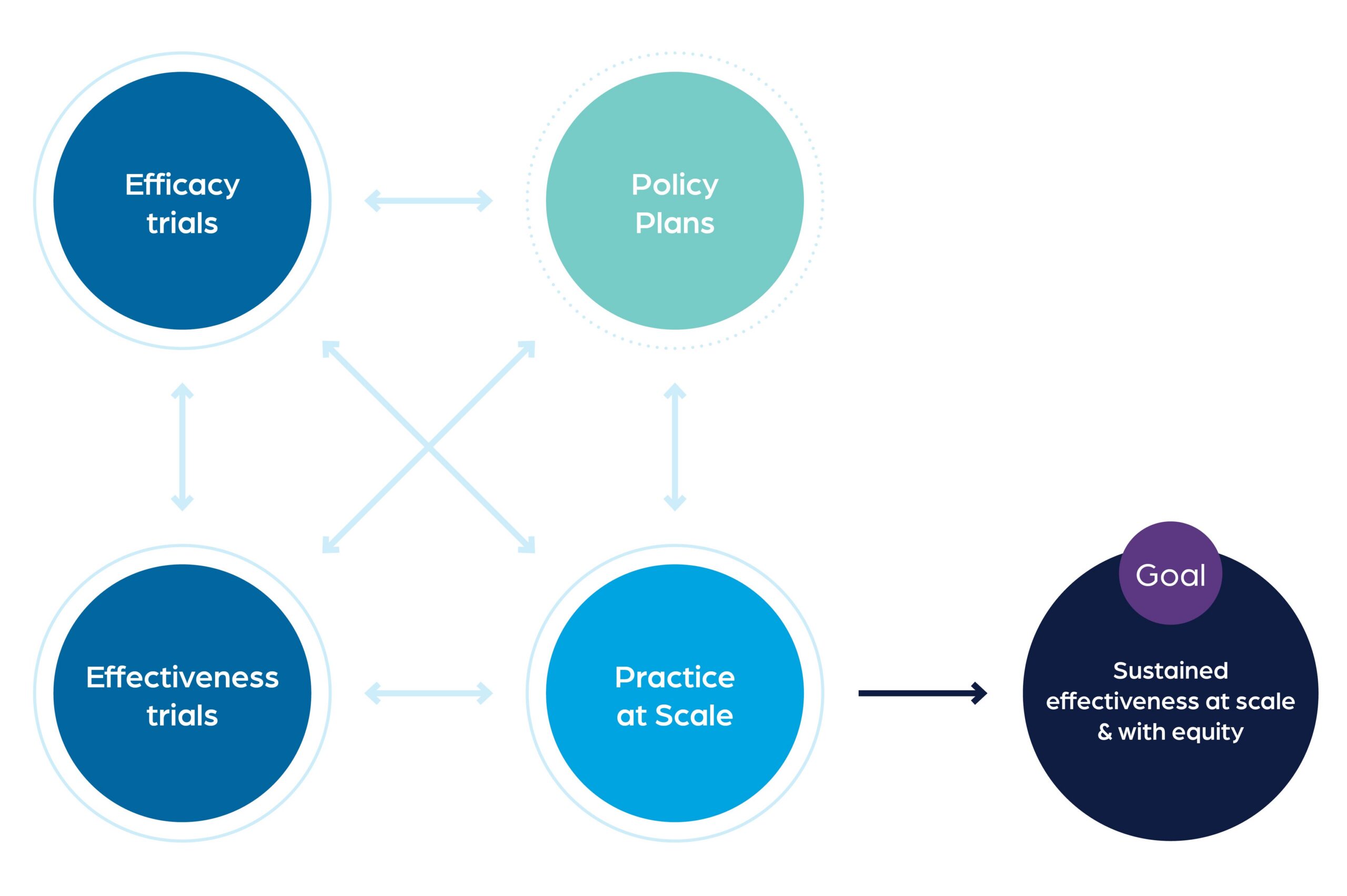
Our implementation science framework identifies four areas along the way to sustained programme effectiveness at scale with equity.
These four areas are:
- Efficacy trials: Evidence from controlled studies showing the efficacy of certain interventions in achieving better learning outcomes.
- Effectiveness trials: Evidence of effectiveness in different contexts and settings, including through government delivery. This can be seen as ‘pressure testing’ of interventions that were found to work in small, controlled studies.
- Policy plans: Plans, ideas, regulations and actions within government that are aimed at getting children learning.
- Practice at scale: What is actually happening in education systems and in large numbers of individual classrooms.
It’s important to note that an intervention can move in many ways among these areas. Interventions don’t necessarily follow a linear progression from a small, controlled study to practice at scale.
The What Works Hub for Global Education intellectual framework
Learn more about implementation science
To learn more, take a look at some of our resources:
- Our implementation science page and our implementation science intellectual framework
- Our initiative on implementation research at the middle tier
- An insight note: ‘Improving implementation while scaling: Differentiated Learning in Ghana.’
Sign up to our mailing list to stay updated about our future work on implementation science and implementation measurement, including reflections on our CIES 2026 implementation measurement workshop.
People

Lily Kilburn
Discover more

What we do
Our work will directly affect up to 3 million children, and reach up to 17 million more through its influence.

Who we are
A group of strategic partners, consortium partners, researchers, policymakers, practitioners and professionals working together.

Get involved
Share our goal of literacy, numeracy and other key skills for all children? Follow us, work with us or join us at an event.