
Blog
What is A/B testing, and why is it so promising for global education?
Lily Kilburn
Recent research has shown that iterative A/B testing can be a powerful way to optimise education interventions, especially those already being implemented at scale.
But what is A/B testing, and what makes it different from other approaches? In this blog post, we’ll explore why iterative A/B testing is getting attention in the global education community – and how it could help you.
What is A/B testing in education?
Iterative A/B testing is a simple, quick way to learn whether a small change in an education intervention makes it more effective or lower in cost.
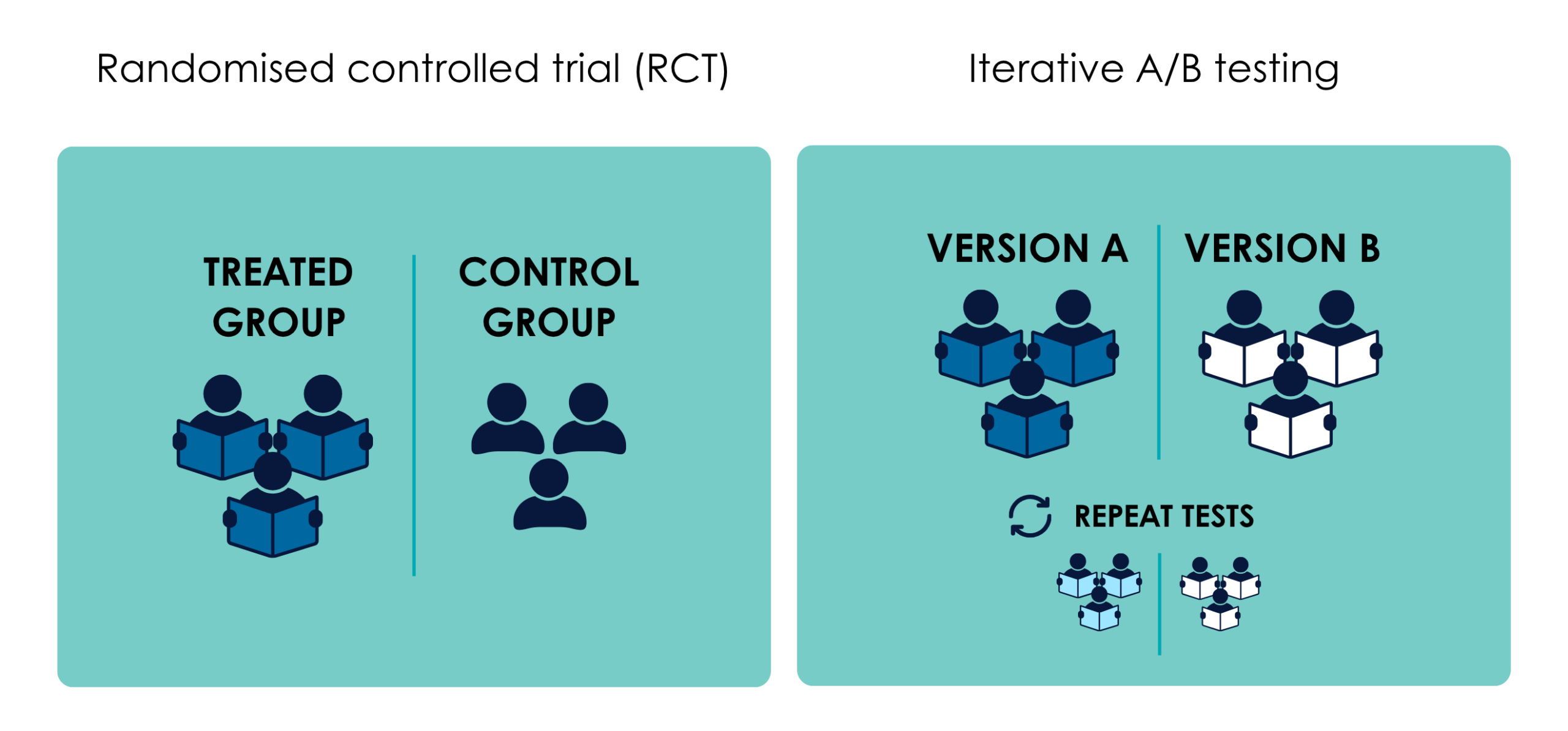
As with a randomised controlled trial (RCT), you’ll randomly assign participants to groups – but a key difference from an RCT is that A/B testing has no control group. Instead, group A and group B receive slightly different versions of the same intervention, allowing you to see which version is better.
Once you know the results of this A/B test, you can then iterate, undertaking further A/B tests to hone your intervention further. Iteration is crucial because a single A/B test may not uncover a tweak that makes a difference – but a process of rapid iterations allows numerous tweaks to be tested and refined, ultimately optimising the intervention.
Comparing randomised controlled trials and iterative A/B testing
Where did A/B testing originate?
A/B testing was first developed in the technology and industry sectors, which now use it widely.
To give one example: a company may assign its customers randomly into two groups, ‘A’ and ‘B.’ It may then send a marketing email that has a different subject line for the two groups. Afterward, the company can assess which subject line was more effective and use that information to shape future emails.
Why is iterative A/B testing so promising in education and the social sector?
As governments and their partners work to ensure children attain foundational literacy and numeracy, they often face challenges in the form of limited funding, implementation difficulties or a loss of effectiveness as programmes are scaling up.
Iterative A/B testing has a unique ability to help confront these challenges. Here are some reasons why.
1. Unlike a randomised controlled trial, A/B testing allows all children in a scaled-up programme to receive an intervention
When an intervention is already being implemented at scale, it’s typically not possible or desirable to place any children in a control group where they don’t receive the intervention.
Iterative A/B testing allows programmes that are scaling up or already working at scale to continue providing the intervention to all children, while also optimising it to become even better. Yet large sample sizes and randomisation still provide rigour that you’d get from a randomised controlled trial.
2. Iterative A/B testing is powerful but low in cost
Iterative A/B testing is simple and easy to use even in contexts where funding is constrained. The logistical demands are low: it can be built into existing organisational monitoring and evaluation systems.
All that’s needed is for children (or teachers, families, or middle-tier officials, depending on the intervention) to be randomly assigned into two groups. One group then receives a tweaked version of the intervention, while another group receives the original version. At the end of the test, you see which version was more effective or lower in cost without decreasing effectiveness.
In this way, A/B tests can reveal how a small change can make a programme better. And with iteration, the power of A/B testing compounds, potentially honing an intervention into an optimised version of itself.
3. Iterative A/B testing is rapid
A classic problem of education reform is that results can take time – sometimes years. Yet children who need to achieve foundational learning early can’t afford to wait; they need the best possible programme as soon as possible. Slow-to-come results can also mean money is spent on an intervention that wasn’t as effective as it could be. And they can make education a challenging arena for policymakers who need to see impact soon.
With repeated rounds of iterative A/B testing, results can be reported in weeks or months – so the effectiveness of a programme can be improved quickly. That can help ensure that children get the skills they need earlier, that the money spent has maximum impact, and that policymakers buy in. It’s a win-win for everyone.
4. Iterative A/B testing helps to produce systems that learn
As you can see, iterative A/B testing propels a shift in thinking away from ‘Does it work?’ (a one-off question) to ‘How can the programme work more effectively, cheaply, and scalably?’ (an ongoing question).
Iterative A/B testing also supports organisational culture based on evidence use, which is crucial for improving learning.
What is iterative A/B testing not suitable for?
It’s important to remember that A/B testing isn’t suitable for all situations.
We often say that iterative A/B testing in education should be rigorous, rapid and regular. So, it’s best used:
- With large sample sizes (to support rigour)
- Repeatedly and regularly, as multiple rounds of A/B testing are often needed to refine a tweak that makes a difference.
How to get started with iterative A/B testing in your organisation
If you’re interested in trying iterative A/B testing, take a look at some of our related resources:
- An iterative A/B testing toolkit backed by Youth Impact’s years of A/B testing experience
- A brief offering a practical approach to developing A/B testing systems for digital-first organisations
- A webinar recording (YouTube) from our recent webinar on the iterative A/B testing toolkit
- A working paper, Cheaper (and more effective) by the dozen: Evidence from 12 randomised A/B tests optimising tutoring for scale.
Or join us at the CIES Conference 2026, where the What Works Hub for Global Education and our partners are involved in several panels related to iterative A/B testing. You can also follow us on LinkedIn, X or Bluesky to keep up with our latest news from CIES.
People

Lily Kilburn
Discover more

What we do
Our work will directly affect up to 3 million children, and reach up to 17 million more through its influence.
Who we are
A group of strategic partners, consortium partners, researchers, policymakers, practitioners and professionals working together.
Get involved
Share our goal of literacy, numeracy and other key skills for all children? Follow us, work with us or join us at an event.