
Equitable Learning blog
What learning reforms miss when they apply a one-size-fits-all design
Amy Jo Dowd and Margaret Wawira
Dowd, A. J. &, Wawira, M. 2026. What learning reforms miss when they apply a one-size-fits-all design. What Works Hub for Global Education. Blog. BL_2026/018. https://doi.org/10.35489/BSG-WhatWorksHubforGlobalEducation-BL_2026/018
Education is a fundamental human right, and every child, regardless of their background or circumstance, is entitled to quality education and meaningful learning opportunities. Yet despite major gains in school access, an estimated 70% of children in low- and middle-income countries still cannot read and understand a simple text by age 10 (World Bank et al., 2022). Even in some of the most effective foundational learning interventions, more than 20% of children are still not learning basic skills (Davidson, 2026). This risk of falling behind is particularly acute for those facing overlapping forms of disadvantage. Yet many education systems still rely on standardised approaches that assume children learn in similar ways and at similar speeds.
The implication is important: education systems cannot accelerate foundational learning while treating equity as a secondary concern. To make real progress on the learning crisis, systems must invest in equity. In practice, this means moving beyond approaches designed for the average learner and instead responding to the wide variation in learning levels within classrooms. Approaches such as Teaching at the Right Level reflect this principle by adapting instruction to learners’ current competencies. The broader lesson, however, is not about adopting any single model but about designing systems that can identify and support children with the lowest learning levels.
This blog launches a months-long series that makes the case for investing in equity and explores key questions for addressing learning gaps experienced by marginalised children: How can successful programmes reach all children when they are taken to scale? What do we know about interventions that effectively address barriers to learning and improve equity within the teaching and learning process? How can national education systems protect equity in learning?
This series will explore monthly topics related to inequalities within education ecosystems – language of instruction, teaching and learning, scaling and systems, and contextual barriers – by hosting weekly spotlights. Blogs will feature case studies, emerging research, and insights on improving learning for all children.
This first blog lays out four reasons why foundational learning efforts should invest in equity: to realise individual and societal economic gains; to accelerate impact; to refine effective programmes; and to bolster systemic efficiency.
Realising individual and societal economic gains
Investing in equitable learning progress has economic benefits for individuals and societies. Estimated increases in individuals’ earnings related to one-standard-deviation increase in literacy are 25–30% (Rossiter et al., 2025), making broadening literacy increases equitably across the population a matter of maximising education investment to realize the promise of achieving universal foundational learning to increase global GDP by $196 trillion over 20 years (Kaffenberger et al, 2026). These broad economic benefits are accompanied by the additional and often intergenerational benefits of investing in girls’ education (Carvalho & Evans, 2022), especially when schooling results in genuine learning as opposed to mere grade attainment (Kaffenberger & Pritchett, 2021).
Accelerating foundational literacy and numeracy impact
A second reason to invest in equity is both mathematical and systemic in nature. Many education systems rely on standardised, one-size-fits-all approaches to teaching and learning, assuming that children progress in similar ways and at similar speeds. But the ‘average learner’ is largely a fiction that results in many children being excluded from meaningful learning opportunities.
Across low- and middle-income countries, large proportions of children are clustered at the lower end of foundational literacy and numeracy skill distributions. As a result, even modest improvements among struggling learners can generate substantial gains in the national mean (Crouch, 2018). By contrast, improving high achievers’ scores affects fewer children and has very little impact on the national mean. Targeting struggling learners therefore promises greater progress in tackling the learning crisis.
For education systems serious about accelerating foundational learning progress, equity cannot be treated as remediation or a secondary concern. It is central to system progress, particularly in low- and middle-income countries, where the majority of learners are struggling to learn while in more highly developed systems those struggling are the minority (Ralaingita, 2024). To make a dent in the learning crisis, the math tells us to invest in equity.
Refining effective programmes
Investing in equitable foundational learning at scale means building upon the progress of effective programmes. The programmes highlighted in Figure 1 show effect sizes greater than half a standard deviation, and some were preceded by pilots that demonstrated impressive impact for low scorers (see, e.g., Banerjee et al., 2007). However, when implemented at scale within education systems, these programmes show between 19% and 50% of learners without basic skills at endline (Stern et al., 2023; Rawle et al., 2019; Banerjee et al., 2016).
Figure 1. Percentage of learners with and without basic skills at the end of interventions with large (>.5 SD) effect sizes
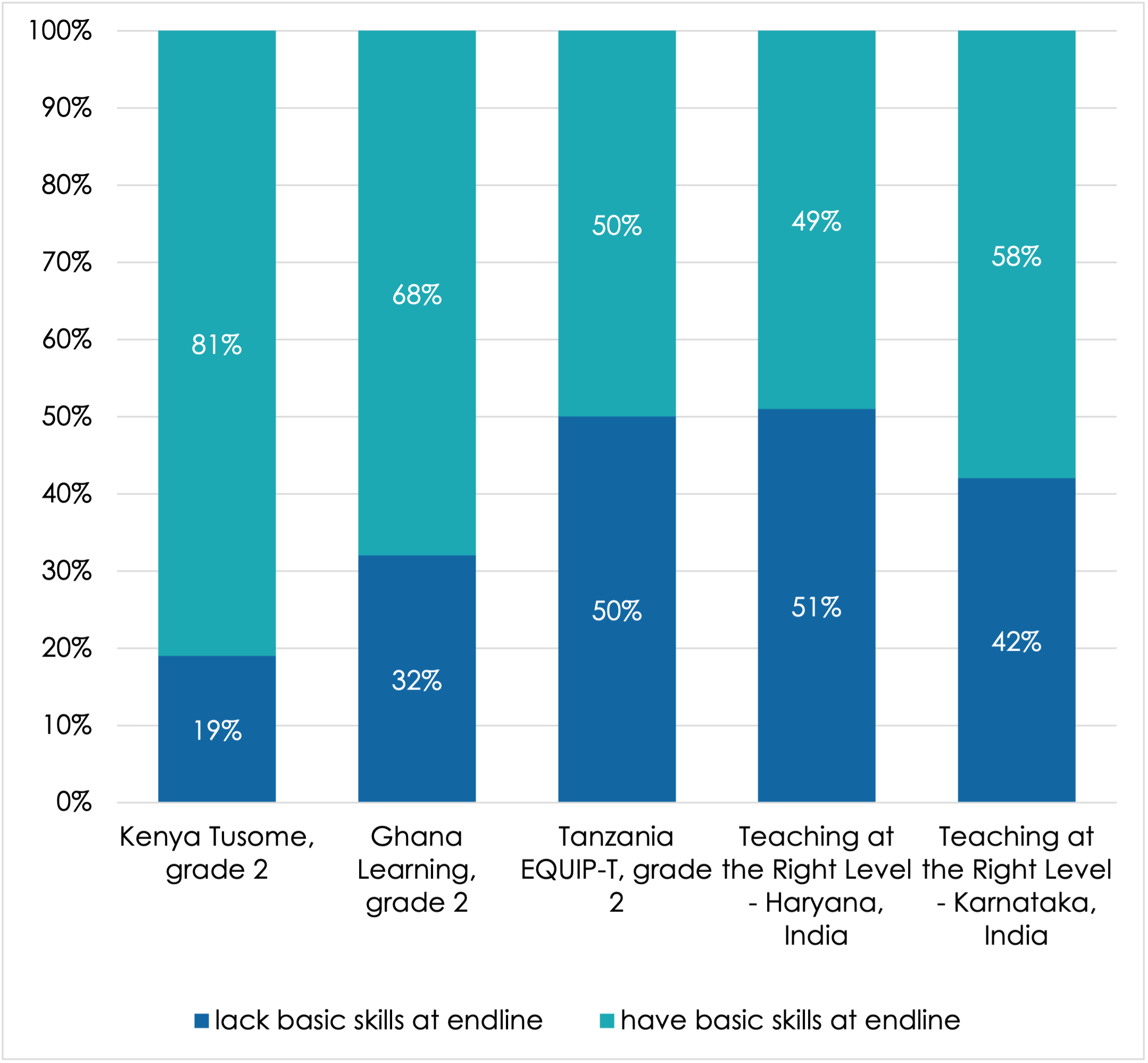
Source: Created by author based on Davidson (2026)
If even these effective programmes do not enable children across the board to achieve basic skills, then we need a means to refine them to better reach the children who remain below basic proficiency. Investing in equity can make these ‘smart buys’ smarter.
Doing so requires looking at the circumstances of learners and whether their struggles relate to factors such as language, poverty, gender, geography, disability, or some combination thereof (Pisani & Dowd, 2022). Learners frequently experience more than one form of disadvantage at the same time, meaning that the challenges are often intersectional. In many contexts, inequities do not simply stack; they interact in ways that shape a child’s entire learning trajectory. As a result, single-issue solutions will rarely be sufficient. Improving learning for all children requires quality instruction and supportive classroom environments that are tailored to the needs of learners and address the barriers they face.
Furthermore, patterns of educational exclusion differ across contexts and groups of learners. In some settings, girls remain disproportionately excluded. In others, boys are increasingly disengaging from learning. This is not a question of girls versus boys. Rather, it highlights how rigid gender norms can fail different groups of children in different ways.
Patterns of exclusion matter not only for learning outcomes but also for longer-term questions of social cohesion, participation and belonging. Classrooms are where children develop literacy and numeracy skills as well as a sense of belonging, identity and place in society. And when education systems consistently signal to some children that they do not belong or that their needs will not be met, the consequences extend far beyond learning outcomes. The failure to address inequity may incubate longer-term risks around exclusion, violence and social fragmentation.
Boosting systemic efficiency
Investing in equitable learning progress is also an investment in systemic efficiency. Increasing equity can reduce repetition and prevent the gap between acquired basic skills and curriculum benchmarks from widening as children move through school.
Learners can fall further off progress trajectories for proficient reading with each additional year of schooling (Crawford et al., 2025). Failing to read with comprehension may be acceptable for a first grader, but it becomes a red flag for a second grader and an urgent warning sign for a third or fourth grader. Investing in equity strengthens the entire education system by helping learners stay closer to expected learning trajectories.
At the same time, the education sector is becoming much better at diagnosing inequity through data, evidence synthesis and learning assessments. Whether we are talking about children who consistently fall into the bottom quartile, persistent evidence gaps, or boys disengaging from learning, these are not isolated issues. They are signals of how our education systems are currently functioning. What remains less clear is whether systems are moving quickly enough to act on what the evidence tells us.
This raises an important question for policymakers and funders alike: are current financing and implementation models aligned with the long-term systems change that equity requires? We need to rethink equity, not as remediation or catching up, but as a way to redesign systems so that fewer children are left behind in the first place. The question no longer seems to be ‘Do we know enough?’ but rather ‘Are we willing to act on what we know?’
Equity-focused reforms are rarely linear. They are complex, context-specific and iterative. Yet many funding structures remain short-term, output-driven and oriented toward quick wins. Bridging this gap will require investments that allow education systems and local actors to diagnose problems, test solutions and adapt over time.
Conclusion
Looking across these reasons to invest, one lesson becomes increasingly clear: Investing in equity is less about funding a single predefined solution and more about helping education systems and local actors identify gaps, test solutions, adapt responses and act.
Importantly, the evidence itself is not neutral. The inequities we choose to measure shape the inequities we choose to act on and, ultimately, the inequities we choose to fund. This means that investing in equity is more than a technical or economic decision. It is a decision about whose learning, experiences and futures education systems are designed to prioritise.
If education systems continue to be designed as one-size-fits-all, many children will continue to be left behind, deepening the very divisions that education has the potential to heal. But if systems intentionally invest in those currently excluded from meaningful learning opportunities, equity can become a pathway toward stronger learning systems, greater social cohesion and more sustainable development outcomes. We have a powerful opportunity before us to align what we know, how we act and how we resource change so that education systems truly work for every child.
References
Banerjee, A. V., Cole, S., Duflo, E., & Linden, L. (2007). Remedying education: evidence from two randomized experiments in India. The Quarterly Journal of Economics, 122(3), 1235–1264. https://doi.org/10.1162/qjec.122.3.1235
Banerjee, A., Banerji, R., Berry, J., Duflo, E., Kannan, H., Mukerji, S., Shotland, M., & Walton, M. (2016). Mainstreaming an effective intervention: Evidence from randomized evaluations of “Teaching at the Right Level” in India (Working Paper No. 22746). National Bureau of Economic Research. https://doi.org/10.3386/w22746
Carvalho, S., & Evans, D. (2022). Girls’ education and women’s equality: How to get more out of the world’s most promising investment. Center for Global Development. https://www.cgdev.org/sites/default/files/girls-education-and-womens-equality-how-get-more-out-worlds-most-promising-investment.pdf
Crawford, M., Raheel, N., Korochkina, M., & Rastle, K. (2025). Inadequate foundational decoding skills constrain global literacy goals for pupils in low- and middle-income countries. Nature Human Behaviour, 9(1), 74–83. https://doi.org/10.1038/s41562-024-02028-x
Crouch, L. (2018). Making the pyramid less pyramidal? In D. A. Wagner, S. Wolf, & R. F. Boruch (Eds.), Learning at the bottom of the pyramid: Science, measurement and policy in low-income countries (pp. 59–71). United Nations Educational, Scientific and Cultural Organization; International Institute for Educational Planning. https://unesdoc.unesco.org/ark:/48223/pf0000265581
Davidson, M. (2026). Learning equity in reading programs: Why millions are left behind and what we can do about it.
Kaffenberger, M., & Pritchett, L. (2021). Effective investment in women’s futures: Schooling with learning. International Journal of Educational Development, 86, Article 102464. https://doi.org/10.1016/j.ijedudev.2021.102464
Kaffenberger, M., Wong, B., Everett, B. & Egbetayo, V. 2026. Achieving universal foundational learning could increase global GDP by $196 trillion over 20 years. What Works Hub for Global Education. Insight note. https://www.wwhge.org/resources/achieving-universal-foundational-learning-could-increase-global-gdp-by-196-trillion-over-20-years/
Pisani, L., & Dowd, A. J. (2022). Diversity and equity in education: Policy, practice, and options for reaching children at the bottom of the pyramid. In D. A. Wagner, N. M. Castillo, & S. Grant Lewis (Eds.), Learning, marginalization, and improving the quality of education in low-income countries (pp. 13–44). Open Book Publishers. https://www.openbookpublishers.com/books/10.11647/obp.0256
Ralaingita, W. (2024, November 14–15). How do we ensure that kids never fall behind? [Conference presentation]. Teaching at the Right Level Africa Conference, Nairobi, Kenya.
Rawle, G., Binci, Pettersson Gelander, G., Harb, J., Jasper, P., Khan, S., Medardi, D., Romarri, A., Rorich, M. & Ruddle, N. (2019). EQUIP-Tanzania Impact Evaluation Endline Quantitative Technical Report, Volume I Results and Discussion. Oxford Policy Management. https://www.opml.co.uk/files/Publications/8383-assessing-equip-t/opm-ie-el-quant-report-vol-i-final-sent-rev.pdf?noredirect=1
Rossiter, J., Sandefur, J., & Hares, S. (2025, April 29). Can better test scores lift kids out of poverty? The case for long-term tracking of education RCTs. Center for Global Development. https://www.cgdev.org/blog/can-better-test-scores-lift-kids-out-poverty-case-long-term-tracking-education-rcts
Stern, J., Jukes, M., DeStefano, J., Mejia, J., Dubeck, M., Carrol, B., Jordan, R., Gatuyu, C., Nduku, T., Van Keuren, C., Punjabi, M., & Tufail, F. (2023). Learning at Scale: Final report. RTI International. https://learningatscale.net/wp-content/uploads/2023/10/Learning-at-Scale-Final-Report-.pdf
World Bank, UNICEF, UNESCO, FCDO, USAID, & Bill & Melinda Gates Foundation. (2022). The state of global learning poverty: 2022 update. World Bank. https://www.unicef.org/media/122921/file/StateofLearningPoverty2022.pdf
Related resources
Agarwal, M. (2025, May 21). Why foundational learning matters for girls: What the evidence tells us. What Works Hub for Global Education. https://doi.org/10.35489/BSG-WhatWorksHubforGlobalEducation-BL_2025/009
Dowd, A. J., & Hinson, L. (2026). The big picture evidence scan: How gender and learning influence later life outcomes and how to improve them (Version 1). Brink Foundation. https://drive.google.com/file/d/1MkYq6919rKaZVx88J_7DXz0xaIVbQxqZ/view
Munene, I. (Ed.). (2021). Ensuring all children learn: Lessons from the South on what works in equity and inclusion. Lexington Books.
Niaz, L., & Rose, P. (2025). Systematic review of gender, equality, disability and social inclusion in implementation science research (Working Paper No. 2025/002). What Works Hub for Global Education. https://doi.org/10.35489/BSG-WhatWorksHubforGlobalEducation-WP_2025/002


Discover more
What we do
Our work will directly affect up to 3 million children, and reach up to 17 million more through its influence.
Who we are
A group of strategic partners, consortium partners, researchers, policymakers, practitioners and professionals working together.
Get involved
Share our goal of literacy, numeracy and other key skills for all children? Follow us, work with us or join us at an event.