
GEDSI blog
Prioritising gender and social inclusion: Lessons from scaling a peer mentorship and life skills programme in Tanzania
Amna Ansari, Nkanileka Loti Mgonda and Pauline Rose
This blog was written by Dr Amna Ansari, Assistant Research Professor, REAL Centre, University of Cambridge; Dr Nkanileka Loti Mgonda, Senior Lecturer and Dean, School of Education, University of Dar es Salaam; and Professor Pauline Rose, Director, REAL Centre, University of Cambridge.
Despite Tanzania’s recent progress in expanding education access, many students from disadvantaged backgrounds continue to face barriers to completing secondary school. Long travel distances, poverty, harmful gender norms such as early marriage, and limited psychosocial support continue to impede their success. In such contexts, peer mentoring and life skills programmes provide vital social and emotional support to keep students engaged, particularly girls, by countering restrictive norms that undermine their confidence, aspirations and ability to remain in education.
This blog draws on our recent research on the Tanzanian Government’s adaptation and scaling of the Learner Guide programme, led by the Campaign for Female Education (CAMFED). Released for International Women’s Day, when we celebrate women and renew our commitment to gender equality, it reminds us why being intentional about gender and social inclusion during scaling matters. Our analysis contributes to implementation science approaches that ensure evidence continuously informs programme design and scaling with equity in real time.
From CAMFED’s Learner Guide programme to the Government’s Life Skills programme
CAMFED’s Learner Guide programme has been operating in Tanzania since 2013 to support marginalised girls in government secondary schools, helping them strengthen self-development and foundational learning skills to stay in school and improve learning outcomes. The main support mechanism is provided by recent school graduates called Learner Guides (see Figure 1a) who once benefited from the programme themselves. These young women return to local schools to deliver a life skills and wellbeing curriculum, My Better World, and provide peer mentorship to students, both girls and boys. Many also serve on school and community committees, such as Parent Support Groups and Community Development Committees. At its heart, the Learner Guide model promotes female leadership and seeks to shift entrenched gender norms by enabling marginalised girls and young women to become role models and change agents within their communities.
Figure 1a: The CAMFED Learner Guide model
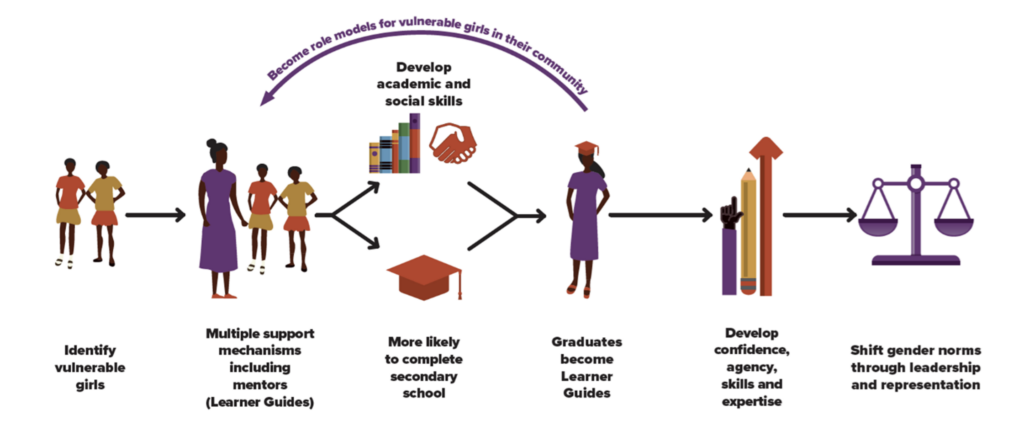
Building on longstanding collaboration and success of CAMFED’s work, the Tanzanian Ministry of Education has partnered with CAMFED to adapt and scale the model into the Life Skills programme (Programu ya Stadi za Maisha in Swahili) in its secondary schools. The government‑led programme engages both male and female community volunteers called Life Skills Facilitators (see Figure 1b) to deliver life skills education to students of all backgrounds. Launched in 2023 across three pilot districts and co‑delivered with CAMFED, the programme is now expanding to 41 additional districts. By equipping students with vital life skills, it aims to prepare them for life beyond school, including pathways to self‑employment and leadership.
Figure 1b: The Life Skills programme
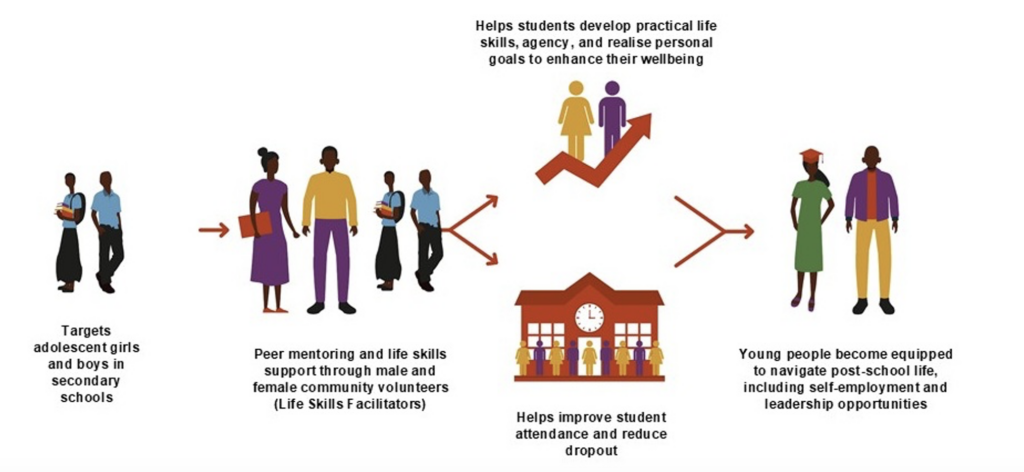
These adaptations prompted our research to explore how the Life Skills programme’s new elements, particularly the inclusion of both male and female Facilitators, are being implemented and scaled in practice, and the challenges and opportunities emerging through a gender equality and social inclusion lens.
Why intentional gender framing matters in scaling
Our research finds that the gender focus is less explicit in the Government’s adapted version of the programme. Designed to support all children in completing education, the inclusion of male Facilitators broadens its reach and capacity to address shared challenges. However, the Government’s implementation guidance adopts a largely gender‑neutral tone, shifting focus from the gender‑transformative intent central to CAMFED’s approach. References to girls’ empowerment and leadership that were central to CAMFED’s approach are less visible in the Government’s Life Skills programme’s objectives and operational guidance. Thus, while the new programme is reported to benefit both girls and boys through improving confidence, wellbeing and attendance, it does not specifically recognise the differential experiences of girls and boys in these respects, and so risks diluting the original gender‑transformative vision.
This matters for at least three reasons:
- Risk of overlooking girls’ disadvantages: When programme design and implementation guidance adopt a gender‑neutral tone, the specific barriers facing secondary school girls, such as early marriage, pregnancy and gender‑based violence, risk becoming less visible in implementation. Girls in school are also likely to feel more comfortable in speaking about these and other sensitive topics with peer mentors who are young women, as noted by a teacher in our study:
‘One challenge is that some girls may find it hard to share their problems with male Facilitators. While some may have confidence, others, because of our social norms, might feel uncomfortable. For example, they might think that saying certain words in front of a man is inappropriate or embarrassing. This can be a challenge for girls.’
- Unintended reinforcement of gender social norms: Without an explicit gender lens in programme design and implementation, scaling may inadvertently entrench existing norms. For instance, our research found that the challenge of Facilitator attrition was partly linked to gendered expectations – female Facilitators were likely to discontinue their engagement in schools after marriage due to relocation to their husband’s villages and/or ‘not being allowed’ to continue engagement after marriage.
- Undermining female leadership: Although generally viewed as beneficial, the engagement of male Life Skills Facilitators may at times risk overshadowing or diminishing the importance of female peers. This dynamic reflects wider gender hierarchies in communities, where male authority can inadvertently reinforce traditional power imbalances. As one respondent in our study explained:
‘When a Facilitator is teaching, maybe girls may not be interested to listen from a female Facilitator but be attentive with the male Facilitator. As it is in other places, when he stands as a man, women become more attentive and vice versa.’
There is therefore a continued need to maintain an explicit focus on gender equity in scaling, empowering girls to overcome entrenched disadvantages linked to harmful social norms, and enabling female peer mentors to emerge as leaders and agents of change within their communities. But how can this be achieved?
Three ways to keep gender at the heart of scaling
Drawing on insights from our research participants, three practical strategies can help ensure gender remains central when scaling similar education programmes.
- Explicitly integrate gender-transformative objectives from design through implementation. Gender equity must be embedded across all stages, from programme objectives and training to monitoring and feedback. This includes addressing contextual social norms that restrict girls’ participation and providing gender-sensitive support for all stakeholders. For male Facilitators under the Life Skills programme in particular, this means equipping them to recognise and challenge harmful norms affecting both girls and boys, work in ways that amplify rather than overshadow female colleagues’ leadership, and engage communities in ways that strengthen, rather than dilute, women’s participation and influence.
- Use the middle tier to reinforce gender goals. Regional, district and community‑level structures are pivotal in determining how programmes are interpreted and implemented. Strengthening feedback loops between these levels helps identify gender‑related challenges, such as the persistence of harmful norms, and adapt accordingly. At the same time, engaging community structures, such as Parent Teacher Associations and Parent Support Groups, as well as influential community leaders, such as traditional and religious leaders, can foster local ownership of a gender‑transformative vision.
- Evaluate dynamically with a gender lens. Programmes should be assessed in real time using agile research approaches that apply gender and inclusion‑sensitive methods reflecting the lived experiences of learners and educators and remain responsive to emerging findings. Gender issues are often silent in policy but highly visible on the ground, further highlighting the need for research and evaluation to bridge this gap and inform adaptive policy and programme design. This includes understanding the importance of participatory approaches in research as well as implementation that include the perspectives of young women and men, including those from marginalised backgrounds in particular.
Looking ahead: Scaling without losing gender intent
Tanzania’s experience offers valuable lessons for governments adapting NGO‑led, gender‑transformative programmes into national systems. For policymakers and practitioners elsewhere, the message is clear: leaving gender to assumption can risk eroding the very foundation of transformation. Sustaining gender‑transformative intent requires continual reflection on how gender equity is understood and operationalised at every level. This means deliberate choices in programme design, training, monitoring and community engagement, so that gender considerations remain visible, actionable and integral throughout implementation.
Ansari, A., Mgonda, N. L. & Rose, P. 2026. Prioritising gender and social inclusion: Lessons from scaling a peer mentorship and life skills programme in Tanzania. What Works Hub for Global Education. Blog. BL_2026/007. https://doi.org/10.35489/BSG-WhatWorksHubforGlobalEducation-BL_2026/007

Discover more
What we do
Our work will directly affect up to 3 million children, and reach up to 17 million more through its influence.
Who we are
A group of strategic partners, consortium partners, researchers, policymakers, practitioners and professionals working together.
Get involved
Share our goal of literacy, numeracy and other key skills for all children? Follow us, work with us or join us at an event.